

Wireless guitar systems have come a long way. Where they used to be clunky, noisy, and unreliable, we now have compact units that just work.
The NU-X B-8 wireless transmitter (on Amazon) is one of those pieces of gear that quietly solves a real problem for guitarists: it gets rid of the cable without adding headaches.
If you’re a gigging player, a home jammer who hates stepping on cables, or someone working with multi-effects and modelers, the XB8 is worth a close look.
Overview / First Impressions
After about a month of daily use, the B-8 has proven to be:
- Simple to use
- Reliable in operation
- Practical for real-world gig lengths
The standout characteristic is its simplicity. There’s no complicated setup, no menus you’re forced to dive into, and no flaky wireless behavior. You plug it in, power it up, and play.
Battery life has been consistently in the 4–6 hour range of non-stop playing, which is more than enough for most live sets, rehearsals, and long practice sessions.
Build Quality & Design
The B-8 is designed around a very straightforward physical layout:
- A transmitter module that connects to your guitar
- A receiver module that sits in your signal chain
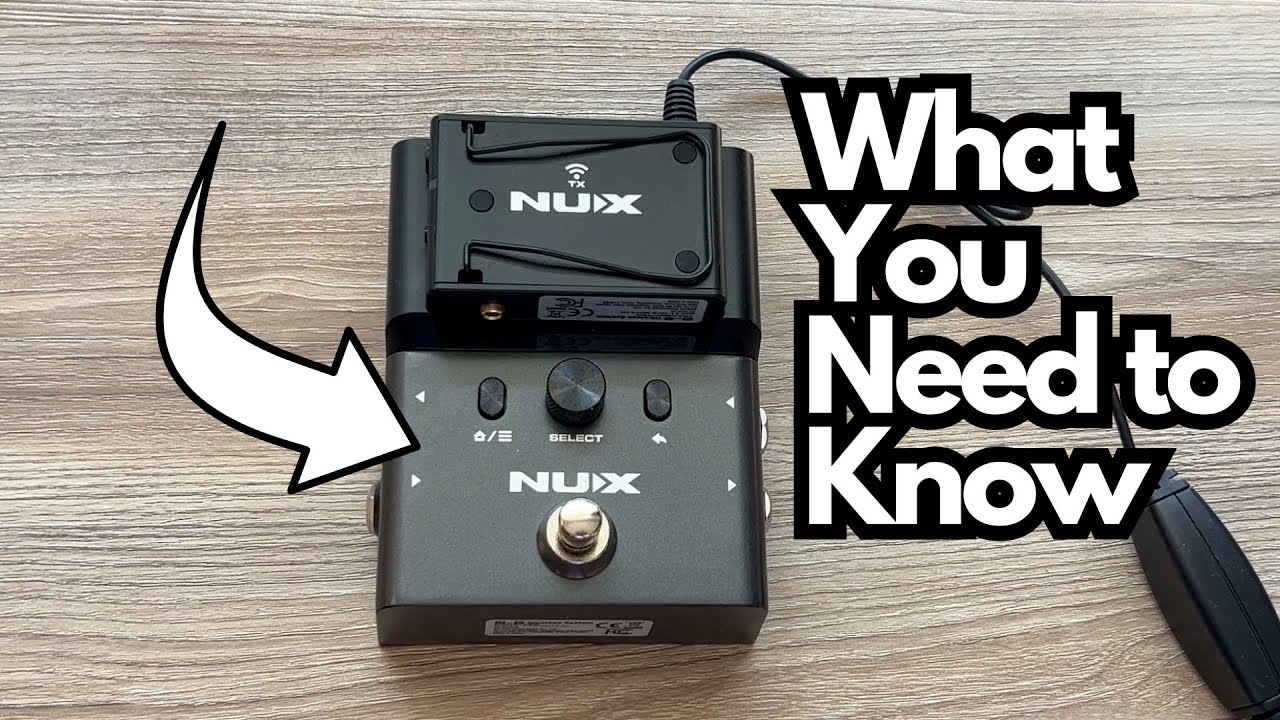
- A charging system that uses a standard 9V DC adapter
The unit charges via a clever snap-on connection:
- Plug a typical 9V DC adapter (like a Boss-style power supply) into the base.
- Attach the transmitter to the charging dock by sliding it onto the contact points.
- That’s it—no extra cables or cradles to fuss with.
From a guitarist’s perspective, the form factor is practical:
- The transmitter connects to your guitar via a short TRS-style jack.
- The body of the transmitter clips onto your guitar strap, keeping it out of the way.
- The receiver plugs into your pedalboard, multi-effects unit, or amplifier via a standard instrument cable.
Overall, it feels like a piece of gear meant to live in your rig, not something you baby or constantly reconfigure.
Features & Functions
While the B-8 is built around simplicity, it still packs a few useful features.
1. One-Button Power & Pairing
Powering on and getting a connection is straightforward:
- Hit the power button on the side.
- A green LED indicates the unit is on and transmitting.
- Once lit, you’re essentially ready to play.
There’s no elaborate pairing process or channel selection needed in normal use.
2. Built-In Tuner
One of the nicest bonuses is the integrated tuner:
- Activated via a dedicated button.
- Intuitive and easy to read.
- Accurate enough for everyday use—no need to drag out an extra pedal tuner if you don’t want to.
For players who like to keep their boards minimal, this is a very practical inclusion.
3. Adjustable Latency Settings
You can adjust latency parameters in the settings menu. For most players, the default setting will feel natural and responsive, but it’s good to know you can tweak it if needed.
4. Signal Boost
The XB8 also includes a boost function that can increase your output level. This could be handy if:
- You’re running into a tube amp and want to hit the front end a little harder.
- You’re compensating for a quieter guitar or long signal chain.
In practice, the reviewer didn’t feel the need to use the boost, but it’s there if you want to experiment.
5. Display & Tuner Options
There are additional settings for:
- Display configuration
- Tuner behavior
These are more “set and forget” options, but they show that the unit isn’t completely bare-bones—it gives you just enough control without overwhelming you.
How It Sounds / Use Cases
From a guitarist’s perspective, the most important question is: does it affect your tone or cut out mid-song?
In extended daily use:
- The B-8 has not exhibited random dropouts.
- It has worked consistently and predictably.
- There’s no mention of unwanted noise or obvious tonal degradation.
This makes it a strong option for:
- Live gigs: 4–6 hours of battery life is enough for most single- or double-set nights.
- Rehearsals: Walk around the room, adjust amps, and talk to bandmates without dragging a cable.
- Home practice: No more rolling over your cable with your chair or getting tangled.
If you’re using pedalboards, modelers, or amp sims, the XB8 fits in seamlessly: receiver into your first pedal or processor, transmitter on the guitar, and you’re off.
Limitations / Things to Know
A few practical notes to keep in mind:
- Battery life window: 4–6 hours is solid, but if you play marathon gigs or long studio days, you’ll want to keep an eye on charge time and maybe top it off between sets.
- Advanced features are optional: Latency tweaks and boost are there, but you don’t have to use them. If you’re a “plug in and go” player, you can ignore most of the deeper settings.
- Power supply not mentioned as included: The unit works with a standard 9V DC adapter (like a Boss-style supply). Make sure you have one on hand if it doesn’t come in the box.
None of these are deal-breakers, but they’re worth knowing so you can plan your rig around them.
Final Thoughts
The B-8 hits a sweet spot: simple, reliable, and practical for real guitar players.
What stands out most is that it just works:
- No random cutouts.
- No confusing setup.
- Enough battery life for real-world playing.
- A genuinely useful built-in tuner.
If you’re tired of being tethered to your amp or pedalboard and want a wireless system that doesn’t feel like a science project, the XB8 is easy to recommend. It’s the kind of tool you can start using daily and quickly forget about—which is exactly what good wireless gear should be.
Resources & Further Study
If you’re looking to improve your playing while you enjoy the freedom of wireless, here are a couple of helpful resources mentioned:
Fretboard Memorization Cheat Sheet
Available at travelingguitarist.com – a fretboard cheat sheet built around major and minor triads in every key. It uses “mapping” techniques to help you:
- Memorize the notes on the fretboard
- Understand triads as the foundation of chords and harmony
- Start improvising confidently in multiple keys
Traveling Guitarist Forum
At forum.travelingguitarist.com, you can:
- Talk guitar, gear, and music with other players
- Ask questions and share experiences
- Dive deeper into theory, technique, and tone
Pair a solid wireless like the XB8 with focused fretboard study, and you’ll not only move more freely on stage—you’ll move more freely on the neck too.