

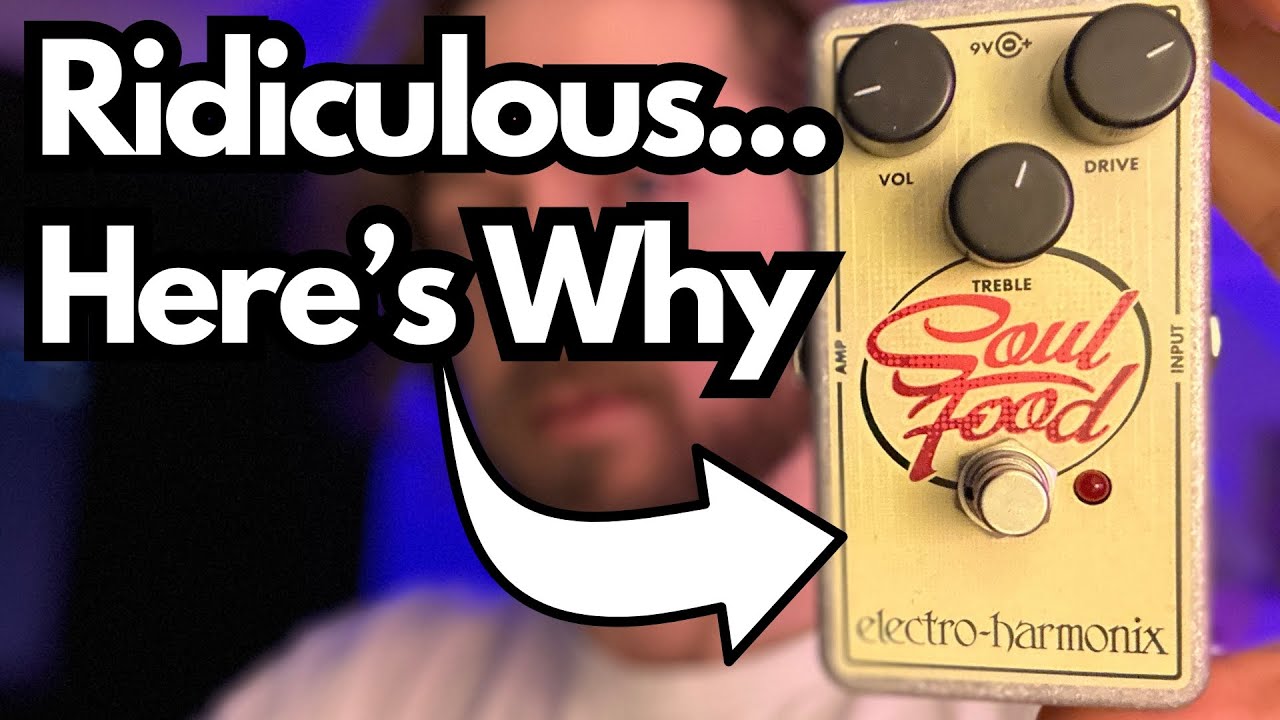
If you play guitar long enough, you eventually go hunting for “the” overdrive pedal—the one that lives on your board, stays on most of the time, and just makes everything sound better. For a lot of players, the Electro-Harmonix Soul Food has quietly become that pedal. Grab it here on Amazon.
Marketed as a transparent overdrive with a nod to the mythical Klon, the Soul Food has earned a massive following for one simple reason: it works. It’s affordable, it’s flexible, and it plays nicely with pretty much any rig.
This post walks through what makes the Soul Food so useful from a guitarist’s perspective—how it’s built, how it sounds, and where it shines on a real-world pedalboard.
Overview / First Impressions
The Soul Food is a transparent overdrive pedal designed to add grit, presence, and sustain without completely repainting your core tone.
Compared with other popular drives like the JHS Morning Glory or the classic Ibanez Tube Screamer, the Soul Food stands out for a few reasons:
- Simplicity – Just three knobs and a switch: Volume, Drive, and Treble.
- Versatility – Goes from a barely-there push to a more aggressive, rock-ready crunch.
- Tone Preservation – It enhances your sound rather than turning it into “the Soul Food sound.”
Among several overdrives I’ve used—including the Morning Glory and Tube Screamer—the Soul Food has become my favorite. It’s the one I reach for most often when I just want my amp to sound like a better version of itself.
Build Quality & Design
Electro-Harmonix has a reputation for sturdy, gig-ready pedals, and the Soul Food fits that mold.
What stands out physically:
- Solid enclosure – Metal housing that feels tough enough for regular live use.
- High-quality knobs – The controls feel tactile and secure, not loose or flimsy.
- Top-mounted power jack – The 9V DC input is on the top, not the side. This is a big plus for tight pedalboards, unlike some pedals that waste horizontal space with side jacks.
- Battery option – You can also power it with a 9V battery via the back plate if you prefer or need a backup in case your power supply fails.
One minor downside:
- Loud footswitch – The mechanical click is noticeable and can be heard through the amp if you’re switching at very low volume. It’s not a dealbreaker, but it’s worth knowing if you play quiet stages or do lots of on/off switching mid-song.
Aesthetically, the Soul Food also looks great. Compared to the more utilitarian visuals of something like the Morning Glory, the Soul Food has a bit more personality and vibe on the board.
Features & Functions
The Soul Food keeps things simple, but there’s a lot of tonal ground inside those three knobs:
- Volume – There’s a lot of output on tap. You can easily use it as a clean(ish) boost to hit the front of your amp harder, even with the Drive set low.
- Drive – This is where the magic happens.
- Low settings: light breakup, subtle grit, and a touch of compression.
- Mid settings: classic rock crunch, great for rhythm or edge-of-breakup lead tones.
- High settings: surprisingly saturated, with enough gain to get into Guns N’ Roses–style rock territory if you crank it.
- Treble – A simple but effective tone control. You can:
- Brighten a darker amp or humbuckers.
- Tame harshness with single coils or brighter amps.
The overall design philosophy is set it and forget it. It’s easy to dial in a great sound quickly and then just leave it on as part of your base tone.
How It Sounds / Use Cases
From a guitarist’s perspective, the Soul Food is all about adding character without losing clarity.
As an Always-On Pedal
- Set Drive low, Volume above unity, and Treble to taste.
- Result: a bit of grit, more presence, and a feel that’s more responsive under the fingers.
- Perfect for players who want their clean tone to have a touch of hair and sustain without sounding like “an effect.”
As a Boost Into an Amp
With its high output, the Soul Food excels at pushing a tube amp:
- Use it in front of an already cooking amp to add:
- More sustain
- Slight mid focus (without the extreme mid-hump of a Tube Screamer)
- Extra punch for solos or heavier sections
This works especially well if you like your amp just on the edge of breakup and want the pedal to tip it over.
As a Primary Overdrive
Turn the Drive knob up, and the Soul Food can absolutely hold its own as your main overdrive:
- Crunchy rhythm tones
- Singing lead lines
- Classic rock and hard rock flavors when fully cranked
You can definitely get into that Guns N’ Roses–style vibe if you’re willing to push the Drive knob to the right and let your amp respond.
Limitations / Things to Know
No pedal is perfect, and the Soul Food has a few quirks and trade-offs:
- Loud footswitch click – As mentioned, the mechanical switch is a bit noisy and can be heard in the amp at low volume. Not a problem for most live situations, but noticeable in quiet environments.
- Not a “character” pedal – If you’re looking for a pedal that drastically reshapes your tone (like a fuzz or a very colored drive), the Soul Food might feel too subtle. Its strength is transparency, not radical tonal change.
- Single-band tone control – The Treble knob is effective, but you don’t get in-depth EQ sculpting. For most players, that simplicity is a plus; for tone tweakers, it might feel limited.
Despite these minor issues, the core experience—great sound, easy to use, built to last—makes it a standout in its price range.
Final Thoughts
The Electro-Harmonix Soul Food has earned its reputation for a reason. Among other overdrives like the JHS Morning Glory and Ibanez Tube Screamer, it stands out as:
- Simple – Three knobs, quick to dial in.
- Versatile – From subtle edge-of-breakup to legit rock drive.
- Musical – Enhances your tone instead of replacing it.
- Practical – Top-mounted power, solid build, and enough output to serve as a boost or main drive.
For many guitarists, it can easily be the primary overdrive of choice—especially if you want something that makes your existing rig sound better, not different.
If you’re building a first board, upgrading from cheaper drives, or just want a reliable, transparent overdrive that works in almost any context, the Soul Food is absolutely worth a spot on your pedalboard.
Resources & Further Study
If you’re working on your playing alongside your tone, these resources can help:
- Fretboard Memorization Cheat Sheet – Available at travelingguitarist.com (look for the fretboard cheat sheet). It covers:
- Major and minor triads in every key
- Techniques like octave mapping
- Practical ways to memorize the fretboard and start improvising confidently using triads—the foundation of harmony and chord construction.
- Traveling Guitarist Forum – At forum.travelingguitarist.com, you can:
- Talk guitar, music theory, gear, and more
- Connect with other players who are also working on their sound and skills
Pairing a solid, transparent overdrive like the Soul Food with a stronger understanding of harmony and the fretboard is a powerful combo for both tone and musical growth.