

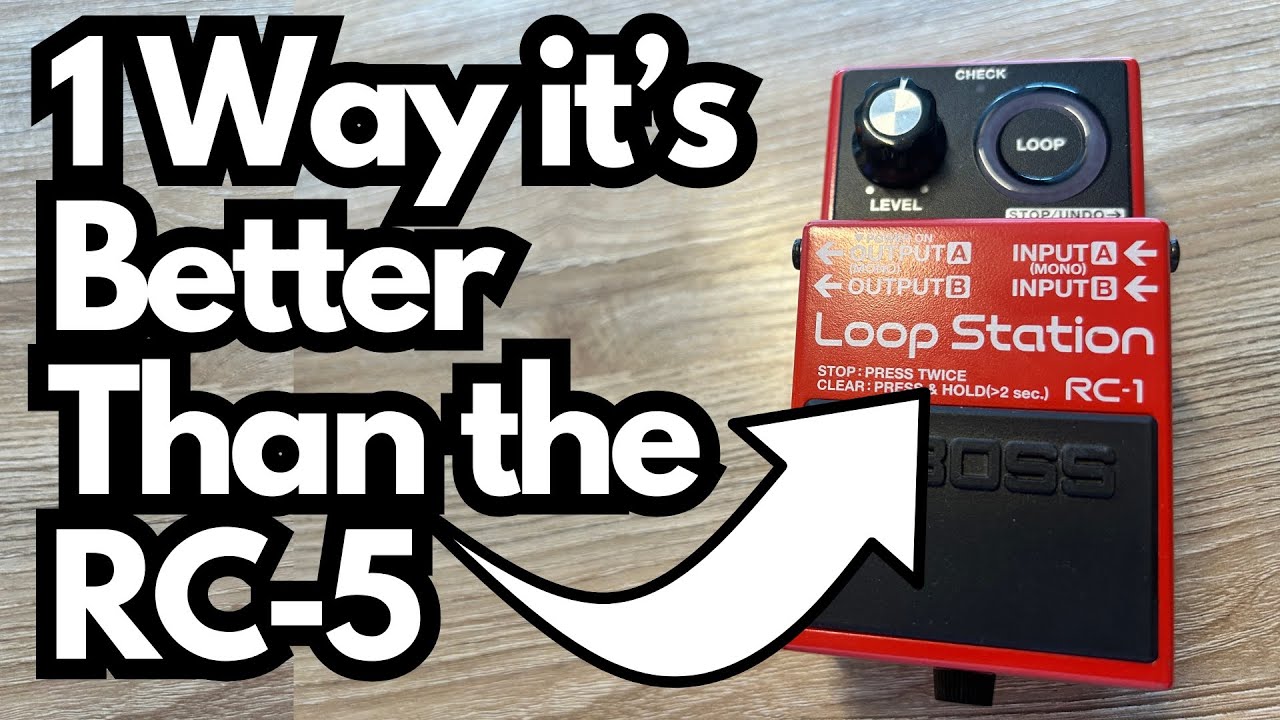
The Boss RC-1 is probably on your radar if you’re interested in a looper pedal. It’s often overshadowed by more feature-packed loopers like the RC-5, but there’s a practical reason many guitarists still keep an RC-1 around: it just works, and it does a few things surprisingly well.
You can grab one here on Amazon.
One of those underrated strengths is how it handles power—especially if you like running pedals on batteries. Let’s dig into why the RC-1 might be a smarter choice than you think.
Overview / First Impressions
The Boss RC-1 is Boss’s most straightforward compact looper. No screens, no menus, no deep editing—just a stompbox-style looper that records, overdubs, and stops when you tell it to.
It’s ideal for:
- Guitarists who want a no-nonsense practice looper
- Players who prefer simple visual feedback instead of a full display
- Anyone who occasionally runs on battery power and doesn’t want to chew through 9Vs
While the RC-5 offers more advanced features (like a full LED screen, multiple memories, and more effects), the RC-1 has a quiet strength: efficiency.
Build Quality & Design
Like most Boss pedals, the RC-1 is built like a tank:
- Sturdy metal enclosure that can withstand regular gigging
- Standard Boss footprint, so it fits easily on most pedalboards
- Top-panel LED ring that shows loop status (recording, overdubbing, playback) in a very simple, intuitive way
That LED ring is a key part of why the RC-1 is so efficient. It gives you just enough visual information without the power draw of a full graphical display.
Features & Functions
The RC-1 keeps things minimal but practical:
- Single footswitch operation for record, overdub, and playback
- LED ring indicator to show what the looper is doing
- Battery or power supply operation (standard Boss-style 9V)
- Compact, plug-and-play layout with no menu diving
It doesn’t try to be a full workstation. Instead, it focuses on doing the core looping job cleanly and reliably.
Battery Life: Where the RC-1 Beats the RC-5
All Boss loopers (and most Boss pedals) can run on batteries, but not all of them are equally efficient.
The RC-5, with its more sophisticated LED screen and deeper feature set, draws more power. That screen is great for detailed feedback, but it’s also more demanding on a 9V battery.
The RC-1, by contrast:
- Uses a simple LED ring instead of a power-hungry display
- Draws less current overall
- Gives you noticeably better battery life than the RC-5 in real-world use
If you:
- Practice a lot away from a power supply
- Use battery power as a backup at gigs
- Just don’t want to constantly swap or recharge batteries
…the RC-1 is the more forgiving option.
How It Sounds / Use Cases
From a guitarist’s perspective, the RC-1 is best at:
- Practicing chord changes and timing: lay down a simple progression and work on your rhythm or lead phrasing over it
- Improvisation drills: loop a triad-based progression in a key and explore scales, arpeggios, and melodic ideas
- Songwriting: capture quick ideas without getting bogged down in settings
Sonically, it’s clean and transparent—exactly what you want from a basic looper. It doesn’t color your tone; it just repeats what you play.
Limitations / Things to Know
The RC-1’s simplicity is both its strength and its limitation:
- No multi-track layering or complex loop management
- No built-in rhythm patterns or advanced effects like the RC-5
- No detailed screen for tempo readouts or patch names
If you need:
- Multiple stored loops
- Built-in drums
- Deep MIDI control
- Complex performance setups
…then the RC-5 or a higher-end looper will serve you better.
But if your main goal is solid, simple looping with good battery life, the RC-1 shines.
Further Study & Resources
If you’re using a looper to improve your playing—especially your fretboard knowledge and improvisation—triads are one of the best tools you can use.
A helpful resource for this is the Fretboard Memorization Cheat Sheet from TravelingGuitarist.com. It lays out:
- Major and minor triads in every key
- How to map them across the neck (including octave mapping)
- How to use triads as the foundation of chords and harmony
You can loop simple triad progressions on the RC-1 and use them to practice improvising in different keys.
There’s also a community forum at forum.travelingguitarist.com, where you can talk guitar, theory, gear, and practice strategies with other players.
Final Thoughts
The Boss RC-5 is the obvious “feature-rich” choice in Boss’s compact looper line, but the RC-1 quietly wins in an area that matters more than most people realize: practical, efficient, everyday use.
If you want:
- A rugged, simple looper
- Clear visual feedback without a screen
- Better battery life than more advanced loopers
…the RC-1 is still a smart, underrated pick for guitarists who just want to plug in, hit record, and play.