

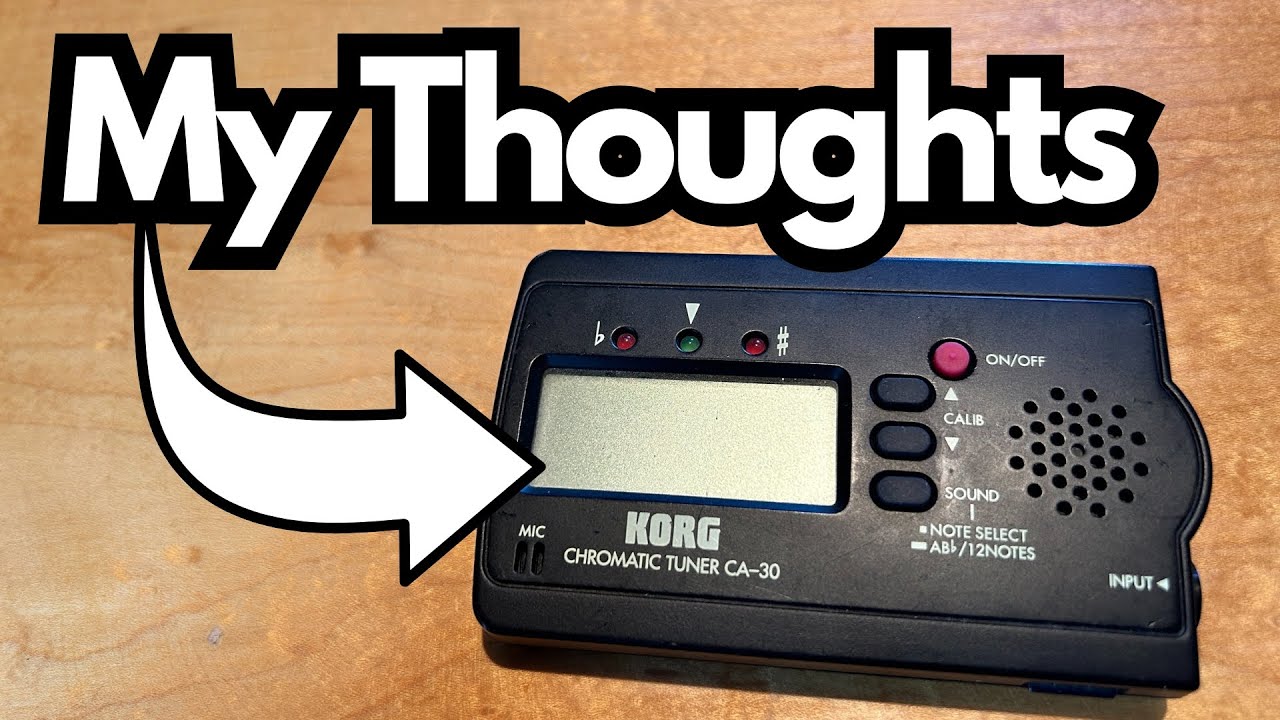
If you play guitar regularly, a reliable tuner is non‑negotiable. Apps are convenient, clip‑ons are everywhere, and multi‑FX units all have tuners built in—but there’s something to be said for a simple, rock‑solid dedicated tuner that just works every time you plug in.
That’s exactly why my Korg CA-30 (on Amazon) has stayed in my toolkit for around 15 years. It’s not flashy, it’s not new, but it’s dependable, accurate, and incredibly easy to use—especially for guitarists who value consistency over gimmicks.
Overview / First Impressions
The Korg CA-30 is a compact, chromatic tuner that’s been around for a long time, and there’s a reason it’s still in use on so many music stands and in so many gig bags.
Key points:
- Chromatic tuner – It reads all 12 notes, so you’re not locked into standard tuning.
- Plug-in or mic operation – Use a cable or the built‑in microphone.
- Simple, clear display – Easy to see when you’re sharp, flat, or dead on.
- Long-term reliability – Mine has survived about 15 years of use and still works great.
If you’re a guitarist who wants a no‑nonsense tuner that doesn’t depend on your phone battery or a noisy room, the CA-3 is exactly that.
Build Quality & Design
The CA-30 is very much a “function over form” device:
- Compact plastic housing – Light, small, and easy to toss into a case or gig bag.
- Front panel layout – Big note display, needle-style indicator, and simple buttons.
- Input jack – Standard 1/4″ input on the side for direct connection from your guitar.
It’s not rugged in the “throw it off a stage” sense, but in normal use it holds up extremely well. The fact that mine still works flawlessly after well over a decade says a lot about Korg’s build quality for this kind of utility gear.
Features & Functions
Even though it’s simple, the CA-30 gives you everything you actually need as a guitarist.
1. Chromatic Tuning
Because it’s chromatic, you can tune to:
- Standard tuning
- Alternate tunings (Drop D, DADGAD, half‑step down, etc.)
- Open tunings (Open G, Open D, etc.)
It doesn’t lock you into guitar‑only note presets; it just shows you the pitch you’re playing and how close you are.
2. Two Ways to Tune: Plug-in or Mic
You can use it in two modes:
Plug-in mode (preferred)
Connect your guitar directly via a cable. This is the most accurate and reliable way to use it, especially:
- In noisy environments
- With electric guitar or bass
- When you want fast, precise readings
Microphone mode
The built‑in mic picks up acoustic instruments or your guitar acoustically. It’s handy in a pinch, but I strongly prefer the plug‑in method for consistency.
3. Calibration by Hertz
You’re not stuck at A=440 Hz. The CA-30 lets you:
- Calibrate the reference pitch in Hertz (Hz), so you can match:
- Orchestral tunings
- Other players using a slightly different reference
- Specific recording or performance requirements
4. Clear Sharp/Flat Indicators
The display shows:
- The note name
- A needle-style meter
- Flat / sharp indicators to show which way you need to adjust
When the needle is centered and the flat/sharp indicators confirm it, you’re in tune. It’s intuitive and easy to read at a glance.
How It Performs for Guitar
The tuner itself doesn’t make sound unless you use its tone generator, but it absolutely affects how you sound.
Why It Works Well for Guitar
- Reliable intonation checks – Plugging in directly gives you stable readings that don’t jump around with background noise.
- Great for practice and recording – When you’re tracking guitars, you want a tuner you can trust every time you punch in.
- Consistent live performance tuning – It’s simple enough to use between songs without fuss.
Typical Use Cases
- Home practice – Leave it on your desk, plug in before you start, and you’re ready to go.
- Teaching – Easy for students to understand; no app distractions.
- Rehearsals and gigs – Throw it in your case as a backup or main tuner if you’re not using a pedalboard.
You can use phone apps, and they’re perfectly usable, but I’ve found a dedicated plug‑in tuner like the CA-30 to be more consistent and less fussy—especially when your phone is busy doing, well, everything else.
Limitations / Things to Know
No piece of gear is perfect, so here are a few realistic points to keep in mind:
- Not a pedal tuner – It’s not meant to sit on your pedalboard or mute your signal; it’s more of a utility tuner.
- Plastic build – Durable enough for normal use, but not designed for abuse.
- Mic mode is less ideal for electric – The microphone works, but for electric guitar I’d always recommend using the input jack for accuracy.
- No fancy extras – No strobe mode, no polyphonic tuning, no built‑in metronome. It just tunes.
If you want stage muting, true bypass, or ultra-fast strobe-style accuracy, a pedal tuner might be a better fit. But for straightforward, dependable tuning, the CA-30 more than does the job.
Final Thoughts
After roughly 15 years, my Korg CA-30 is still going strong, and that says a lot. It’s:
- Simple
- Accurate
- Reliable
- Flexible enough for any tuning you’re likely to use as a guitarist
You can absolutely get by with a phone tuner, and clip-ons have their place, but having a dedicated plug‑in chromatic tuner like this is one of those small investments that pays off every single time you pick up your guitar.
If you like straightforward gear that quietly does its job and never gets in your way, the CA-30 (or its current equivalent from Korg) is an easy recommendation.
Resources & Further Study
If you’re working on your playing and not just your tuning, here are a couple of helpful resources mentioned:
Fretboard Memorization Cheat Sheet – Available at travelingguitarist.com, this cheat sheet lays out all the major and minor triads in every key. It uses the “optive mapping” approach and other techniques to help you:
- Memorize the notes on the fretboard
- Understand the harmonic foundation of chords (triads)
- Start improvising more confidently in multiple keys
Traveling Guitarist Forum – At forum.travelingguitarist.com, you can discuss guitar, music, and related topics with other players, ask questions, and share your progress.
A solid tuner keeps you in tune; solid knowledge keeps your playing musical. Both are worth
having.