

Chorus is one of those effects that can really divide guitar players. For a lot of us, it brings to mind super-wet 80s clean tones and can feel a bit cheesy or overdone. I used to be firmly in that camp—chorus was the pedal I never thought I needed.
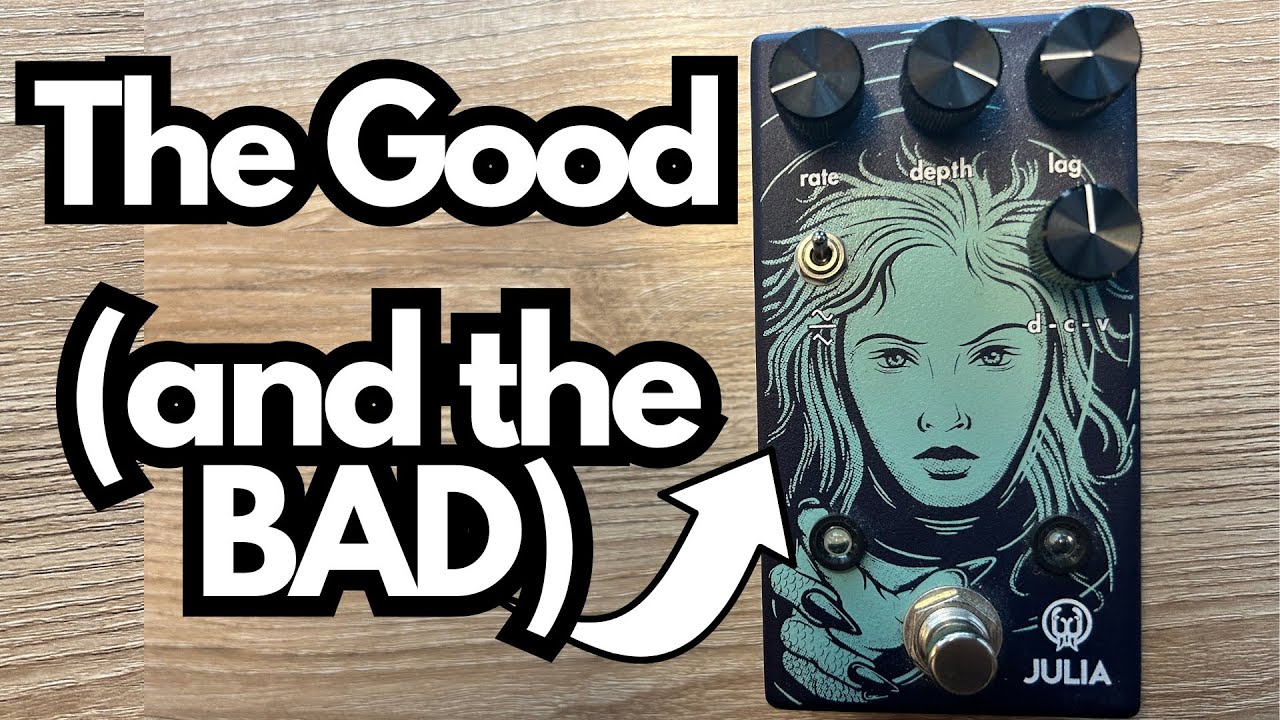
Then I got the Walrus Audio Julia (on Amazon).
After a year of using it, this is the pedal that completely changed my mind about chorus. If you’ve been chorus-averse, or you’re hunting for a high-quality modulation pedal that can do both subtle sweetening and full-on warble, the Julia deserves a serious look.
Overview / First Impressions
The Julia is a chorus/vibrato pedal from Walrus Audio, and it immediately stands out in a few ways:
- It looks fantastic – Walrus is known for their artwork, and this one is no exception.
- It feels premium – everything from the knobs to the footswitch screams quality.
- It sounds musical – not just “effect-y,” but genuinely tone-enhancing.
Most importantly, it offers a very usable range of chorus and vibrato sounds, from gentle thickening to rich, saturated modulation, without instantly jumping into cheesy territory.
Build Quality & Design
Physically, the Julia is built like a tank:
- Enclosure: Solid and substantial. It’s a bit larger and thicker than many standard-sized pedals (for example, it’s noticeably bigger than an MXR Carbon Copy), so it does take up more pedalboard space.
- Knobs and switches:
- The dials feel high quality, with a smooth, confident turn.
- The footswitch is soft-activating—no loud mechanical “clack” when you turn it on or off.
- Jacks and power:
- Standard 9V DC power input (center-negative), compatible with most pedalboard power supplies.
- Current draw is around 100 mA, so make sure your power supply has enough headroom.
- Input and output jacks feel solid and well-mounted.
One thing to note: the Julia is mono only—no stereo in/out. That’s a downside if you run a stereo rig, but for a straightforward pedalboard into an amp, it’s not a dealbreaker.
Features & Functions
The Julia is a chorus and vibrato pedal with a smart, musical control layout. Here’s how the main controls break down from a guitarist’s perspective.
Rate
- What it does: Controls the speed of the modulation.
- Low settings: Slow, gentle movement—perfect for subtle thickening and always-on tones.
- High settings: Fast, warbly, almost rotary-like textures.
There’s also an LED that flashes in time with the rate, so you can visually see how fast the modulation is running. On a dark stage, that can be handy; in some situations, it might even be a bit bright, so a small piece of tape over it isn’t the worst idea if it distracts you.
Depth
- What it does: Controls the intensity of the effect—how deep the pitch modulation goes.
- Lower depth: Adds width and movement without drawing attention to itself.
- Higher depth: More dramatic pitch wobble, great for vibrato or more experimental sounds.
A practical tip: keeping Rate and Depth in proportion works really well. For example:
- Slow Rate + medium Depth = lush, musical chorus.
- Faster Rate + lower Depth = shimmering, less “seasick” modulation.
Lag
Walrus calls this control Lag, and it essentially adjusts the delay time of the modulated signal.
- Lower Lag: Tighter, more traditional chorus sound.
- Higher Lag: A more pronounced, almost “clicky” or more obvious modulation character.
It’s one of the reasons the Julia feels more tweakable than your average one-knob chorus. You can really shape how the modulation sits in your tone.
Blend / Dry–Wet Control
This is where the Julia gets especially useful:
- Fully dry: No effect at all.
- Middle area: Classic chorus—a blend of your dry signal with the modulated signal.
- Fully wet: Pure vibrato—no dry signal, just pitch-modulated sound.
In other words, you can go from:
- Subtle, “is it even on?” chorus
- Rich, lush modulation
- Full-on seasick vibrato
Personally, I like a gentle chorus setting—Blend somewhere in the middle, so it adds movement and body without sounding like an 80s time capsule.
Waveform Selector: Sine vs Triangle
The Julia lets you choose between sine and triangle waveforms:
- Sine wave:
- Smooth, rounded modulation.
- Best for chorus—it feels more natural and musical.
- Triangle wave:
- More abrupt, linear rise and fall.
- Great for vibrato or when you want a more pronounced, noticeable effect.
A good rule of thumb:
- Use sine when you want your clean tone to just feel richer.
- Use triangle when you want the modulation to stand out or get a bit weird.
How It Sounds / Use Cases
The Julia shines in several real-world guitar scenarios.
1. Subtle Always-On Sweetening
With the Rate low, Depth moderate, Blend set to a light chorus, and sine wave selected, you get:
- A gentle widening of your clean tone
- A slight saturation-like feel that makes your sound feel “bigger”
- Zero cheese factor if you keep it subtle
This is a fantastic setting for:
- Clean arpeggios
- Worship/ambient textures
- Indie rhythm parts that need a bit of character
2. Classic Chorus Without the Cheese
If you’ve always felt chorus was too much, this is where the Julia can change your mind:
- Keep Rate fairly low.
- Adjust Depth so you can hear the movement, but it doesn’t dominate.
- Set Blend so the effect is present but not swimming.
- Use the sine wave.
You get that familiar chorus shimmer, but it still feels modern and tasteful.
3. Vibrato and Experimental Sounds
Crank the Blend towards fully wet, switch to triangle wave, and start playing with Rate, Depth, and Lag:
- Slow, deep settings: Woozy, pitch-bent soundscapes.
- Faster settings: Almost Leslie-like or synthy textures.
These sounds are great for:
- Intros and interludes
- Shoegaze, psych, or experimental parts
- Adding motion to sustained chords or single-note lines
Limitations / Things to Know
No pedal is perfect. Here are the main trade-offs with the Julia:
- No stereo in/out: If you run a stereo rig, this is a real limitation. It’s strictly mono.
- Larger footprint: It’s bigger and thicker than many “standard” single-footswitch pedals. If your board is already cramped, you’ll need to plan for the extra space.
- Bright Rate LED: The rate-indicator LED is helpful, but in dark environments it can be a bit intense. A small piece of tape can tame it if it bothers you.
That said, in terms of tone and feel, it’s hard to fault. The trade-offs are mostly about size and stereo capability, not sound quality.
Final Thoughts
The Walrus Audio Julia is the pedal that turned me from a chorus skeptic into a chorus fan.
From a guitarist’s perspective, it hits a sweet spot:
- Tonal quality: Rich, musical, and capable of both subtle enhancement and dramatic modulation.
- Control: Enough tweakability (Rate, Depth, Lag, Blend, waveform) to really dial in your sound.
- Feel: High-quality build and quiet switching make it a joy to use.
If you:
- Dislike cheesy, over-the-top chorus
- Want a single pedal that can cover both chorus and vibrato
- Appreciate premium build and artwork
…the Julia is absolutely worth putting on your board, even if it means rearranging a few things to make room.
Resources & Further Study
If you’re looking to improve not just your tones but your overall mixes, there’s a free mixing cheat sheet available at the following link on my other site: Producer Society.
You can also join the community forum here.
It’s currently free to sign up and includes additional tips and discussions that go deeper into tone shaping, mixing, and production.