

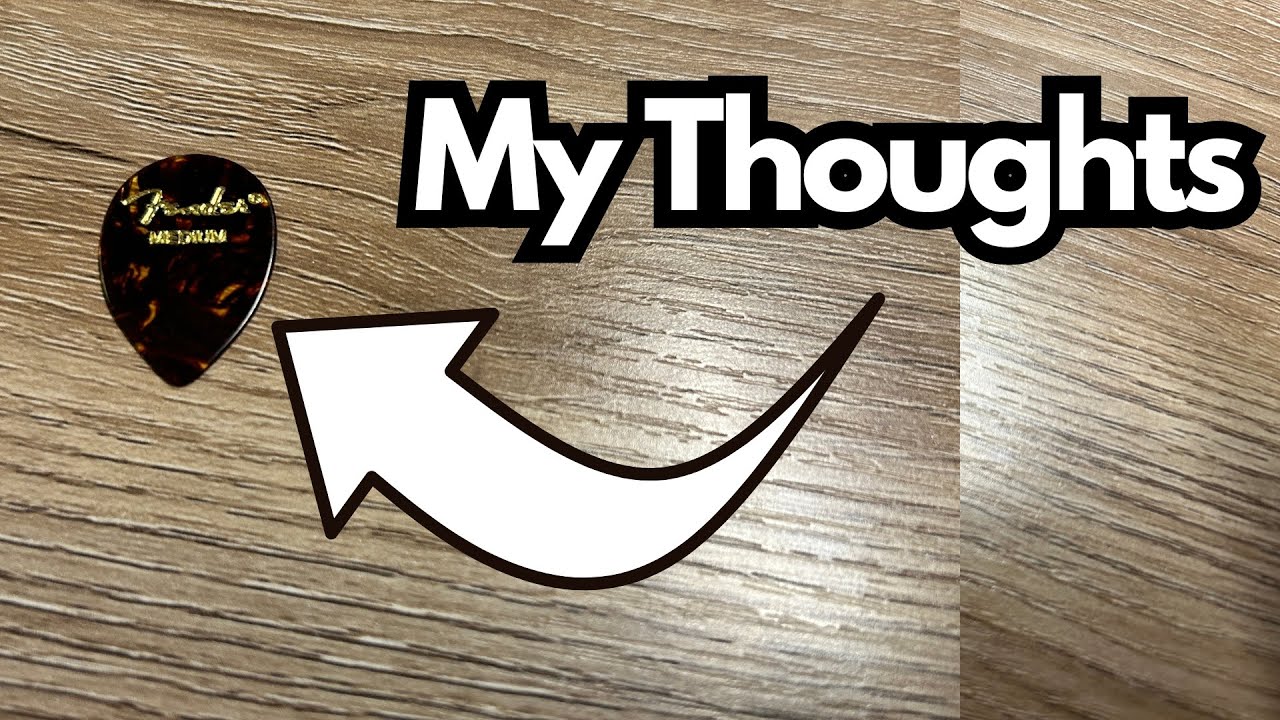
If you’ve ever browsed a music store and spotted those tiny, almost toy-like guitar picks, you’ve probably wondered: Who actually plays with those?
I went through a phase when I was younger where I thought these ultra-small picks were the coolest thing ever. They’re cute, compact, and look like they’d make you play faster just by holding them. But do they actually work in real-world guitar playing?
This post is a quick, honest look at one of those mini picks—how it feels, what it’s like to play with, and whether it’s worth your time as a guitarist.
Overview / First Impressions
This particular pick is even smaller than a Jazz III, which is already considered a small, precise pick by most players. Unlike a Jazz III, though, it’s not very pointy—so you don’t get that sharp, surgical attack you might expect from a tiny pick.
My first reaction when picking it up again after years was basically: “Wow, this thing is really small.”
It looks cool and feels kind of fun in the hand at first, but once you start actually playing, the downsides show up fast.
Build & Design
From a design standpoint, here’s what stands out:
- Size: Extremely small—smaller than a Jazz III.
- Shape: Less pointy than a typical shred-style pick.
- Grip area: Because of the size, there’s very little surface area to hold onto.
The idea behind picks like this is usually control and precision. In theory, less pick sticking out past your fingers should mean more accuracy and faster picking. In practice, the tiny form factor creates its own set of problems.
Features & Practical Use
There aren’t many “features” in the modern sense—this is just a very small, simple pick. No special grip texture, no complex bevel, no multi-material construction. Its main “feature” is the size.
Who might it appeal to?
- Players who love very small picks and want minimal pick exposure.
- Guitarists curious about different pick styles and how they affect technique.
- People with very controlled right-hand technique who don’t mind a tiny contact area.
If you’re coming from a standard 0.73–1.0mm regular-sized pick, this is going to feel like a big jump.
How It Feels & Plays
From a guitarist’s perspective, here’s the core issue:
It’s just too small to be practical for most players.
Because of the tiny footprint:
- It’s easy for the pick to slip out of your fingers, especially if your hands get a bit sweaty.
- You don’t have much leverage or stability, which can make strumming feel awkward.
- Fast alternate picking can feel insecure because you’re constantly worrying about your grip.
If you’re used to something like a Jazz III, you might adapt a little faster, but this still feels like a step beyond what’s comfortable or necessary.
For most players, especially beginners or intermediate guitarists, this will likely feel more like a novelty than a serious, everyday tool.
Limitations / Things to Know
Before you rush out to experiment with mini picks like this, keep these points in mind:
- Grip is a real problem. The pick can easily slip or rotate between your fingers.
- Not ideal for beginners. If you’re still working on basic right-hand control, this will just make things harder.
- Less forgiving for strumming. It doesn’t feel natural for big open chords or aggressive rhythm playing.
- Limited versatility. It might work for very specific lead styles, but as an all-rounder, it falls short.
I’d say: sure, give it a shot if you’re curious, but don’t expect it to replace your main pick.
Final Thoughts
While I used to think these tiny picks were cool when I was younger, I wouldn’t seriously use one now. For my playing, it’s simply too small to be reliable. The constant risk of it slipping out of my fingers outweighs any theoretical benefits in precision or speed.
If you’re a guitarist experimenting with different picks to refine your tone and technique, this could be a fun side quest—but not a must-have. For most players, a Jazz III or a slightly smaller-than-standard pick offers a far better balance of control, comfort, and practicality.
Resources & Further Study
If you’re more interested in improving your actual fretboard knowledge and musical understanding than chasing ultra-tiny picks, here are a couple of useful resources:
Fretboard Memorization Cheat Sheet – Available at travelingguitarist.com, this guide walks through:
- Major and minor triads in every key
- An “octave mapping” approach to visualize the neck
- How understanding triads—the foundation of chords and harmony—helps you improvise in multiple keys
Traveling Guitarist Forum – At forum.travelingguitarist.com, you can:
- Talk guitar, gear, and music with other players
- Ask questions, share progress, and get feedback
If you do try one of these tiny picks, it’s worth remembering: your technique and fretboard knowledge will always matter more than the size of the plastic in your hand.