

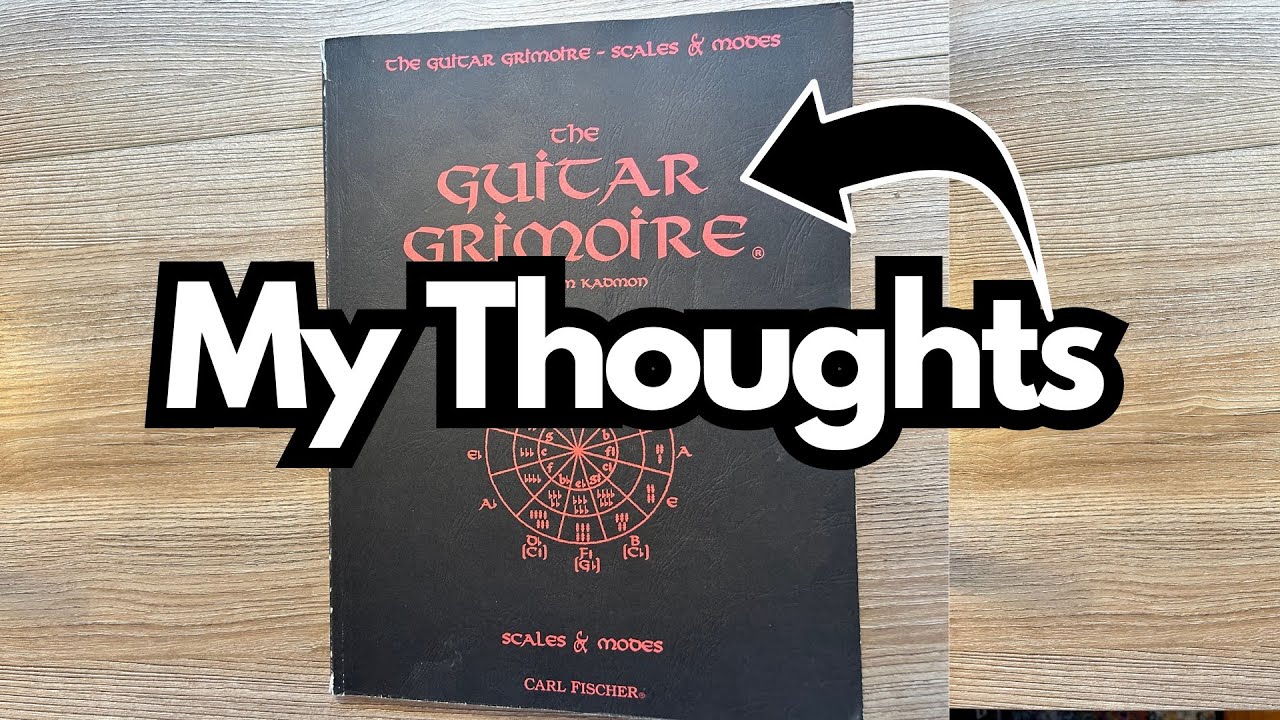
If you’ve been playing guitar for a while and you’re ready to really dig into scales, modes, and theory, The Guitar Grimoire is one of those books that always seems to come up.
It’s been around for years, and for good reason: it’s absolutely loaded with information.
You can grab it here on Amazon if you’re interested.
This isn’t a casual “learn a pentatonic lick” type of book. It’s more like an encyclopedia of scales and theory for guitarists who want to understand the fretboard inside and out.
Overview / First Impressions
The Guitar Grimoire is essentially a massive reference guide to scales on the guitar. It aims to give you:
- Every scale you can imagine (and plenty you probably haven’t heard of)
- Each scale mapped out in multiple positions across the neck
- Supporting theory explanations so you’re not just memorizing patterns, but actually understanding them
If you’re the kind of player who loves digging into patterns, modes, exotic scales, and the “why” behind harmony, this book can keep you busy for a very long time.
It’s not a quick read or a step-by-step beginner method. It’s a serious tool for intermediate to advanced players who want a deep dive into the mechanics of scales and harmony.
Build Quality & Design
Physically, the book is solid and clearly laid out with fretboard diagrams, scale charts, and explanatory text. Everything is organized logically by scale type and key, and you can flip to what you need fairly quickly once you understand the layout.
One design choice that stands out is the notation system:
- The author uses symbols like triangles and other icons to represent certain ideas or intervals.
- There is a legend and explanation section that breaks down what all the symbols mean, so you’re not left guessing.
- That said, the symbol-heavy approach can feel a bit annoying or unintuitive at times, especially if you’re used to standard notation or simple tab and interval formulas.
In other words, the information is all there, but the visual language might take some getting used to.
Features & Functions
1. Huge Scale Library
- Major, minor, modes, exotic scales, synthetic scales—it’s all in there.
- Scales are shown in multiple positions across the neck, so you’re not locked into one box pattern.
- This makes it useful as a fretboard mapping tool as much as a scale reference.
2. Practical Music Theory
It’s not just a wall of diagrams. There are also theory sections that explain:
- What the scales actually are
- How they’re built (interval structures, degrees, etc.)
- How to think about them in a musical context
- How they relate to chords and harmony
This is crucial: the book doesn’t just say “here’s a pattern—go memorize it.” It gives you the conceptual tools to understand why these scales work and how to use them.
3. Video Support
There’s a video companion available online that walks through parts of the material. Watching someone explain or demonstrate ideas from the book can make the dense content easier to digest, especially if you’re a visual or auditory learner.
How It Sounds / Use Cases (From a Guitarist’s Perspective)
From a practical playing standpoint, The Guitar Grimoire is best used as:
- A reference manual: When you want to explore a new scale, mode, or sound, you look it up, find the positions, and start experimenting.
- A fretboard expansion tool: By working through scale shapes in different positions, you’ll naturally improve your ability to navigate the neck in any key.
- A theory lab: Pairing the scale diagrams with the theory explanations helps you connect what you hear, what you see on the fretboard, and what you understand intellectually.
Some specific use cases:
- You’re stuck in pentatonic boxes and want to explore Dorian, Lydian, Mixolydian, etc.
- You want to experiment with more exotic or unusual scales for soloing or composing.
- You’re trying to understand how chords and scales relate, and how to build lines that outline harmony instead of just running patterns.
Used thoughtfully, this book can really sharpen your improvisation, composition, and overall fretboard fluency.
Limitations / Things to Know
While The Guitar Grimoire is powerful, it’s not perfect for everyone. A few things to keep in mind:
1. Notation Style Can Be Frustrating
- The use of triangles and other symbols instead of more standard notation can be off-putting.
- You do get an explanation of all the symbols, but there’s a learning curve.
- If you prefer very clean, minimal diagrams, this might feel cluttered or overcomplicated at first.
2. It’s Dense, Not Hand-Holding
- This is not a “Day 1 beginner” book.
- It doesn’t walk you step-by-step through how to practice, how long to spend, or in what order to learn things.
- You get the raw materials—it’s up to you to build a practice routine around them.
3. Overwhelm Is Possible
- With “every scale known to man,” it’s easy to fall into the trap of collecting patterns instead of mastering a few and making real music.
- You’ll get the most out of this book if you’re disciplined about focusing on a small subset of scales at a time and applying them musically.
Final Thoughts
The Guitar Grimoire really lives up to its name: it’s a massive, almost encyclopedic resource for scale work and theory on guitar. For the right player—someone who’s serious about understanding the fretboard, exploring new sounds, and deepening their theory—it’s a very solid investment.
The symbol-based notation might annoy some players, but the author does explain everything clearly, and the sheer volume of useful, well-organized information more than makes up for that quirk.
If you pair this book with consistent practice and some backing tracks or real musical contexts, it can become one of the core tools in your guitar education.
Resources & Further Study
If you’re looking for structured ways to practice concepts that complement what’s in The Guitar Grimoire, especially around fretboard knowledge and harmony, these can help:
Fretboard Memorization Cheat Sheet – TravelingGuitarist.com
A focused resource on major and minor triads in every key, using techniques like “octave mapping” to:
- Memorize the notes on the fretboard
- Understand triads as the foundation of chords and harmony
- Start improvising more confidently in multiple keys by targeting chord tones instead of just running scales
Traveling Guitarist Forum – forum.travelingguitarist.com
An online community where you can:
- Talk guitar, theory, and practice strategies
- Ask questions about scales, triads, and fretboard mapping
- Connect with other players working through similar material
Used together, a deep reference like The Guitar Grimoire plus targeted triad work and community support can give you a well-rounded path to real fretboard fluency.