

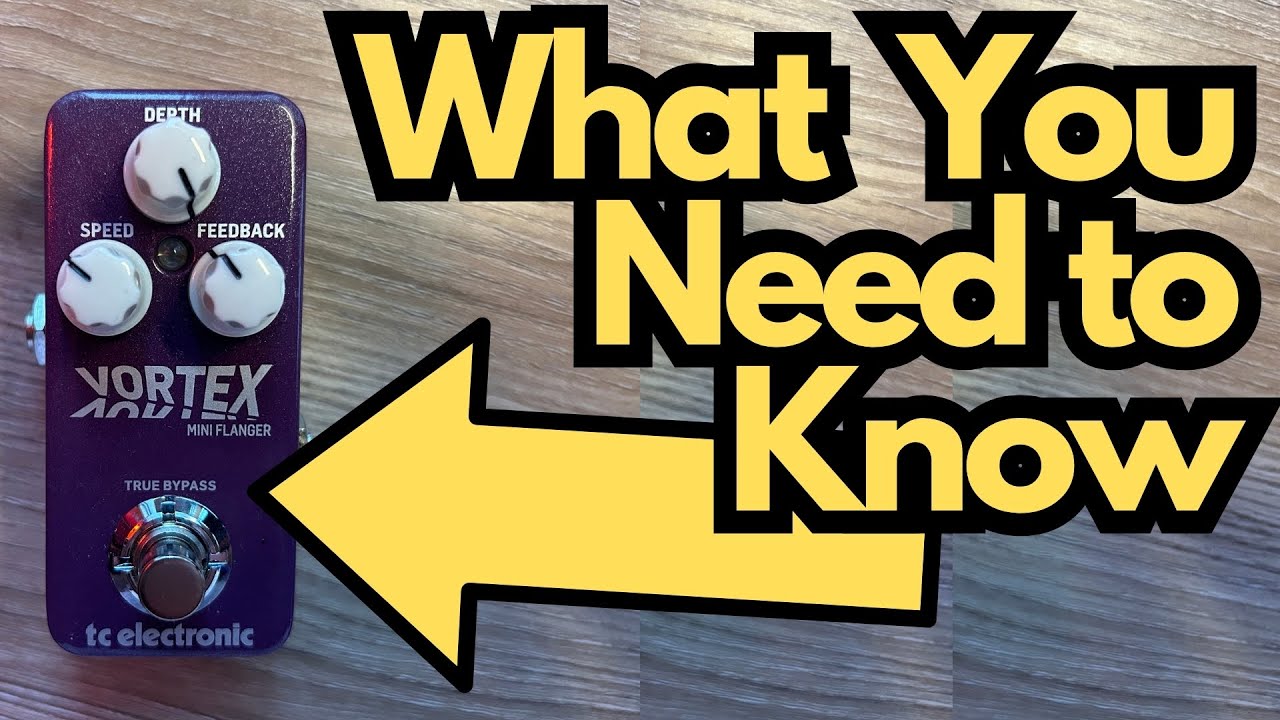
If you’re hunting for a compact modulation pedal that delivers classic flanger tones without hogging pedalboard space, the TC Electronic Vortex Mini Flanger is worth a serious look. It’s simple, tiny, and surprisingly versatile for having just three knobs—and it brings TC’s TonePrint tech along for the ride. You can grab it here on Amazon if you’re interested.
This post walks through how it works, how it sounds, and where it really shines from a guitarist’s perspective.
Overview / First Impressions
The Vortex Mini Flanger is a straightforward, no-nonsense flanger pedal:
- Mini enclosure – perfect for cramped pedalboards.
- Three main controls – Feedback, Depth, and Speed.
- TonePrint support – load custom presets via your phone and pickups.
What stands out most is how usable it is. You don’t have to spend 20 minutes tweaking to get a good sound. With everything around noon, it already sits in that sweet spot of classic, musical flange—subtle enough to use in real songs, but still obviously modulated.
If you just want a flanger that sounds good, is easy to dial in, and doesn’t take up much room, this pedal ticks those boxes.
Build Quality & Design
From a guitarist’s practical standpoint, the design is all about space-saving and simplicity:
- Mini footprint – fits easily on crowded boards or fly rigs.
- Sturdy housing – typical TC Electronic metal mini enclosure; solid enough for gigging.
- Top-mounted controls – three small knobs:
- Feedback
- Depth
- Speed
There’s no screen, no menu diving, and no extra switches cluttering the top. It’s a “set and play” pedal that encourages you to use your ears instead of getting lost in options.
Features & Functions
The Three Main Controls
The core of the Vortex Mini is its simple control layout:
- Depth – Controls how intense the modulation is.
- Low Depth = more subtle, chorus-like movement.
- High Depth = dramatic, swooshing flange.
- Speed – Controls how fast the modulation cycles.
- Low Speed = slow, sweeping movement.
- High Speed = fast, warbly, almost vibrato-like effects.
- Feedback – Feeds some of the output back into the input.
- Low Feedback = smooth, gentle flange.
- High Feedback = more pronounced, resonant, and “jet-like.”
Interestingly, Depth and Speed almost feel like they work in reverse proportion in terms of perceived intensity. For example:
- High Speed + Low Depth gives you quick, subtle shimmer.
- Low Speed + High Depth gives you wide, dramatic sweeps that can start to dominate your tone.
TonePrint Capability
The Vortex Mini also supports TC Electronic’s TonePrint system:
- Download the TonePrint app on your phone.
- Choose a preset in the app.
- Hold your phone’s speaker up to your guitar’s pickups.
- The app sends a special audio signal through your pickups that programs the pedal with that preset.
Functionally, it’s a way to completely change the internal settings of the pedal—LFO shapes, EQ, modulation ranges, and more—without adding extra knobs.
In practice, if you’re the kind of player who loves deep tweaking and artist presets, TonePrint can be a big plus. If you just want a pedal that sounds good with a few simple controls, you may find it more of a “nice to have” than a core feature.
How It Sounds / Use Cases
The Sweet Spot Settings
For many players, the magic is right around:
- Depth: about 12 o’clock
- Speed: about 12 o’clock
- Feedback: about 12 o’clock
With all three knobs at about halfway, you get:
- A musical, classic flanger sound.
- Enough movement to be clearly modulated.
- Not so extreme that it overwhelms your core tone.
It works great for:
- Clean arpeggios and chord work.
- Slightly driven rhythm parts.
- Adding motion to leads without going full sci-fi.
More Extreme Settings
If you push the controls, you can get some wild textures:
- Depth maxed, Speed high – very intense, almost out-of-control modulation. Fun for experimental or psychedelic sounds, but not always practical for everyday use.
- Depth high, Speed low – deep, dramatic sweeps that can feel huge, almost like a moving filter. This can be cool for ambient parts, but it’s easy to overdo.
- Higher Feedback – adds more edge and resonance, giving you that more aggressive, “jet engine” flanger vibe.
For most musical contexts—especially in a band mix—moderation works best. The Vortex Mini really shines when you keep things around the middle of the range and use it as a tasteful color rather than the main event.
With Distortion
Running the Vortex Mini into distortion can quickly get intense:
- The modulation becomes more pronounced.
- High Depth and Feedback can make things feel “out of control.”
If you’re using it with gain, it’s often better to:
- Keep Depth and Feedback more conservative.
- Use moderate Speed so it doesn’t sound seasick.
You can absolutely get those classic ’80s flanged distortion tones; just be aware that extreme settings will jump out even more once you add drive.
Limitations / Things to Know
A few points to keep in mind:
- Mini format = no extra knobs
Great for size, but there’s no dedicated mix knob or secondary functions on the surface. What you see is what you get (unless you dive into TonePrint). - TonePrint may feel like overkill
While powerful, not everyone wants to mess with an app and pickup beaming. If you prefer plug-and-play simplicity, you may end up ignoring TonePrint entirely—and that’s fine, because the stock behavior already sounds good. - Can get too intense at extremes
Maxing Depth or Feedback, especially with higher Speed, can easily push the effect into “novelty” territory. Usable tones are there, but they’re mostly in the moderate ranges.
Final Thoughts
The TC Electronic Vortex Mini Flanger is a great choice if you want:
- A small, pedalboard-friendly flanger.
- Simple, intuitive controls that sound good around noon.
- The option to dive deeper with TonePrint if you feel like experimenting.
Its biggest strengths are ease of use and its core sound: set everything around halfway and you’re in a very musical, usable flanger zone. It doesn’t try to be 20 pedals in one on the surface—it just gives you a solid, classic modulation voice in a tiny box.
If your priority is a flanger that’s easy, sounds good, and stays out of the way on your board, the Vortex Mini Flanger is hard to argue with.
Resources & Further Study
If you’re looking to improve your playing and make better musical use of effects like flanger, it helps to really know your fretboard and harmony.
A couple of useful resources:
- Fretboard Memorization Cheat Sheet – TravelingGuitarist.com
A focused guide to:- Major and minor triads in every key
- The “octave mapping” approach
- Using triads to both memorize the fretboard and improvise confidently in multiple keys
- Traveling Guitarist Forum – forum.travelingguitarist.com
A place to talk guitar, gear, and music with other players, ask questions, and share ideas.
Knowing your triads and fretboard positions makes it much easier to use modulation pedals musically—whether you’re adding subtle movement to chords or building more experimental textures.