

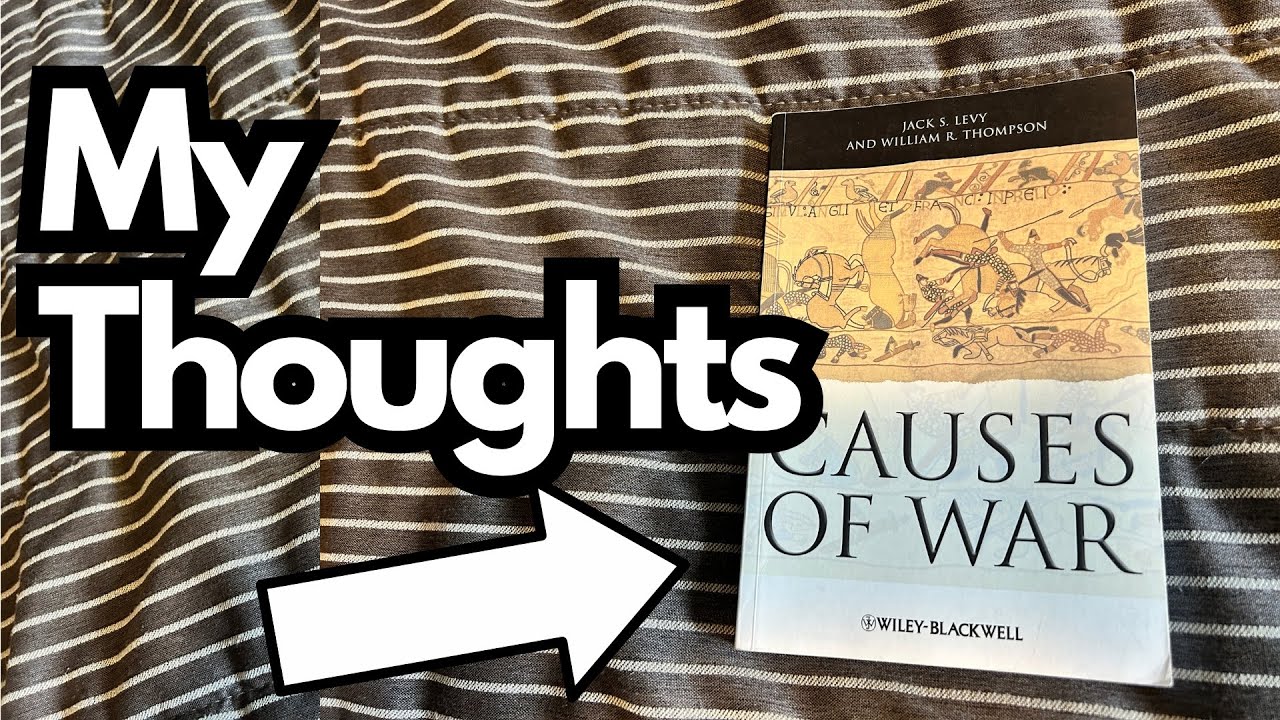
When you’re trying to understand why wars happen, you quickly run into two very different kinds of books:
- Collections of essays and historical case studies from political figures and historians.
- Theoretical, systems-based textbooks that try to explain war in abstract terms.
The Causes of War (and books like it in international relations) falls firmly into the second category. If you’re curious about how scholars model conflict at a high level—rather than just telling stories about specific wars—this kind of book is aimed at you.
If, on the other hand, you prefer concrete examples, narrative history, and first-hand perspectives, a heavily theoretical, systems-focused approach can feel dry, distant, and even a bit out of touch.
Let’s break down what this type of book offers, who it’s really for, and what its limitations are.
You can grab it here on Amazon if you’re interested.
Overview / First Impressions
This is not a light, anecdotal read. It’s written as a textbook for students of international relations, political science, and related fields.
Instead of:
- vivid battlefield descriptions
- personal accounts from leaders
- detailed chronological histories
You get:
- conceptual frameworks
- models of international systems
- abstract discussions of how states behave
The goal is to explain why wars happen in general, not just how specific wars unfolded. That means less narrative and more theory.
Build Quality & Design (as a Textbook)
From a “book as a tool” perspective, it’s structured like a classic academic text:
- Dense chapters that build one theoretical layer on top of another
- Heavy use of jargon common in international relations (e.g., “systems,” “structures,” “actors,” “balancing”)
- Emphasis on models of state behavior rather than storytelling
This structure is great if you’re taking a course and need a clear, systematic map of the field. It’s less friendly if you’re casually interested in history or politics and want something engaging to read after work.
Features & Functions: What the Book Actually Does
A systems-based book on the causes of war usually focuses on:
- International systems
How the overall structure of the global order (unipolar, bipolar, multipolar) influences the likelihood of war. - State behavior as “units”
States are treated less as unique cultures and more as rational (or bounded-rational) actors responding to incentives and constraints. - Theoretical models of conflict
Things like power transitions, security dilemmas, deterrence, and alliances are explored as abstract mechanisms. - Less emphasis on “facts” and case detail
Historical events are often used as brief examples to illustrate a model, not as full narratives to be studied on their own.
If you enjoy thinking in terms of systems, patterns, and structures, this is the core value: it tries to reveal the underlying logic behind seemingly chaotic events.
How It Feels to Read
Who It’s For
This kind of book is most useful if you:
- Are studying international relations or political science at university
- Want a conceptual toolkit for analyzing current and future conflicts
- Enjoy abstract thinking and theory-building
It can help you:
- Understand how policymakers and scholars frame the problem of war
- See recurring patterns in how states interact
- Read news about international crises with a more analytical lens
When It Doesn’t Land
If you’re not into systems-based thinking, the book can feel:
- Overly abstract – lots of models, few human stories
- Very academic – written for seminars and exams, not casual reading
- Out of touch – the human cost of war can feel minimized when everything is reduced to “units” and “systems”
If you prefer concrete narratives and fact-rich case studies, you may find yourself wishing the author would stop theorizing and just tell you what actually happened and why.
Limitations / Things to Know
Before you dive into a systems-based book on war, it helps to know:
- It’s not primarily historical.
It uses history, but only as raw material to test or illustrate theories. - It can feel detached.
The language and framing can make real suffering and complexity feel like variables in an equation. - It’s not “wrong,” just narrow.
Systems theory captures some important truths about how power and structure influence conflict, but it doesn’t fully capture:- individual leaders’ personalities
- culture and ideology
- misperceptions, emotions, and chaos
- It’s best read with supplements.
Pairing this with memoirs, detailed histories, or collections of essays from practitioners can give you a more rounded understanding.
Final Thoughts
A systems-based book on The Causes of War is a powerful tool—if you’re the right kind of reader.
- If you like clean models, broad patterns, and theoretical explanations, it can be eye-opening and intellectually satisfying.
- If you’re drawn to stories, concrete facts, and on-the-ground perspectives, it may feel abstract, academic, and disconnected from real life.
In the end, it’s less about whether the book is “good” or “bad” and more about whether its approach matches the way you like to learn about the world. For many, the sweet spot is using a text like this as one lens among many, not as the final word on why wars happen.