

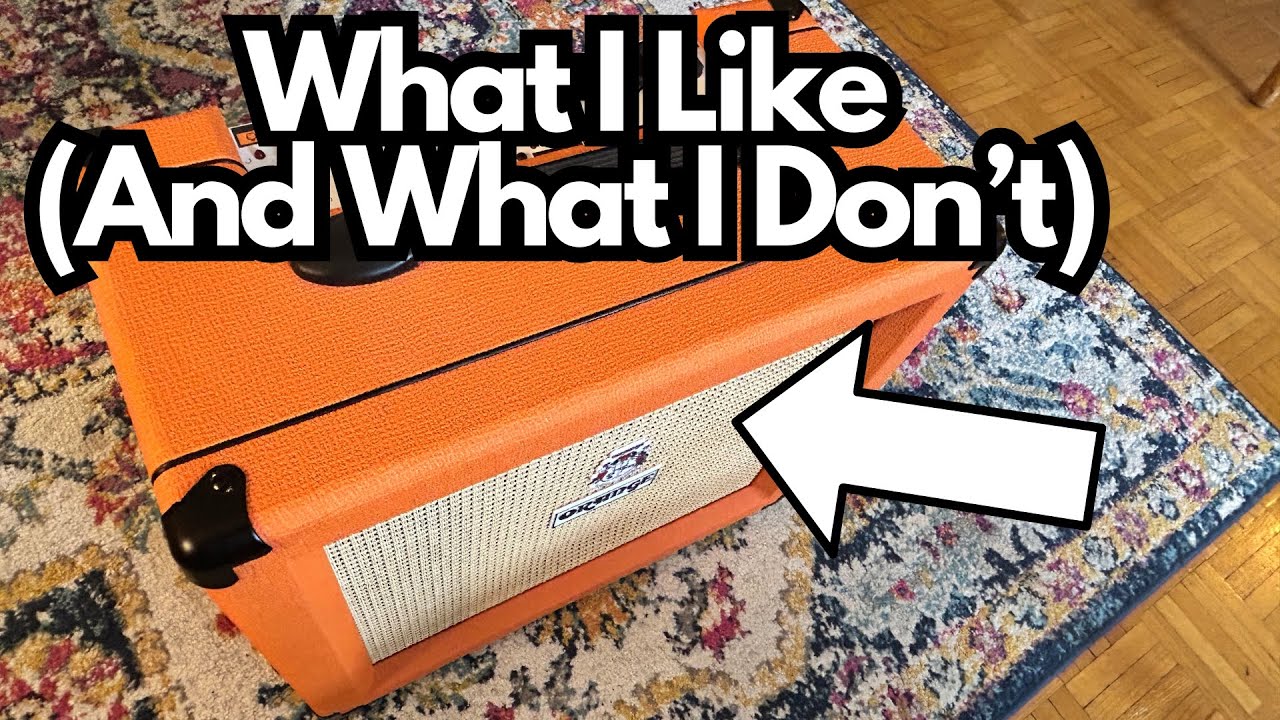
If you’re a guitarist trying to balance good tone with real-world volume limits—like in an apartment—the Orange Crush 35RT (on Amazon) is one of those amps that pops up again and again. It’s a solid-state combo with classic Orange styling, a usable effects loop, and enough power for small gigs and rehearsals.
I’ve been using the 35RT for about a year, mainly as a compact rig for home and practice, and I’ve learned where it shines and where it needs a little help—especially when it comes to volume control.
Overview / First Impressions
The Orange Crush 35RT is a 35-watt solid-state combo with:
- A single 10″ Voice of the World speaker
- Two channels: Clean and Dirty
- Built-in reverb
- Built-in tuner
- A fully buffered effects loop
- Headphone out for silent practice
On paper, it’s a great all-in-one practice and small-gig solution. In reality, it’s surprisingly loud—loud enough that even in an apartment, you’ll probably need some extra volume-taming if you want to push the amp a bit.
For my setup, I pair it with a JHS Little Black Amp Box in the effects loop, which makes the whole thing much more apartment-friendly.
Build Quality & Design
Orange is known for their rugged, no-nonsense builds, and the 35RT fits that mold:
- Classic orange tolex and simple, clear control layout
- Solid-feeling knobs and switches
- The 10″ Voice of the World speaker holds up well for both clean and dirty tones
- Everything is laid out logically on the top panel
It feels like an amp you can drag to rehearsal or keep in a home studio without babying it. Dust will collect on it like any other piece of gear, but it’s clearly built to be used, not just looked at.
Features & Functions
Channels & Controls
Clean Channel
- Simple volume control
- I typically set the clean volume around 4 and then fine-tune overall loudness with the JHS Little Black Amp Box in the loop. This gives me a nice clean base tone that’s not too sterile.
Dirty Channel
- Gain control for saturation
- Shared 3-band EQ (Treble, Middle, Bass)
- You can go from mild crunch to more saturated rock tones. It’s not a metal monster, but it covers a lot of ground for classic rock, punk, and heavier bluesy stuff.
EQ Section
- Treble / Middle / Bass
- Shared between channels
- Very usable for shaping both clean and driven sounds
- Easy to dial in a balanced tone quickly
Effects Loop (Fully Buffered)
This is the standout feature for me.
- Fully buffered effects loop on the back panel
- Perfect for:
- Reverb and delay pedals
- Modulation (chorus, phaser, etc.)
- Volume control devices like the JHS Little Black Amp Box
I specifically chose the 35RT because I wanted an amp that would take pedals:
- In front of the amp for drives, boosts, wah, etc.
- In the loop for time-based and ambient effects
The loop works well and keeps the signal clear and consistent.
Reverb
- Built-in digital reverb
- Always handy if you don’t own a reverb pedal
- In my case, I don’t really use it because I prefer a dedicated reverb pedal in the loop—but it’s there, and it’s functional.
Tuner
- Onboard tuner
- Useful in a pinch, especially if you’re new to guitar or don’t have a pedalboard yet
- Personally, I don’t use it since I rely on:
- A tuner pedal, or
- A Snark or similar clip-on tuner
- Still, it’s a nice bonus for a practice amp.
Headphone Output
- Headphone jack on the front
- Use a TRS adapter to plug in standard headphones
- Great for late-night practice or when you need to be totally silent
- Those little green TRS adapters work perfectly for this
Power & Cabling
I’m running the amp with a 100V–240V AC mains cord that’s extra long. The reason:
- My power bar is across the room
- The longer cable lets me:
- Plug the amp and all pedals into one power strip
- Control the entire rig (amp + pedals) from a single switch
It’s a small quality-of-life upgrade, but super handy in a home setup.
How It Sounds / Use Cases
At Home (Apartment Use)
Out of the box, 35 watts through a 10″ speaker is too loud for most apartments if you want any kind of breakup or punch. It’ll work at low volume, but you won’t really feel the amp breathe.
That’s where the JHS Little Black Amp Box in the effects loop becomes essential:
- Set the amp’s clean volume or gain where it sounds best
- Use the Little Black Amp Box as a master volume
- This lets you keep your tone while dropping the overall loudness to apartment-appropriate levels
If you’re mostly practicing at home, this combo makes the 35RT far more usable.
Practice & Rehearsals
With a drummer who isn’t a total basher, the 35RT can hold its own:
- Enough volume for band practice
- Takes pedals well, so you can build a full rig around it
- Clean channel stays fairly clear until pushed hard, then breaks up slightly
It’s a solid all-rounder for:
- Bedroom players who occasionally jam
- Guitarists who want a pedal platform without going full tube-amp
Tone Character
Clean Channel:
- Clear, with a bit of that Orange mid character
- Not ultra-glassy like some Fender-style amps, but sits nicely in a mix
Dirty Channel:
- Crunchy, punchy, and responsive enough for rock
- Works well with boost and overdrive pedals in front
Overall, it’s voiced in a way that feels musical and usable, not sterile.
Limitations / Things to Know
A few things to keep in mind before you buy:
- 1. Volume for Apartment Use
- Even at 35 watts solid-state, it’s still pretty loud.
- If you’re strictly a home/apartment player, a 5-watt amp might be a better choice and could eliminate the need for an external volume box.
- 2. Built-In Features vs. Pedals
- The built-in reverb and tuner are convenient, but if you already have:
- A tuner pedal or clip-on
- A favorite reverb pedal
you might not use them much.
- The built-in reverb and tuner are convenient, but if you already have:
- 3. Speaker Size
- The 10″ speaker is great for home and small spaces, but if you’re used to 12″ speakers, you’ll notice a difference in low-end fullness.
- For most practice and light gigging purposes, it’s more than adequate.
- 4. No Tubes
- It’s a solid-state amp. That’s good for reliability and maintenance, but if you’re chasing that edge-of-breakup tube response, this won’t fully replace a tube combo.
Final Thoughts
The Orange Crush 35RT is a very practical amp for guitarists who:
- Want a pedal-friendly combo with a proper effects loop
- Need something that can handle home practice, rehearsals, and maybe small gigs
- Appreciate Orange aesthetics and voicing
If I were buying again strictly for apartment use, I’d probably look at a lower-wattage amp (around 5 watts) to avoid relying on an external volume box. But paired with something like the JHS Little Black Amp Box, the 35RT becomes a flexible, great-sounding platform for pedals and practice.
If you’re after a solid, reliable, feature-packed combo that won’t break the bank—and you’re okay managing the volume—it’s a very strong option.
Resources & Further Study
If you’re using an amp like this to really work on your playing, especially your fretboard knowledge and improvisation, these resources are worth checking out:
- Fretboard Memorization Cheat Sheet – Available at travelingguitarist.com.
It covers:- Major and minor triads in every key
- Fretboard mapping techniques (like octave mapping)
- How to use triads as the foundation for harmony and improvisation
- Guitar & Music Forum – You can join the community at forum.travelingguitarist.com to talk gear, theory, practice strategies, and more with other players.
These pair nicely with a practical amp like the 35RT, giving you both the tools and the knowledge to make the most of your practice time.