

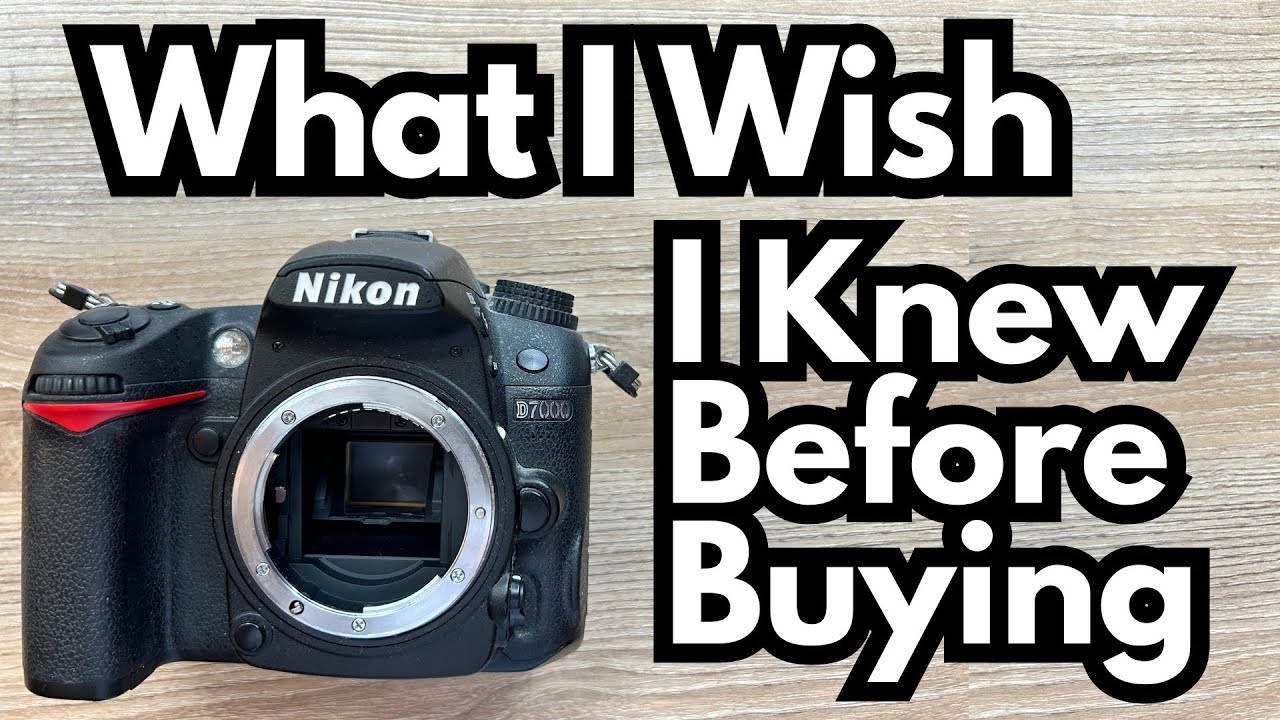
If you’re getting into photography or content creation and you’ve stumbled across the Nikon D7000 (on Amazon), you’re probably wondering: is this old DSLR still worth it when phones are so good now?
The short answer: it absolutely can be—if you value image quality and don’t mind a more old‑school workflow.
But if your priority is speed, convenience, and getting files onto your computer instantly, a modern smartphone might be the better tool for you. Let’s break down where the D7000 still shines, and where it starts to feel its age.
Overview / First Impressions
The Nikon D7000 is a classic DSLR body that was a big deal when it came out. It’s often considered a “foundational” camera for many photographers because it offered serious features at a relatively accessible price.
Even today, this camera is still capable of producing fantastic photos. The sensor, color, and overall image quality easily beat most phone cameras in good lighting, and it gives you that true “camera” look—especially with a decent lens.
However, it’s an older body, and that shows most clearly in how you get your photos and videos off the camera. If you’re used to modern wireless workflows, this can be a deal‑breaker.
Build Quality & Design
- Solid DSLR body: The D7000 feels like a “real” camera—robust, substantial, and built to last.
- Body‑only option: Often sold as a body‑only unit, which is ideal if you already own Nikon F‑mount lenses or want to choose your own glass.
- Rear display: It has a clear rear LCD for reviewing shots and navigating menus.
- Traditional controls: Dedicated buttons and dials give you quick access to exposure settings, which many photographers still prefer over touchscreen‑only interfaces.
From a handling standpoint, the D7000 is comfortable and confidence‑inspiring. It’s not a toy; it’s a proper tool.
Features & Functions
Even though it’s an older camera, the D7000 covers pretty much everything a typical photographer or content creator needs:
- High‑quality stills: Great image quality for portraits, landscapes, product shots, and general photography.
- Manual control: Full control over shutter speed, aperture, ISO, and focus modes.
- Interchangeable lenses: The biggest advantage over a phone—swap lenses for wide‑angle, telephoto, macro, low‑light primes, and more.
- Onboard display and menus: Easy to check settings, playback images, and adjust configurations.
For someone who wants to step up from a phone and learn “real camera” techniques—exposure, depth of field, and lens choice—the D7000 absolutely does the job.
How It Fits Creators & Content Work
If you’re a content creator, YouTuber, or social media shooter, here’s where the D7000 fits.
Best for:
- High‑quality photo work (thumbnails, product shots, portraits, behind‑the‑scenes stills).
- Situations where you can take your time: planned shoots, studio work, and controlled environments.
- Anyone who wants to learn proper photography and benefit from interchangeable lenses.
Not as ideal for:
- Fast, on‑the‑go content where you need to shoot and post immediately.
- Workflows that rely heavily on instant transfer to your computer or phone.
In terms of pure image quality—sharpness, depth of field, dynamic range—the D7000 still outperforms most smartphones. Where it falls behind is everything around the image: speed, sharing, and convenience.
Why an iPhone Might Be Better for You
Even acknowledging that the D7000 can take better‑quality photos, there’s a strong argument for just using an iPhone (or another modern smartphone), especially for content creators.
Here’s why:
- Instant transfer: With an iPhone, you can AirDrop photos and videos directly to your desktop in seconds. No cables, no card readers, no hassle.
- Multiple devices: You can keep a few older iPhones around dedicated to filming or photography. They’re small, easy to mount, and still shoot very usable video.
- Good enough image quality: Modern phones have surprisingly good cameras—more than enough for YouTube, Instagram, TikTok, and even many professional‑looking projects.
- All‑in‑one workflow: Shoot, edit, and upload from the same device if you want. That’s something a DSLR simply can’t match.
If your priority is speed, efficiency, and simplicity, a phone wins. You’re more likely to actually create consistently when your workflow is frictionless.
Limitations & Things to Know About the D7000
Before you commit to a D7000, keep these limitations in mind.
No modern wireless transfer
This is the big one. The D7000 is too old to support the kind of seamless wireless transfer you might be used to:
- No built‑in Wi‑Fi for quick file transfer.
- No AirDrop‑style functionality.
- You’ll need to use a cable or card reader to get photos and videos onto your computer.
Slower workflow
- Pull the SD card or plug in a USB cable.
- Import into your editing software.
- Then edit and export.
It’s not hard—but compared to tapping “Share” on a phone, it feels slow.
Video limitations
While not deeply covered here, as an older DSLR, its video capabilities are more limited than modern mirrorless cameras or even smartphones in terms of autofocus, resolution, and frame rates.
Size and weight
It’s bulkier than a phone. For travel and casual shooting, that can be a downside.
Who the Nikon D7000 Is For
You’ll likely appreciate the D7000 if:
- You want higher image quality than a phone can give you.
- You don’t mind a more manual, cable‑based workflow.
- You’re learning photography and want to understand exposure, lenses, and composition on a dedicated camera.
- You need a more “professional” look for photos—especially with good lenses.
You might be better off with an iPhone (or similar smartphone) if:
- You value speed and convenience above all.
- You want to shoot, transfer, and edit quickly without dealing with cables.
- You’re primarily creating content for web and social media, where phones are more than capable.
- You like having multiple small, inexpensive devices dedicated to filming.
Final Thoughts
The Nikon D7000 is still a very capable camera. Its age doesn’t stop it from delivering excellent image quality and a proper photography experience.
If you’re willing to live with its older workflow—cables, SD cards, and no wireless transfer—it can be a fantastic budget‑friendly tool.
But if your creative process revolves around speed, simplicity, and instant sharing, especially for online content, a modern iPhone (or similar smartphone) is often the more practical choice.
The D7000 may be “better” on paper in terms of image quality, but the best camera for you is the one that fits your workflow and keeps you creating.