

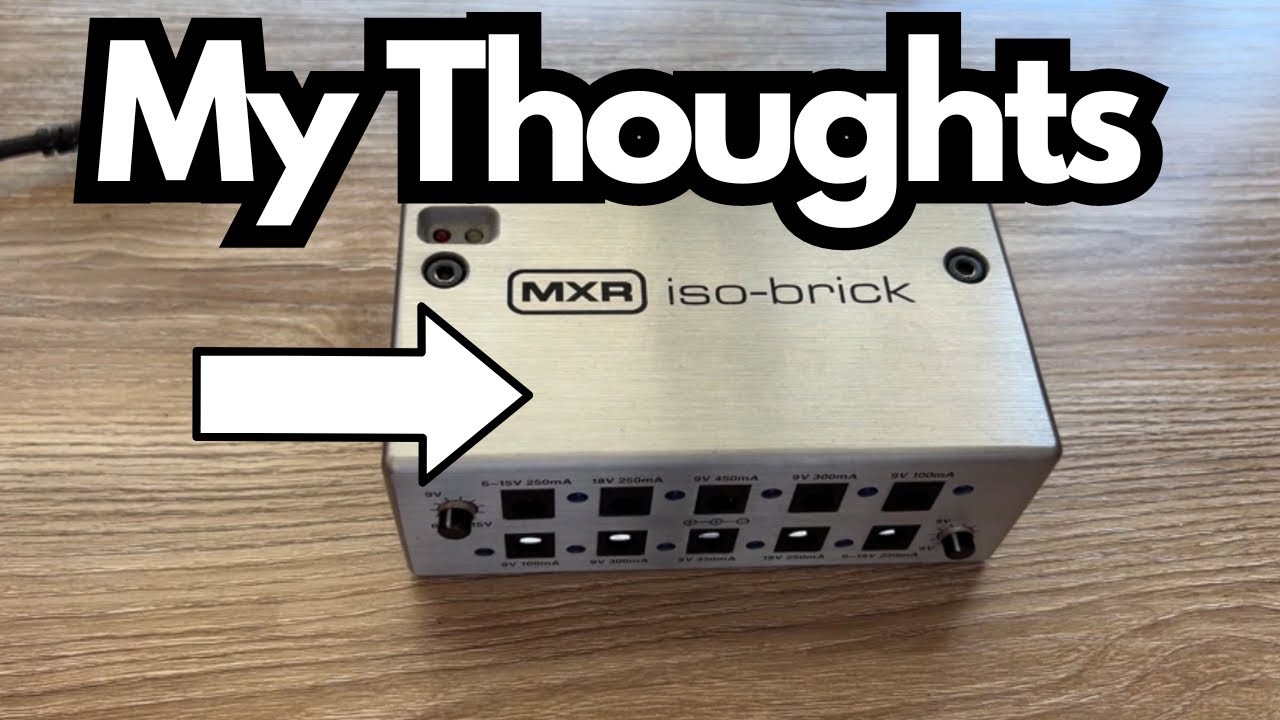
If you’re starting to build a pedalboard—or you’ve outgrown daisy chains and noisy wall warts—the MXR Iso-Brick (on Amazon) is one of those power supplies that pops up again and again.
It’s compact, versatile, and aimed squarely at the guitarist who wants a reliable, isolated power solution without jumping straight into the boutique, high-end stuff.
I’ve used the Iso-Brick for a couple of years on a real, gigging board. It was my first proper multi-output power supply, and it handled everything I threw at it until my setup simply got too big and too demanding. This post walks through what it does well, where it falls short, and who it’s really for.
Overview / First Impressions
The MXR Iso-Brick is a small, fully isolated power supply designed to power a variety of pedals—from basic 9V stomps to higher-current digital units and even 18V drives or delays.
Key impressions
- Compact footprint – It’s not much bigger than a computer mouse, so it’s easy to tuck under or on top of a board.
- Versatile outputs – A mix of 9V, 18V, and two variable-voltage outputs.
- Beginner- to intermediate-friendly – Ideal for boards with roughly 1–10 pedals.
- Quiet operation – Switch-mode design means you avoid the hum issues of large toroidal transformers.
For a lot of players, this is a “first serious power supply” that can last a few years before you truly outgrow it.
Build Quality & Design
Physically, the Iso-Brick feels solid and roadworthy:
- Chassis: Sturdy aluminum housing that feels like it can handle being thrown in a gig bag.
- Aesthetics: The chrome-and-blue look is slick. The blue LEDs in particular look sharp—though they’re a bit too bright (more on that later).
- Size: Very compact, which is a big plus if you’re trying to maximize pedalboard real estate.
The overall vibe is “built like a tank,” with one caveat: the AC inlet and adapter design could be better.
Features & Functions
Here’s what you get on the Iso-Brick:
Outputs
- Six 9V outputs
Each is rated up to 450 mA (depending on the specific jack; check MXR’s official spec for the exact breakdown). Suitable for most analog pedals and many digital units. - Two 18V outputs
Great for pedals that open up with higher headroom—certain overdrives, boosts, and some delays. - Two variable-voltage outputs (6–15V)
Labeled 6–15V, with a small knob to dial in the voltage. These are often marketed for “dying battery” tones—especially with old-school fuzzes and overdrives.
Power Topology
- Switch-mode power supply.
- No big toroidal transformer throwing a magnetic field around your board.
- Less chance of added hum or noise when used near sensitive pedals.
Included Accessories
In the box, you get:
- Iso-Brick unit
- 10 DC cables (one for each output)
- AC adapter (wall wart) for the power supply
- International plug adapters for use in different regions
- Manual and warranty info
Everything you need to get up and running is included—no need to buy extra cables just to power a standard board.
How It Sounds / Use Cases
A power supply doesn’t technically “have a sound,” but it definitely affects whether your rig is quiet, stable, and reliable.
In practice, the Iso-Brick performs well:
Noise & High-Current Pedals
- Noise performance: It’s quiet in real-world use. You don’t get the hum or buzz you often hear with cheap daisy chains or unisolated bricks.
- High-current pedals: Even though some outputs are rated at 450 mA, they can power certain 500 mA pedals in practice.
- Examples:
- Line 6 M5 Stompbox Modeler (listed at 500 mA) – works fine on a 450 mA output.
- Neural DSP Trident – also powers up and runs without issue.
- Source Audio EQ2 Programmable EQ – a high-current digital pedal that runs fine on the higher-current outputs.
That said, you’re technically exceeding the printed spec when you do this, so it’s at your own risk.
Multiple Digital Pedals at Once
- You can run several high-draw pedals simultaneously (e.g., looper, modeler, digital EQ) and still have plenty of outputs left for standard 9V stomps.
- Example setup:
- One 450 mA output → a 500 mA-ish digital pedal (e.g., M5)
- Another 300–450 mA output → Boss RC-5 looper (~200 mA)
- Another high-current output → Source Audio EQ2
- And you still have seven more outputs free for other pedals.
Dying Battery Effect
The two variable outputs let you starve certain pedals for that saggy, sputtering tone—especially fuzzes and old-school overdrives. Dial them down toward 6–7V and experiment.
For the typical small-to-medium board—overdrive, fuzz, delay, reverb, a couple of digital boxes—the Iso-Brick handles it without drama.
Limitations / Things to Know
No power supply is perfect. Here are the main drawbacks and quirks of the Iso-Brick.
1. AC Adapter Size (Wall Wart)
The AC adapter is large—the kind of wall wart that hogs space on a power strip:
- It can easily block two or three outlets on a typical surge protector.
- You’ll usually need to plug it into the very bottom or end of a strip so it doesn’t interfere with other plugs.
Functionally, it works fine, but from a practical standpoint, it’s a bit annoying.
2. AC Input Feels Shaky
On the Iso-Brick itself, the AC mains input (where you plug in the adapter) feels slightly less robust than you might expect:
- It works reliably.
- It just doesn’t have that super-solid, locked-in feel some higher-end supplies offer.
Not a deal-breaker, but worth noting if you’re rough on gear.
3. Very Bright LEDs
The blue LEDs on the top are bright:
- In a well-lit room, they look cool.
- In a dim studio, rehearsal space, or on a dark stage, they can be borderline blinding.
If you’re sensitive to bright lights, you may end up putting tape over them or angling the unit out of your direct line of sight.
4. Variable Output Knobs Don’t “Lock In”
The two variable-voltage outputs are controlled by small knobs:
- They don’t click or detent into set positions.
- There’s no ridge or “snap” to lock them at a particular voltage.
- They can, in theory, be bumped and moved slightly.
In practice, they’re not super loose, and it’s unlikely they’ll get knocked mid-gig if the unit is mounted under a board. But if you want precise, repeatable voltage settings that can’t be nudged, this design might bother you.
There’s a trade-off here: detents would make them less “truly variable,” but some kind of tactile feedback or protection would be nice.
5. Current Ratings vs. Real-World Use
As mentioned:
- Some pedals rated at 500 mA will run on a 450 mA output.
- It’s technically over the printed spec, even if it works.
My Personal Stance
- I follow the label—if it says 450 mA, I keep the load at or under 450 mA.
- If you’re desperate, you can try running a slightly higher-draw pedal and it will probably work, but you’re operating outside the official rating.
If you routinely run multiple 400–500 mA pedals, you may want to step up to a larger, higher-headroom supply eventually.
Who Is the Iso-Brick For?
The MXR Iso-Brick is a great fit if:
- You have 1–10 pedals.
- You want true isolation and low noise without spending boutique money.
- You run a mix of:
- Standard 9V analog pedals
- A few higher-current digital pedals
- Possibly one or two 18V units
- You like the idea of voltage sag options for fuzzes or overdrives.
It’s less ideal if:
- You have a large, complex board with lots of high-current digital pedals.
- You need super-precise, locked-in variable voltages.
- You’re very particular about power strip space and hate big wall warts.
Final Thoughts
The MXR Iso-Brick is a strong, practical power supply for the working guitarist who’s outgrown daisy chains but isn’t yet running a spaceship of Strymons and multi-FX units.
What it does well:
- Compact, solid, and quiet
- Enough current for most real-world boards
- Flexible outputs (9V, 18V, and variable 6–15V)
- Comes with all the cables and adapters you need
What you’ll want to keep in mind:
- Oversized wall wart
- Very bright LEDs
- Variable knobs that don’t lock into place
- Current ratings that you can push—but probably shouldn’t, long term
If you’re building or upgrading a small-to-medium board and want a reliable, isolated power solution that won’t break the bank or eat up space, the Iso-Brick is absolutely worth considering.
Resources & Further Study
If you’re working on your tone and pedalboard, it’s also worth tightening up your fretboard knowledge—especially triads and chord tones. A solid handle on triads makes it much easier to craft musical parts that actually justify all those pedals.
You can check out a dedicated triads resource here:
Triads & Fretboard Mapping – A document focused on learning triads all over the neck, using octave mapping and root-note awareness:
travelingguitarist.com/fretboard-cheatsheet.
It’s a great complement to dialing in your rig: better notes + better power = better tone.