

If you’re building a serious pedalboard, your power supply quietly becomes one of the most important pieces of gear you own. No one hears it directly, but everyone hears what happens when it hums, sags, or fails mid-set. You can grab one here on Amazon.
The MXR Iso-Brick is a popular choice among guitarists who want clean, isolated power in a compact, great-looking package. After spending time with it on a real board, here’s how it holds up in day-to-day use.
Overview / First Impressions
The MXR Iso-Brick immediately stands out for its design. In terms of aesthetics, it’s arguably one of the best-looking power supplies on the market. The compact metal enclosure, clean layout, and overall visual appeal make it an easy fit on modern, pro-level boards.
Functionally, it does what you’d expect from a quality power supply:
- Multiple isolated outputs
- Enough current for most standard and mid-draw pedals
- A footprint that works well under or on top of a board
From a guitarist’s perspective, it feels like a well-thought-out solution aimed at players who care about both tone and presentation.
Build Quality & Design
Physically, the Iso-Brick feels solid and roadworthy:
- Sturdy enclosure – Metal housing that feels like it can handle gigging and travel.
- Clean layout – Jacks are clearly labeled, and the overall design looks professional.
- Compact form factor – Easy to integrate into most pedalboard layouts.
Visually, it’s a standout. Even with a mess of patch and power cables running off it, the unit itself looks sleek and modern. If you like your board to look as good as it sounds, the Iso-Brick definitely helps.
Features & Functions
While the exact output configuration can vary by model, the general idea with the MXR Iso-Brick is:
- Multiple isolated outputs to reduce noise and ground loop issues
- A mix of different current ratings – some lower mA outputs for typical analog pedals, and higher mA outputs for digital or higher-draw units
- LED status indicators on the unit to show that each output is active and powered
The isolation and flexibility make it suitable for a wide range of pedals: drives, modulation, delays, reverbs, and many digital stompboxes.
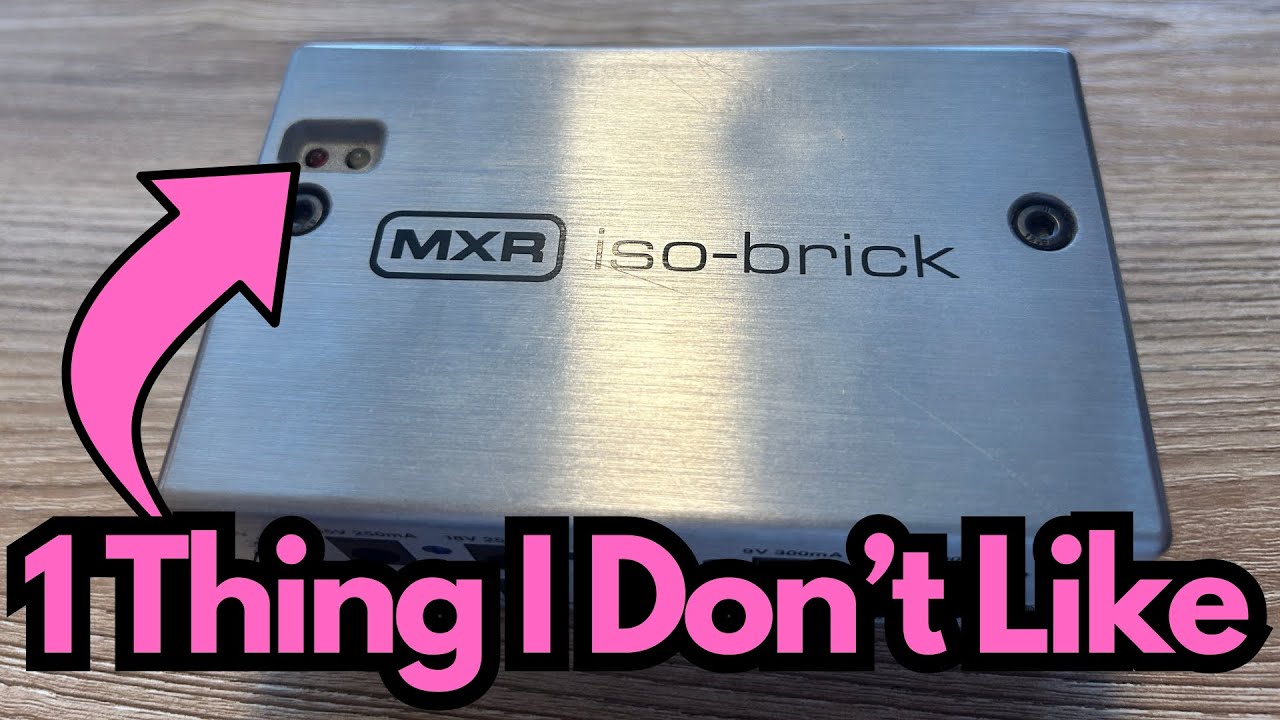
However, one design choice stands out as a double-edged sword: the LEDs.
The LED Issue: Bright. Very Bright.
One of the most noticeable aspects of the Iso-Brick in actual use is just how bright the blue LEDs are.
- In a dark room or stage environment, they can be intense.
- If your cables aren’t covering them, the LEDs can throw a surprising amount of light across your board.
- Every section of the unit that’s lit contributes to this brightness, so it’s not just a subtle status indicator—it’s more like a mini light show.
From a pure functionality standpoint, the LEDs work: you can easily tell that everything is powered. But for players who prefer a more low-key visual setup or who play in dark environments, the brightness can be distracting.
If MXR revises this unit in the future, toning down the LED brightness would be a very welcome change.
Power Output: Good, But Could Be More Uniform
The other notable limitation is the variation in current ratings across the outputs.
The Iso-Brick offers a mix of outputs with different mA ratings. That’s fine for many boards, but from a modern guitarist’s perspective, there’s an argument for more uniform, higher-current outputs—especially as digital pedals and multi-FX units become more common.
Something like the Voodoo Lab Pedal Power 3 Plus, for example, gives you multiple 500 mA outputs across the board. That kind of uniformity makes power planning a lot simpler:
- You don’t have to think as hard about which pedal goes where.
- You’re less likely to “outgrow” the supply when you add a new high-draw pedal.
The Iso-Brick is still a solid device, but it would be even better if all—or at least more—of the outputs were rated at 500 mA. As it stands, you just need to be a bit more intentional about which pedals you plug into which outputs.
How It Sounds / Use Cases
From a tone perspective, the Iso-Brick does its job: it provides clean, isolated power so your pedals can perform at their best.
Typical use cases where it shines:
- Medium to large pedalboards with a mix of analog and digital pedals
- Home practice and studio rigs where low noise and reliability are important
- Gigging setups where you want a compact, reliable power solution that looks professional
As long as your current draw per pedal stays within each output’s rating, you can expect:
- Low noise floor
- Stable operation
- Consistent performance across multiple pedals
Limitations / Things to Know
Before you commit to the MXR Iso-Brick, keep these points in mind:
- Extremely bright LEDs
- Can be distracting on dark stages or in low-light rooms.
- Some players may end up taping over them or blocking them with cables.
- Mixed current ratings
- Not all outputs are high-current.
- You’ll need to plan your pedal placement based on each output’s mA rating.
- If you run several high-draw digital pedals, you may find yourself wishing every output was 500 mA.
- Power planning required
- It’s not a “just plug anything anywhere” solution in the way some newer all-500 mA supplies are.
- Check your pedals’ current requirements and map them thoughtfully.
None of these are deal-breakers, but they are practical considerations for real-world rigs.
Final Thoughts
The MXR Iso-Brick is a strong, good-looking power supply that delivers clean, isolated power in a compact and stylish package. For many guitarists, it will handle a full pedalboard without breaking a sweat.
Its main downsides are:
- Overly bright LEDs that can be distracting in darker environments
- A mix of current ratings that requires a bit more planning, especially if you’re running multiple high-draw digital pedals
If you value aesthetics, solid build quality, and reliable isolation—and your pedalboard isn’t packed with power-hungry units—the Iso-Brick is a very solid choice. If you want maximum flexibility with high-current outputs across the board, you might want to compare it with options like the Pedal Power 3 Plus.
Resources & Further Study
If you’re working on your rig and your playing at the same time, you might also find these helpful:
- Fretboard Memorization Cheat Sheet – Available at travelingguitarist.com, this cheat sheet covers major and minor triads in every key. It uses octave mapping and other techniques to help you:
- Memorize the fretboard
- Understand triads as the foundation of chords and harmony
- Start improvising more confidently in multiple keys
- Guitar & Music Forum – You can join the community at forum.travelingguitarist.com to talk gear, guitar, and music with other players.
A great power supply like the Iso-Brick keeps your pedalboard stable—pair that with solid fretboard knowledge, and you’ll have both your tone and your playing moving in the right direction.