

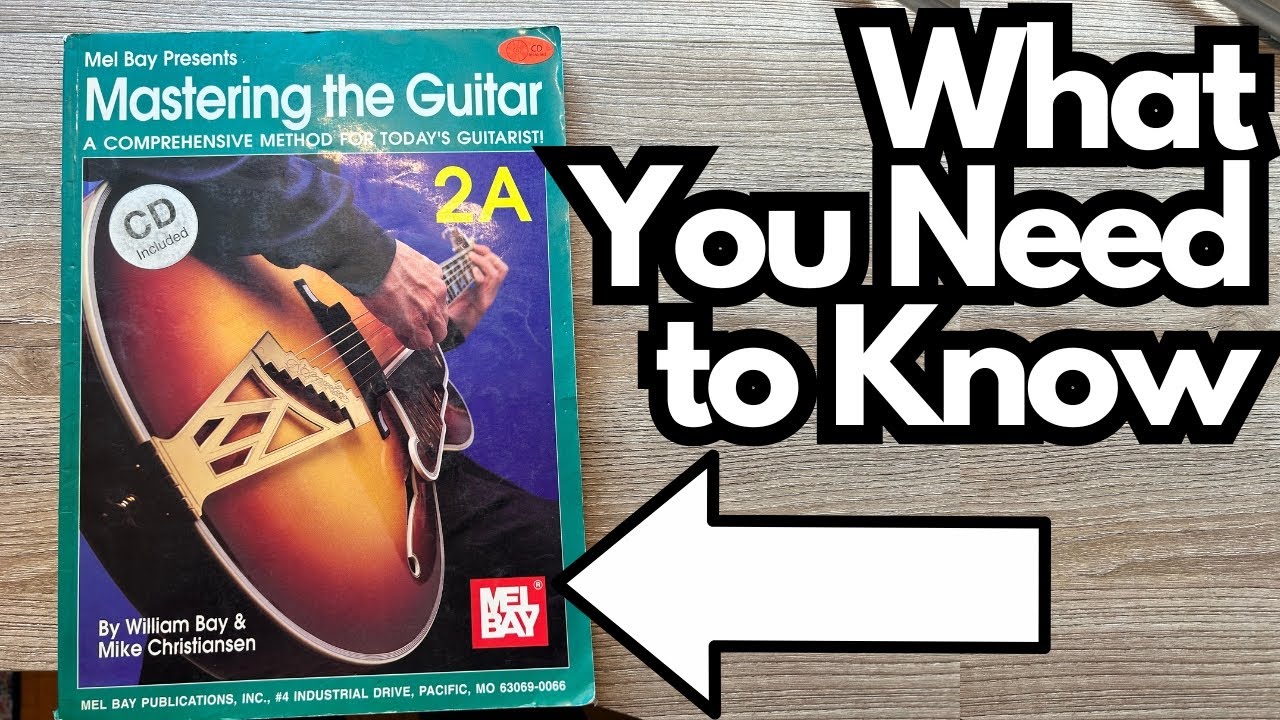
If you’ve already worked through Mastering the Guitar 1A and 1B and you’re wondering what comes next, Book 2A is where things start to feel a lot more like real-world guitar playing.
This volume keeps you in familiar keys like C and G, but pushes you up the neck, into more sophisticated notation, and into music that demands better technique and musical awareness. You can grab it here on Amazon if you’re interested.
This is a great book for late-beginners to early-intermediate players who can already read a bit, know basic open chords, and are ready to leave “just strumming in first position” behind.
Overview / First Impressions
Mastering the Guitar 2A continues directly from 1A and 1B, with:
- The same structured, methodical approach
- A gradual increase in difficulty
- More complex songs and exercises
- A strong focus on moving out of first position and up the fretboard
You’ll still see a lot of material in the keys of C and G, but the harmonic world starts to open up. The music looks and feels more like what you’d encounter in real pieces rather than just basic exercises.
If you’re just starting out, you absolutely want to begin with 1A before jumping into 2A. But if you’ve finished the earlier books, 2A is a natural next step.
Build Quality & Design
From a guitarist’s perspective, the layout and design matter more than glossy paper. This book delivers with:
- Clear notation and TAB: The notation is more sophisticated than in the earlier books, but it’s laid out clearly enough that you can track your progress visually as you move up the neck.
- Logical progression: Concepts are introduced in a sequence that makes sense—first finger in Zone 1, then Zone 2, then further along the neck.
- Song-based learning: Rather than endless drills, the material is wrapped into actual pieces and recognizable song forms, including more classic tunes and stylistic studies.
The overall feel is that of a well-structured method book that respects the student’s time and attention.
Features & Functions
Position Work: Zones 1 and 2
One of the main goals of 2A is to get you out of living solely in “first position” (open chords and the first few frets) and into:
- First finger Zone 1: Solidifying your comfort in the lower part of the neck.
- Zone 2 and beyond: Introducing you to playing further up the fretboard, shifting positions, and tracking notes as you move.
This is crucial for breaking out of the “I only know open chords” phase and starting to see the neck as a continuous map.
More Sophisticated Notation & Harmony
Compared to 1A and 1B, you’ll notice:
- Richer rhythms and note values
- More key signatures beyond just C and G
- More chords and harmonic movement, including:
- Power chords
- Songs in the key of B minor
- Chord progressions that feel more like real music
You’re not just reading notes—you’re starting to understand how chords and keys fit together on the guitar.
Style Elements: Rock & Power Chords
The book also steps into more stylistic territory, including:
- Movable power chords: Learning how to play power chords (root + fifth) that can be shifted all over the neck.
- Intro to rock playing: Using those power chords and riffs to get into rock sounds and grooves.
This is especially helpful if you’ve come from a more classical or method-book-heavy background and want to start sounding more like the guitar music you actually listen to.
Who It’s For / Use Cases
This book is ideal if you want to:
- Develop fretboard awareness by moving up the neck rather than camping on the first three frets
- Bridge the gap between beginner and intermediate with material that’s more demanding without being overwhelming
- Play more musical pieces that feel like actual music instead of dry drills
- Prepare for improvisation and lead playing by understanding positions, keys, and chord shapes
Stylistically, you’ll touch on:
- Classic-sounding pieces
- Rock-style riffs and power chords
- More harmonically interesting tunes in minor keys like B minor
Limitations / Things to Know
A few points to keep in mind:
- Not for absolute beginners: If you haven’t gone through 1A (and ideally 1B), 2A will feel like a big leap. Start from the beginning of the series.
- Reading is required: The notation gets more complex. If you’ve avoided reading music so far, you’ll need to lean into it here.
- Still somewhat “method-book” in feel: While the songs are more musical, it’s still a structured course, not a collection of radio-ready riffs.
For players who are serious about mastering the instrument, these are ultimately strengths more than weaknesses—it keeps you honest and moving forward.
Final Thoughts
Mastering the Guitar 2A is a solid step up for players who are ready to:
- Move beyond open chords and first position
- Handle more involved notation and rhythms
- Explore new keys and more complex harmony
- Start sounding more like a real guitarist, not just a beginner
If you’ve completed 1A and 1B and want a structured way to improve your fretboard knowledge, technique, and musicality, 2A is a very good book to practice with on a daily basis.
Resources & Further Study
If you’re serious about really understanding the fretboard and harmony, there are a couple of helpful resources mentioned alongside this material:
- Fretboard Memorization Cheat Sheet – TravelingGuitarist.com
A downloadable guide that lays out:
- Major and minor triads in every key
- How to map them across the neck using “octave mapping” and other visual approaches
This is especially useful if you want to:- Memorize the notes on the fretboard
- Understand the triads that form the backbone of chords
- Start improvising confidently in multiple keys
- Traveling Guitarist Forum – forum.travelingguitarist.com
An online community where you can:- Talk guitar, theory, and gear with other players
- Ask questions about practice, harmony, and technique
- Share your progress as you work through books like Mastering the Guitar 2A
Used together—a structured method like Mastering the Guitar 2A plus focused fretboard and triad study—you’ll build not just chops, but a real understanding of how the guitar works.