

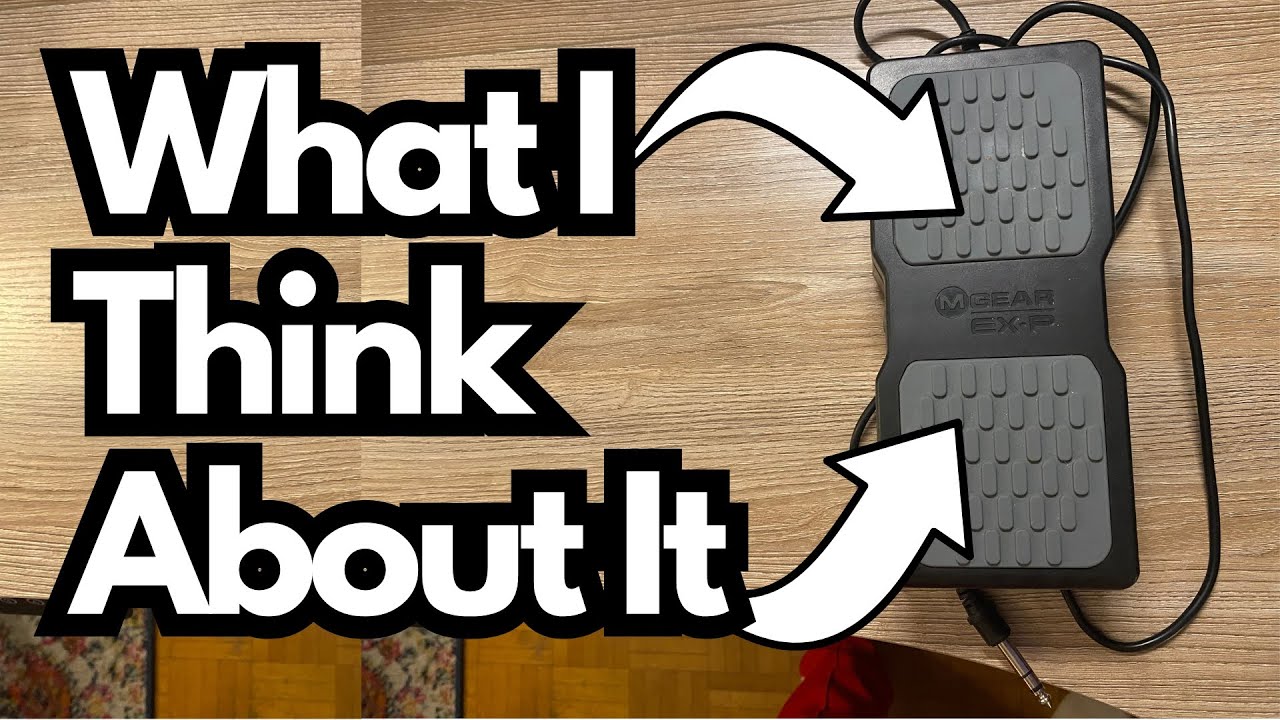
If you’re building a pedalboard and want hands-free control over gain, modulation, filters, or any other tweakable parameter, an expression pedal is one of the most useful tools you can add.
The M-Audio EX-P expression pedal is a budget-friendly option that’s been around for years, and it promises broad compatibility with pedals and devices that feature an expression input.
You can grab it here on Amazon if you’re interested.
This post looks at how the EX-P actually performs in a real-world guitar rig: what it does well, where it falls short, and who it’s best suited for.
Overview / First Impressions
The M-Audio EX-P is a compact, plastic expression pedal designed to work with a wide range of gear:
- M-Audio devices (keyboards, controllers, etc.)
- Guitar pedals with an expression input
- Other devices that accept a standard TRS expression pedal
On the underside, there’s a simple switch that lets you choose between M-Audio mode and Other mode. In practice, that means:
- Set it to M-Audio when using it with M-Audio hardware.
- Set it to Other when using it with most guitar pedals and non–M-Audio devices.
With the right setting, it will control the majority of pedals that have an expression jack. Some pairings feel more natural and responsive than others, but overall it’s surprisingly capable for the price.
Build Quality & Design
This is very much a budget expression pedal, and the build reflects that, but not in a deal-breaking way.
Key points:
- Plastic chassis: Lightweight and easy to toss in a gig bag. It’s not built like a tank, but for home use or careful gigging it holds up fine.
- Standard pedal form factor: Feels similar to a compact wah or volume pedal underfoot.
- Tension and travel: The sweep is smooth enough to control most parameters without feeling jumpy.
- Simple layout: No clutter—just the treadle, a cable, and the mode switch.
If you’re expecting heavy-duty metal construction, this isn’t it. But for the price, the EX-P offers plenty of functionality without feeling flimsy in normal use.
Features & Functions
The EX-P keeps things straightforward, which is part of its appeal.
Compatibility Switch
On the bottom, you’ll find a two-position switch:
- M-Audio – for M-Audio keyboards, controllers, and devices.
- Other – for most third-party pedals and gear, including many guitar pedals.
This simple toggle is what allows the pedal to play nicely with different manufacturers’ expression standards.
Expression Control
Once connected to a compatible expression jack, you can control parameters such as:
- Gain or drive level
- Filter cutoff / tone
- Delay feedback or mix
- Modulation depth or speed
- Volume (if the pedal supports expression volume)
You’re limited only by what the target pedal or device allows you to map to expression.
How It Sounds / Use Cases (From a Guitarist’s Perspective)
An expression pedal doesn’t “sound” like anything on its own—it’s all about how it interacts with your other gear. Here’s how the EX-P fares in a guitar context.
Works Great with Analog-Style Pedals
The EX-P pairs very well with certain overdrives and similar pedals. For example:
- JHS Morning Glory – The pedal works great here. You can:
- Sweep the gain for dynamic control over your crunch.
- Use it almost like a “hands-free gain knob,” morphing from clean-ish to pushed tones.
- Other analog-style drives and effects with expression jacks tend to behave similarly well.
In this kind of setup, the EX-P feels natural and musical, giving you expressive control without any weird jumps or dead spots in the sweep.
Mixed Results with Multi-FX (e.g., Line 6 M5)
With some digital multi-effects, results can be more hit-or-miss. For instance:
- Line 6 M5 Stompbox Modeler
- The EX-P will control certain parameters.
- However, the feel and range of control can be less than ideal.
- You might not get the smooth, precise response you’d want for more nuanced effects.
It’s not that the pedal doesn’t work—it does—but the integration isn’t as refined as you might hope, especially compared to purpose-built expression pedals from the same manufacturer.
Practical Use Cases for Guitarists
Some ways you might use the EX-P in a rig:
- Dynamic gain control – Ride the gain on an overdrive like the Morning Glory.
- Manual filter sweeps – If your pedal supports it, you can get wah/auto-filter style sounds.
- Ambient control – Fade in delay mix or reverb depth for evolving textures.
- Modulation morphing – Increase chorus or tremolo intensity for certain sections of a song.
For players who want to add expressive movement to their tones without spending a lot, the EX-P is a very usable option.
Limitations / Things to Know
While the EX-P offers solid value, there are a few caveats to keep in mind:
- Not equally compatible with every device
- It will control most pedals with an expression jack.
- Some pairings (like the Line 6 M5) technically work but don’t feel as smooth or precise as you might like.
- Budget build
- Plastic construction is fine for home and light gigging, but it’s not a heavy-duty touring tank.
- No extra bells and whistles
- No adjustable minimum/maximum knobs.
- No polarity switch beyond the basic M-Audio/Other toggle.
- No LEDs or status indicators.
If you need rock-solid road reliability or extremely fine-tuned response with a particular multi-FX unit, you might eventually look at a higher-end or brand-matched expression pedal. But for most general uses, the EX-P does the job.
Final Thoughts
The M-Audio EX-P is a cost-effective, no-nonsense expression pedal that offers a lot of value for the money.
- It works very well with many guitar pedals—especially analog-style drives like the JHS Morning Glory and similar effects.
- It can control parameters on digital multi-effects like the Line 6 M5, though the response may not be ideal for every parameter or use case.
- It’s lightweight, simple, and affordable, making it a great first expression pedal or a backup for players who want extra control without a big investment.
If you’re a guitarist looking to experiment with expression control—swelling gain, shaping filters, or morphing effects in real time—the EX-P is an easy, budget-friendly way to get started.
Resources & Further Study
If you want to go deeper into your playing while you’re exploring new gear, here are a couple of helpful resources mentioned:
Fretboard Memorization Cheat Sheet
Available at travelingguitarist.com – a fretboard cheat sheet that lays out major and minor triads in every key using the Optive mapping technique and other methods. It’s useful for:
- Memorizing notes across the neck
- Understanding triads—the foundation of harmony and chord construction
- Learning to improvise in multiple keys more confidently
Guitar & Music Forum
You can join the community at forum.travelingguitarist.com to:
- Talk guitar, theory, and gear with other players
- Ask questions and share tips
- Stay motivated and connected as you learn and practice
These resources pair nicely with an expression pedal like the EX-P, helping you not only shape your tone but also deepen your understanding of the fretboard and harmony.