

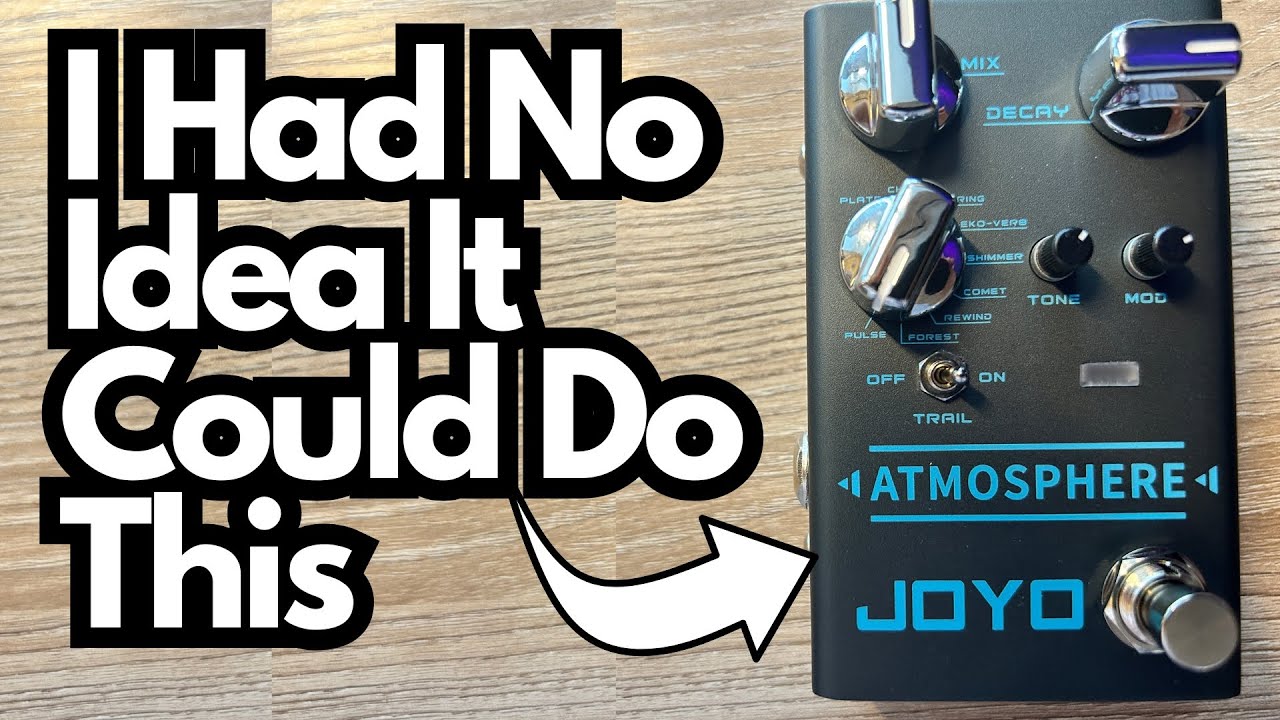
If you’re a guitarist looking to add some character and ambience to your sound without spending boutique money, the Joyo Atmosphere (on Amazon) is a pedal worth a serious look. It’s packed with multiple reverb types, some creative ambient modes, and a few quality-of-life features that make it fun and inspiring to use.
This isn’t a studio-grade stereo reverb with deep editing and MIDI. It’s a compact, affordable stompbox that gives you a wide range of usable tones—from classic spring and plate to shimmering, spacey textures—ideal for practice, home recording, and even as a backup on a gigging board.
Overview / First Impressions
The Atmosphere is one of the more interesting reverb pedals in Joyo’s lineup. What stands out immediately is how fun it is to play.
- Multiple reverb modes ranging from traditional to experimental
- Easy-to-use controls that cover the essentials
- A unique rear LED that can be customized to react to your reverb
It’s the kind of pedal that invites you to twist knobs and explore. If you’re into ambient, worship, post-rock, or just want more dimension in your clean and driven tones, this pedal delivers a lot of flavors for the price.
Build Quality & Design
Physically, the Atmosphere is a compact, sturdy stompbox that feels solid enough for regular use. It follows the typical single-footswitch, three-knob layout, with a mode selector and a couple of extra switches.
One of the coolest touches is the LED on the back of the pedal:
- You can set it to Off, Always On, or Sync.
- In Sync mode, the LED reacts to the type of reverb you’re using, pulsing or glowing in time with the effect.
- In Always On, it simply stays lit, which looks great on a dark stage or in a home studio.
It’s a small detail, but it makes the pedal feel more “alive” and visually ties into the ambient nature of the sounds it produces.
The downside: the Atmosphere is mono only—no stereo inputs or outputs—which is important to know if you’re building a bigger ambient or wet/dry rig.
Features & Functions
The Atmosphere gives you several core controls plus a bank of different reverb algorithms. Here’s what you get on the main panel.
Core Controls
- Mix – Your wet/dry control.
- Turned fully counterclockwise: essentially dry, no audible reverb.
- Turned clockwise: more reverb in the signal, up to very wet, washy sounds.
- Decay – Controls how long the reverb lasts.
- High settings: long, lingering tails, great for ambient swells and pads.
- Low settings: short, tight rooms and plates that get out of the way quickly.
- Tone – Acts like an EQ just for the reverb signal.
- Turn it up for brighter, more present reverb.
- Turn it down for darker, more subdued ambience that sits behind your dry tone.
- Modulation – Adds and controls modulation on the reverb tail.
- At lower settings, you get subtle movement and a slightly “chorused” feel.
- At higher settings, it can get more lush and warbly, ideal for dreamy textures.
Trails Switch
There’s also a Trails option:
- Trails On – When you bypass the pedal, the reverb continues to fade out naturally.
- Trails Off – When you bypass the pedal, the reverb stops instantly.
For most players, leaving Trails on feels more musical, especially for ambient or worship styles. Trails off can be useful if you need tight, abrupt stops for rhythmic or staccato playing.
Reverb Modes: From Classic to Experimental
The Atmosphere offers a range of reverb types, each suited to different musical contexts. While names and exact positions may vary slightly depending on your unit’s labeling, the main modes include both traditional and more experimental sounds.
Traditional Reverbs
- Plate
A smooth, studio-style plate reverb. Great for:- Lead lines that need a bit of sheen
- Clean arpeggios
- General-purpose ambience that doesn’t get in the way
- Church
A big, lush hall-style reverb. Perfect for:- Worship music
- Big, sustained chords
- Slow, melodic lines that need a sense of “space”
- Spring
Emulates an amp-style spring tank. Ideal for:- Surf tones
- Vintage rock and blues
- Adding subtle “bounce” to clean tones
More Creative / Ambient Modes
- Echo Verb
A combination of delay and reverb. Useful when:- You want a single pedal to cover both ambience and rhythmic repeats
- You’re running a small board and need to save space
- Shimmer
Adds a pitched, glistening top end to the reverb tail. Great for:- Ambient pads and swells
- Worship and cinematic music
- Making simple chords sound huge and orchestral
- Comet
A more unusual, spacey mode with a modern ambient vibe. Think:- Experimental textures
- Soundscapes and intros
- Layered guitar parts in atmospheric music
- Rewind (Reverse Reverb)
Reverse-style reverb that swells up into your notes instead of decaying away. Perfect for:- Ethereal, backwards-sounding leads
- Ambient interludes
- Creating a sense of tension and release
- Forest / Pulsating-Style Reverbs
There are also modes that feel more rhythmic or “pulsating,” where the reverb has movement built into it. These are great for:- Creating evolving textures under simple chord progressions
- Adding motion without using a separate tremolo or modulation pedal
Between all of these, you can go from subtle room-like ambience to full-on cinematic soundscapes with just a few knob tweaks.
How It Sounds: Use Cases for Guitarists
From a guitarist’s perspective, the Atmosphere covers a lot of ground.
- Everyday Reverb
Plate and Spring modes will comfortably handle most “always-on” reverb duties. Set Mix low, Decay moderate, and Tone to taste, and you’ve got a set-and-forget sound that works for rock, blues, pop, and more. - Worship & Ambient
Church, Shimmer, Comet, and the more pulsating modes shine for:- Swell techniques using a volume pedal or volume knob
- Long, sustained chords
- Clean, high-register melodic playing
Here, you’ll likely want:- Higher Decay
- Higher Mix
- Some Modulation to keep the tails moving
- Experimental & Sound Design
Rewind (reverse) and the more unusual modes are fantastic for:- Intros, interludes, and transitions
- Layering in a recording context
- Ambient solo projects or looping
If you’re a player who likes to experiment with textures but doesn’t want to invest in a high-end multi-FX unit, the Atmosphere gives you a taste of that world in a simple stompbox format.
Limitations / Things to Know
The Atmosphere is a strong value, but it’s not without compromises. Important points to consider:
- Mono Only
There are no stereo inputs or outputs. If you run a stereo rig or like to place reverb after stereo delays or modulation, this could be a dealbreaker. - Bypass Options
You can’t switch between true bypass and buffered bypass—you’re limited to the built-in bypass type. For most players this is fine, but if you’re very particular about signal chain architecture, it’s something to note. - Not a Deep Editor’s Pedal
There’s no MIDI, no presets, and no deep parameter editing. What you see on the knobs is what you get. That’s part of its simplicity and charm, but if you’re used to high-end programmable reverbs, this will feel more “plug and play” than “tweak forever.”
That said, for the price point, these trade-offs are expected, and the pedal still delivers a lot of musical value.
Final Thoughts
The Joyo Atmosphere is a surprisingly versatile and creative reverb pedal that punches above its weight for the cost. It covers:
- Classic plate and spring tones for everyday use
- Big, churchy halls and shimmer for worship and ambient styles
- Experimental modes like reverse and Comet for more adventurous players
Yes, it lacks stereo I/O and advanced bypass options, but if you’re after a fun, great-sounding, budget-friendly reverb—either as a main pedal on a simple board or as a backup to something more expensive—the Atmosphere is easy to recommend.
It’s the kind of pedal you can throw on your board, start playing, and quickly find inspiring sounds without getting lost in menus.
Resources & Further Study
If you’re working on your playing alongside your tone, two useful resources mentioned in connection with this pedal are:
- Fretboard Memorization Cheat Sheet – A guide to major and minor triads in every key, using octave mapping and other techniques to help you:
- Memorize the notes on the fretboard
- Understand triads as the foundation of chords and harmony
- Improvise more confidently in multiple keys
- TravelingGuitarist Forum – An online community where you can discuss guitar, gear, theory, and technique with other players.
You can find both resources at:
https://www.travelingguitarist.com and https://forum.travelingguitarist.com.