

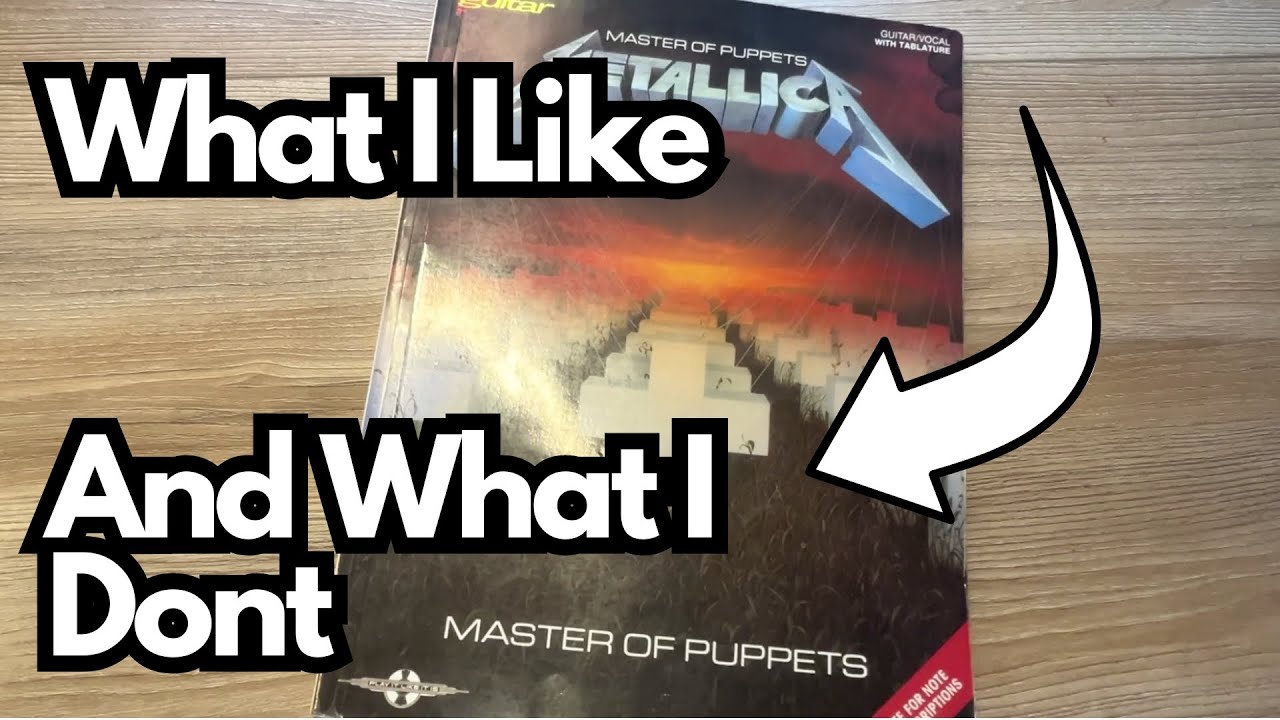
If you’ve ever tried to learn Metallica solos note-for-note, you know how much a good tab book can help—or frustrate—you. Some are legendary for their accuracy, others for how unplayable or confusing they are.
Today we’re looking at a Metallica tab book I picked up around 15 years ago. It’s better than the …And Justice for All book, but it isn’t perfect either.
If you’re a guitarist who loves Metallica and wants a reliable book to work from—especially for solos—this rundown will help you decide if it deserves a spot on your music stand.
Overview / First Impressions
This book is one of the better Metallica tab books out there. It’s not flawless, but it gets a lot right:
- The solos are generally very well done.
- Most of the riffs are accurate enough to play along with the record.
- It’s easily “good enough to own” if you’re a Metallica fan or a working guitarist who needs reliable reference material.
Compared to some notoriously rough Metallica tab books (looking at you, …And Justice for All), this one feels more carefully put together and much more usable in real-world practice.
Build Quality & Notation Style
From a guitarist’s perspective, the layout and notation choices matter almost as much as the accuracy. That’s where this book is a bit of a mixed bag.
The good:
- Clear standard notation plus tab.
- Most sections are logically laid out and easy to follow.
- Solos are presented in a way that makes them reasonably approachable.
The not-so-good:
- Some spots use “harmonization” in a confusing way—two notes stacked together on the tab/staff in places where it’s not immediately obvious what’s going on musically.
- As a beginner or intermediate player, this can feel like, “What am I even looking at?”
When I first worked through this book as a kid, that harmonized notation really threw me off. I didn’t yet understand how guitar harmonies were built or how two guitar parts might be notated together, so it just felt inefficient and unnecessarily confusing.
Features & Functions (From a Player’s Perspective)
Here’s what this book actually gives you in practical terms:
- Full song transcriptions – Riffs, rhythm parts, and solos.
- Generally accurate solos – The lead work is usually on point, which is crucial for Metallica. That’s where a lot of cheaper or rushed tab books fall apart.
- Usable rhythm parts – The riffs are close enough to the original that you can comfortably jam along with the album or a backing track.
For most players, especially if you’re learning by ear alongside the book, this level of accuracy is more than enough to:
- Tighten up your rhythm playing.
- Understand how the solos are structured.
- Build your metal vocabulary—licks, patterns, and phrasing ideas.
How It Plays in the Real World
Solos: Mostly Great, With a Few “Yeah, Right” Moments
The solos are where this book shines—most of the time.
One standout issue is in the “Orion” guitar solo. There’s a specific section where the transcription calls for a wild string skip and position jump that’s basically unplayable in the way it’s written:
- It has you jumping from a low fret to a high fret on a non-adjacent string in a way that makes no physical sense.
- You’d have to be some kind of freak of nature to execute it exactly as written at tempo.
This is a classic example of a transcription that might look right on paper but doesn’t reflect how a guitarist would realistically finger or phrase the part. When that happens, you’re better off:
- Taking the general idea from the tab.
- Listening closely to the original recording.
- Adapting the fingering into something that makes musical and physical sense.
Despite that, the majority of the solos are very playable and feel true to the record.
Riffs: Reliable Enough to Gig With
The riffs are “well done” in the sense that:
- They’re not wildly off.
- You can use them to learn the songs solidly.
- They’ll hold up in band practice, live situations, or just jamming at home.
If you’re picky, you might tweak a note or a rhythm here and there after comparing with the album, but this isn’t one of those books where you’re constantly thinking, “This is just wrong.”
Limitations / Things to Know
Before you buy or dive deep into this book, be aware of a few limitations:
1. Occasional Unrealistic Fingerings
- Certain passages (like that section in “Orion”) are not written in a way that reflects how a real guitarist would play them.
- Treat those as suggestions, not gospel.
2. Confusing Harmonized Notation
- Sometimes two notes are stacked together on the staff/tab in a way that isn’t clearly explained.
- If you don’t already understand harmony or dual-guitar parts, this can be frustrating.
3. Not Perfect, Just “Ok”
- This is not a note-for-note Bible.
- Think of it as a strong reference plus your own ears, not a replacement for listening to the album.
Final Thoughts: Should You Own It?
Yes—this is a tab book worth keeping.
Pros:
- Solos are usually very accurate.
- Riffs are solid and playable.
- Overall, much better than some of the older, sloppier Metallica books out there.
Cons:
- A few unplayable or unrealistic passages.
- Some confusing harmonized notation that may trip up less experienced players.
If you’re a Metallica fan, a working guitarist, or just someone who loves learning classic metal solos, this book is absolutely “good enough to own.” I wouldn’t sell it, and it still holds value even after 15 years.
Use it as a tool—but always cross-check with your ears and your hands. If something feels impossible or awkward to the point of insanity, it’s probably the transcription, not you.
Resources & Further Study
If you’re using books like this to push your playing, it really helps to understand the fretboard and harmony more deeply. Two resources that can help:
Fretboard Memorization Cheat Sheet – TravelingGuitarist.com
A practical guide to:
- Major and minor triads in every key
- Mapping the fretboard using triad shapes and patterns
- Building improvisation skills by understanding how chords and harmony actually work
It’s especially useful if you want to:
- Move beyond just copying tabs
- Start seeing how solos and riffs are built from chord tones and triads
Traveling Guitarist Forum – forum.travelingguitarist.com
A place to:
- Talk guitar, gear, and music with other players
- Ask questions about tricky passages, theory, or technique
- Share your progress and get feedback
Combining a solid tab book with a strong grasp of triads and fretboard knowledge will make you far less dependent on any one transcription—and a lot more confident in your own playing.