

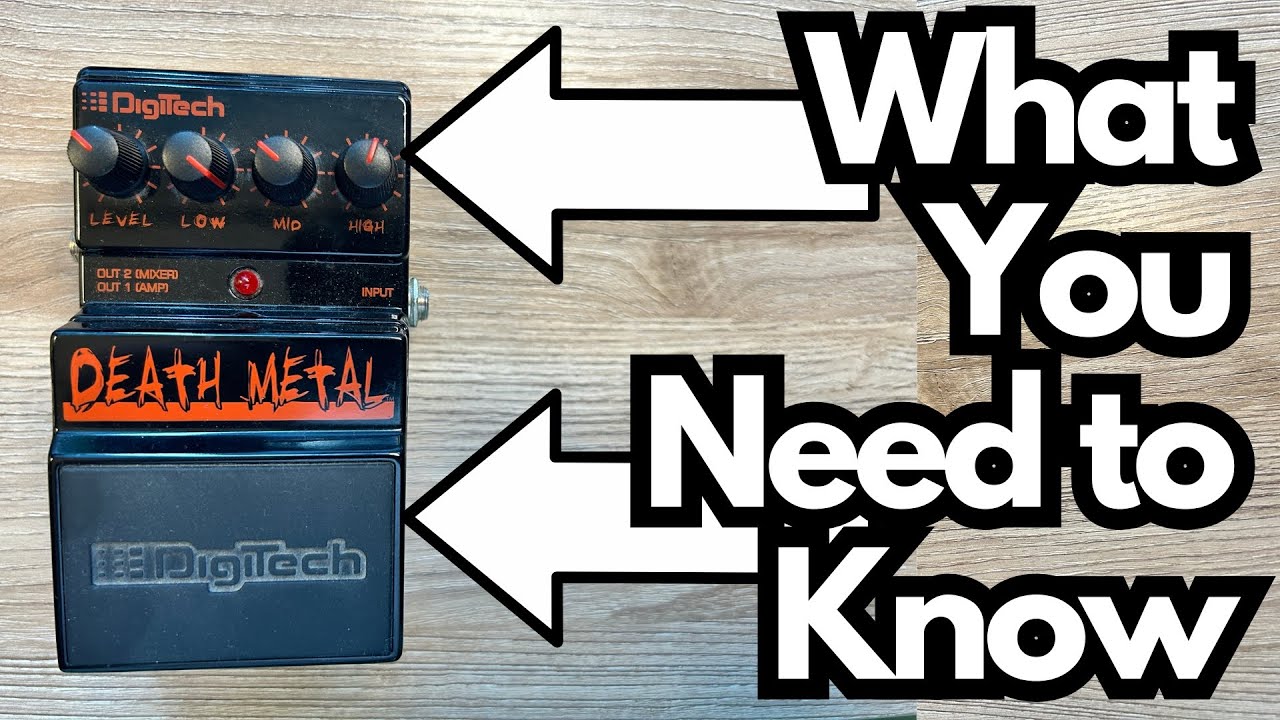
If you’ve ever chased extreme metal tones with pedals, you know how much the label on the box can mislead you.
That’s exactly what’s going on with this distortion pedal: it’s marketed as a “death metal” unit, but in practice, it shines much more in the black metal realm. You can grab one here on Amazon if you’re interested.
If you’re into raw, cold, high-gain tones with a lot of EQ control, this pedal is worth a serious look. If you’re after tight, modern death metal chunk, you’ll want to keep your expectations in check.
Let’s break down what it actually does well, where it falls short, and who it’s really for.
Overview / First Impressions
This pedal delivers:
- Huge, aggressive distortion (with no separate gain control)
- Extremely powerful EQ that can reshape your tone dramatically
- A solid metal enclosure that feels roadworthy
- Dual outputs for flexible routing
Sonically, it leans toward:
- Black metal: cold, biting, wasp-swarm high end and scooped or hollow mids if you want them
- Old-school or lo-fi extreme metal: think raw, buzzy, and unapologetically harsh
It can absolutely do “metal” in a general sense, but if you’re expecting a tight, modern, palm-muted death metal machine with tons of low-end punch and articulated chugs, this isn’t the best fit. As a black metal-style pedal, though, it’s actually excellent.
Build Quality & Design
From a guitarist’s perspective, the physical design is very solid and practical:
- Enclosure: Steel/metal casing (often referred to as a steel ENC-style housing), which feels tough and gig-worthy.
- Top-mounted power jack: The 9V power input is on the top of the pedal, not the side. This is a big win for pedalboard layouts because:
- It saves width on your board.
- It keeps cables from getting in the way of neighboring pedals.
- Battery access: There are small metal posts or poles on the side of the pedal (near the “D” in the logo/label). Pressing on these lets you pop the back and access the 9V battery compartment. No screwdriver needed.
- Dual output jacks: You can send the signal:
- To a standard guitar amp, and
- To a mixer or another amp at the same time.
That dual-output setup is especially useful if you:
- Run a wet/dry rig
- Want to send a direct signal to a PA or recording interface
- Like blending different amp tones live
Overall, the build feels robust and thought-through for real-world use.
Features & Functions
The control layout is simple but surprisingly powerful. While the exact knob labels aren’t explicitly listed in the source, the main functions are clear.
Level
- Level controls the overall output volume.
- There is no separate gain knob—the distortion character and intensity are basically “baked in.”
- You use Level to balance the pedal’s output with your amp or to boost it above unity for leads.
3-Band EQ (Low, Mid, High)
This is where the pedal really stands out. The EQ isn’t subtle—it’s drastic, and that’s a good thing for extreme metal.
- Low:
- Turned all the way down, it almost completely strips the low end, giving a thin, cutting tone.
- Turned way up, it adds a ton of bottom, making the sound fuller and heavier (though still more raw than tight).
- Mid:
- Cranking the mids makes the pedal much more present and aggressive in the mix.
- Boosted mids can help cut through a band setting and give a nastier, more in-your-face character.
- High:
- Turning this up gives that “attack of bees” sound—super bright, fizzy, and biting.
- Great if you want that black metal-style, razor-sharp top end.
- Dial it back if your rig is already bright or if you’re using single-coils.
Because the EQ is so responsive, you can radically shift the character of the distortion, even though you can’t change the actual gain amount.
How It Sounds / Use Cases
Black Metal Tones
This is where the pedal truly shines.
- Tremolo-picked riffs come out harsh, icy, and aggressive.
- With highs boosted and lows/mids adjusted to taste, you get that classic, raw black metal wall of sound.
- The inherent distortion voice is more buzzy and abrasive than tight and percussive, which suits black metal aesthetics very well.
If your goal is:
- Cold, evil, lo-fi or raw-sounding distortion
- High-end-heavy, swarm-of-insects type tones
- Atmospheric, dissonant chord work with lots of gain
…this pedal is a strong contender.
Traditional / General Metal
You can dial in more “standard” metal tones:
- Add low end for weight.
- Use moderate mids so your sound doesn’t disappear in a band mix.
- Tame the highs to avoid excessive fizz.
However, even with careful EQ:
- The distortion still feels more raw than refined.
- It won’t easily give you that tight, modern, palm-muted chunk you’d expect from many death metal-focused pedals.
Death Metal
This is where the marketing doesn’t quite line up with reality.
- It can do high gain, no problem.
- But for modern death metal—tight low end, focused mids, clear palm mutes—there are better options.
- You might get closer with a boost in front (like a Tube Screamer) and very careful EQ, but it’s not the pedal’s natural wheelhouse.
If you mainly play death metal, you might want to treat this as a specialty flavor rather than your main rhythm distortion.
Limitations / Things to Know
Before you buy, keep these points in mind:
- No gain knob:
You can’t dial in more or less distortion—what you hear is essentially what you get, and you shape it with EQ and Level. - Voicing leans toward harsh/bright:
That “attack of bees” description is pretty accurate when the highs are pushed. Great for black metal, but it may be too fizzy for players who want smoother distortion. - Not ideal for tight modern metal:
If your benchmark is ultra-precise, low-tuned, djent or modern death metal rhythm tones, this pedal isn’t optimized for that. - Marketing mismatch:
It’s sold as a “death metal” pedal, but functions more like a black metal or extreme raw metal pedal. Knowing that going in will save you disappointment.
There’s nothing actually wrong with the pedal itself—the hardware, sound, and controls all do what they’re supposed to. The issue is expectations.
Final Thoughts
From a guitarist’s perspective, this pedal is:
- Excellent for black metal and raw, extreme high-gain sounds
- Usable for general metal if you take advantage of the strong EQ
- Less than ideal for modern death metal, despite the branding
The build is solid, the EQ is powerful, and the dual output plus top-mounted power jack are all practical touches for real-world rigs.
If you:
- Play black metal or raw extreme metal
- Like harsh, buzzy, high-gain tones
- Want a pedal that can drastically reshape its EQ
…this is absolutely worth trying.
If your main goal is tight, modern death metal rhythm tone, you’ll probably be happier with a different distortion pedal and maybe using this one as a more specialized atmospheric or secondary sound.
Resources & Further Study
If you’re working on your playing alongside your tone, there are a couple of useful resources mentioned:
- Fretboard Memorization Cheat Sheet – TravelingGuitarist.com
A downloadable guide covering major and minor triads in every key. It uses approaches like octave mapping to help you:- Memorize the notes on the fretboard
- Understand triads as the foundation of chords and harmony
- Start improvising more confidently in different keys
- Traveling Guitarist Forum – forum.travelingguitarist.com
A community space where you can:- Talk guitar, gear, and music
- Ask questions
- Connect with other players
Pairing a focused tone tool like this pedal with solid fretboard and harmony knowledge is a great way to level up both your sound and your musicianship.