

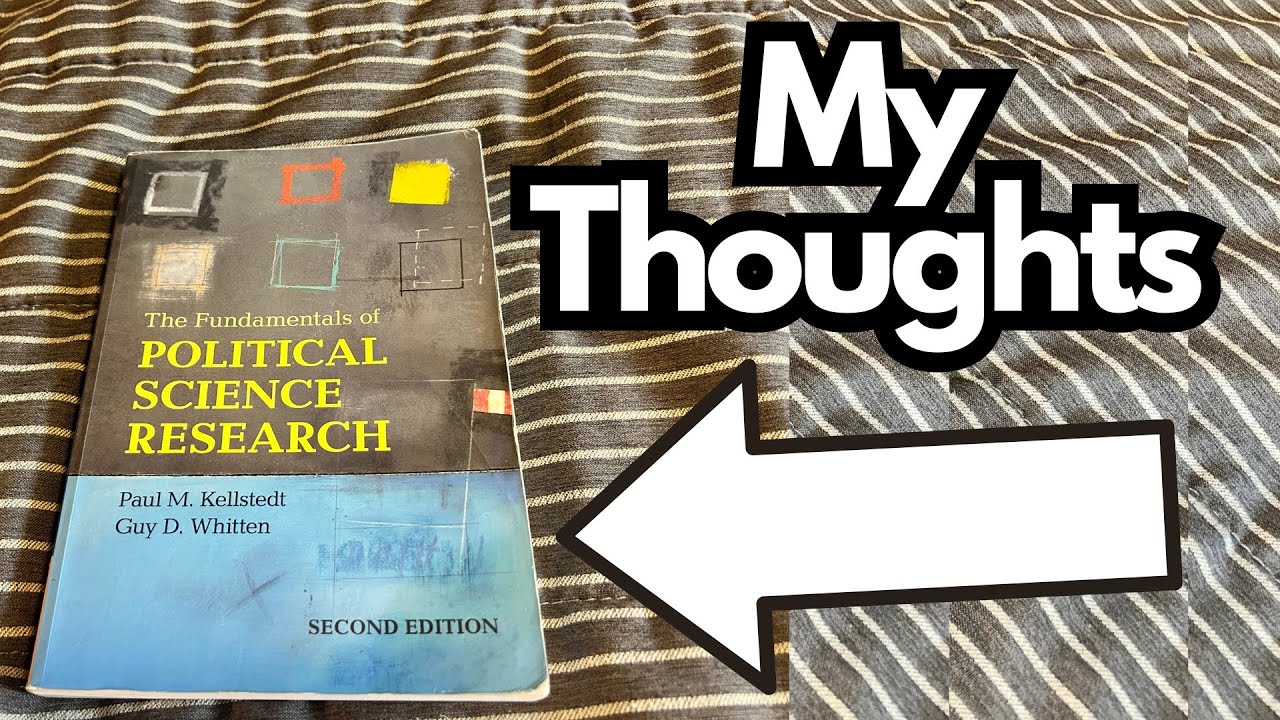
If you’ve just been assigned a political science methods or statistics textbook and you’re already dreading it, you’re not alone. For a lot of students, these books are the single most painful part of a political science degree. They sit at the uncomfortable crossroads of math, statistics, and theory—three things many people didn’t sign up for when they chose politics.
This post is for you if:
- You’re staring at a stats-heavy political science book and wondering how you’ll survive.
- You’ve heard “it’s not that hard” from classmates, but it still feels miserable.
- You want to know what to expect and how to mentally approach it.
You can grab it here on Amazon if you’re interested.
Overview / First Impressions
The kind of book we’re talking about here is usually a political science research methods or statistics-for-political-science text. It typically covers things like:
- How political scientists measure concepts like democracy, inequality, public opinion, etc.
- Basic and intermediate statistics: averages, correlations, regressions, significance tests.
- How to design studies and interpret data in a rigorous way.
On paper, that sounds straightforward. In reality, it can feel like a foreign language—especially if you’re more into theory, philosophy, or qualitative analysis.
For some students, it clicks. For others, it’s pure pain. If you’re in the second group, there’s nothing wrong with you. This material is just a very different skill set from what most people expect when they think “political science.”
Build Quality & Design (of the Typical Textbook)
Most political science methods books share a few traits:
- Dense writing: Long paragraphs, compact explanations, and a lot of jargon (variables, coefficients, significance levels, operationalization, etc.).
- Heavy on formulas and tables: Even if it’s “introductory,” there are often equations, statistical notation, and datasets to interpret.
- Examples from real studies: They’ll pull in case studies or data from elections, surveys, and international relations to show how the stats are used.
The problem? The design often feels more like a reference manual than a teaching tool. If you’re not already comfortable with numbers, the layout and pacing can be overwhelming.
Features & Functions: What the Book Is Actually Teaching You
Underneath the frustration, there are some important skills these books are trying to build:
- Measurement in political science
How do you turn vague ideas like “political trust” or “authoritarianism” into something you can actually measure with numbers? - Descriptive statistics
Means, medians, standard deviations—basic tools for summarizing political data. - Relationships between variables
Correlation and regression: how one political factor (like education) might be related to another (like voter turnout). - Hypothesis testing
Are the patterns in your data real, or could they just be random noise? - Study design
Surveys, experiments, observational studies—how political scientists set up research so their conclusions are credible.
If you plan to read academic articles, work with polling data, or go to grad school, this is the backbone of how the field works.
How It Feels to Use These Books
From a student’s perspective, using this kind of book often feels like:
- Constant translation: Turning math and jargon into plain language you can actually understand.
- Mental whiplash: One minute you’re reading about democratic theory, the next you’re knee-deep in regression tables.
- Slow progress: You might need to reread sections multiple times before they make sense.
But once it starts to click—even a little—you’ll notice:
- Journal articles become less mysterious.
- You can look at a graph or table and actually understand what it’s saying.
- You gain a healthy skepticism about statistics thrown around in the news or by politicians.
Limitations / Things to Know
Before you beat yourself up over hating this material, keep a few things in mind:
- It’s not “easy” just because others say so.
Different brains are wired for different things. Some classmates breeze through stats and struggle with theory; others are the opposite. - The teaching style matters a lot.
A dry textbook plus a rushed lecture is a recipe for misery. Sometimes the problem isn’t you—it’s the way the material is presented. - The math can feel disconnected from the politics.
When the examples aren’t engaging, it just feels like generic stats with a political label slapped on. - You can pass without loving it.
Not everyone needs to become a methods wizard. For many political science careers, a basic working understanding is enough.
Final Thoughts
For some of us, the stats-and-methods side of political science is the bane of our academic existence. It can feel like a slog, a mismatch with why we chose the subject in the first place, and a constant source of stress.
But it’s also the toolkit that underpins a huge chunk of modern political research. Even if you never love it, pushing through and picking up the essentials will make you a sharper reader, a better critic of data, and a more informed participant in political debates.
If you’re stuck with a methods or stats book you absolutely hate, you’re not alone—and you’re not broken. Do what you need to get through it, grab the core concepts, and remember: this is just one part of the field, not the whole story.