

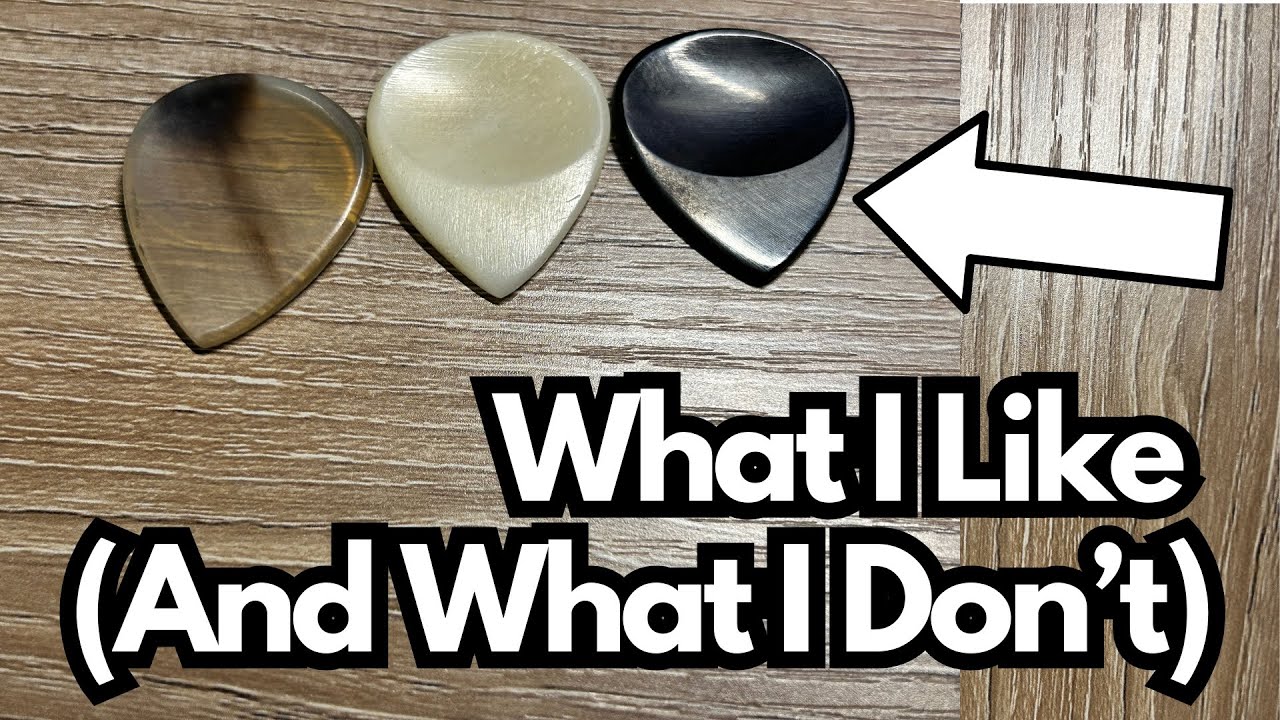
If you’re the kind of guitarist who loves experimenting with different picks to chase new tones and feels, horn-style picks are a fun rabbit hole.
They’re not your everyday Tortex or Jazz III, but they bring a distinctive attack and vibe that can really change how your guitar responds—especially on acoustic or cleaner tones. You can grab one here on Amazon.
This post walks through what these horn picks are like to play, how they compare to standard picks, and where they actually make sense in a guitarist’s toolkit.
Overview / First Impressions
These horn picks came in a set of three (one has since gone missing—classic guitar player problem). Right away, a few things stand out:
- They look very cool – visually striking, with a darker, organic aesthetic.
- They feel great in the hand – there are small rivet-like details that make them easier and more fun to hold.
- They seem ideal for jazzier or more articulate acoustic playing, rather than high-speed shredding.
They’re slightly larger than a typical Jazz III or standard 1.0mm pick, but they still come to a sharp point, so you can play fast with them if you want. It just feels different than using a small, tight, shreddy pick.
Build Quality & Design
These picks are marketed as “horn” picks, though it’s not entirely clear whether they’re made of actual horn or just plastic designed to look like it. Real horn can raise ethical and environmental concerns, so there’s a good chance these are a synthetic or composite material.
A few design details are worth noting:
- Shape & Size: Larger than a Jazz III, closer to a traditional pick size but with a sharper tip.
- Edge & Point: The point is well-defined, which helps with precision and fast alternate picking.
- Grip: The rivet-style texture isn’t just cosmetic—it genuinely helps with grip, especially during longer sessions.
- Aesthetic: Dark, glossy, and unique-looking. If you like your gear to look as cool as it sounds, these definitely qualify.
Overall, they feel solid and durable—more “premium trinket” than disposable pick.
Features & Functions
From a practical playing perspective, here’s what these horn picks offer:
- Defined attack: The material and shape give a slightly more pronounced attack compared to a typical Tortex-style pick.
- Control: The pointed tip and textured grip make it easy to control note articulation and dynamics.
- Versatility: While they can handle fast playing, they really shine in more controlled, expressive styles:
- Jazz comping and soloing
- Fingerstyle with occasional flatpicking
- Acoustic chord-melody lines
- Clean or edge-of-breakup electric tones
If you’re used to very small, tight jazz picks, these might feel a bit large at first. But for players who like a bit more to hold onto, they’ll feel comfortable quickly.
How It Sounds / Use Cases
When you actually put these picks to the strings, they do have a particular sound that stands out from something like a standard Tortex.
Compared to a Regular Tortex Pick
Using a typical Tortex-style pick (like the classic green or orange ones), you tend to get:
- A slightly softer attack
- A more familiar, rounded pick sound
- A bit less “click” at the front of the note
Switching to the horn pick, you notice:
- More attack and definition at the front of the note
- A slightly brighter, more percussive tone
- A different feel in how the string releases off the tip
If you strum chords or play riffs, you’ll hear that extra presence and bite, especially on acoustic or clean electric.
Compared to a Jazz III
Jazz III picks are known for:
- Tiny profile
- Tight control
- Focused, precise attack
The horn pick shares the sharp point and articulate feel, but:
- It’s bigger, so it doesn’t feel quite as laser-focused for ultra-fast shredding.
- It offers a bit more surface area and comfort for players who don’t like super small picks.
If you like the sound and precision of a Jazz III but want something that feels more substantial in the hand, these are an interesting middle ground.
Best Use Cases
These horn picks work especially well for:
- Jazz and fusion lines on electric or acoustic
- Articulate acoustic playing where you want each note to pop
- Melodic riffing where pick attack is part of the tone
- Players who like distinctive gear and enjoy subtle tonal variations
Limitations / Things to Know
A few caveats before you go all-in:
- Not ideal for everyone’s shred style: If you’re used to tiny, super-snug picks for high-gain shredding, these might feel a bit bulky.
- Material uncertainty: It’s unclear whether they’re genuine horn or an imitation. If you care about the ethical or environmental aspect, that’s something to keep in mind and research per brand.
- Niche appeal: They’re more of a specialty pick than a daily driver for most players. Great to have in the collection, but not necessarily the one pick you’ll use for every gig and style.
Final Thoughts
Horn-style picks are one of those small pieces of gear that can unexpectedly shift your tone and feel. They’re:
- Visually striking
- Comfortable to hold, thanks to the riveted texture
- Sonically distinct, with more attack and presence than a typical Tortex pick
For jazz, acoustic work, and any style where note definition and pick attack matter, they’re absolutely worth trying. Even if they don’t become your main pick, they’re a cool addition to your toolkit and a fun way to explore how much a simple pick can change your sound.
Resources & Further Study
If you’re experimenting with picks, it’s also a great time to deepen your fretboard knowledge and improvisation skills:
- Fretboard Memorization Cheat Sheet – TravelingGuitarist.com
A practical resource that lays out major and minor triads in every key, using the octave mapping technique and other methods. It helps you:- Memorize the notes on the fretboard
- Understand the harmonic foundation of chords and triads
- Improvise more confidently in multiple keys
- Traveling Guitarist Forum – forum.travelingguitarist.com
A place to talk gear, guitar technique, theory, and music in general with other players.
If you’re curious about how different picks, tones, and fretboard understanding all tie together, those resources are a solid next step.