

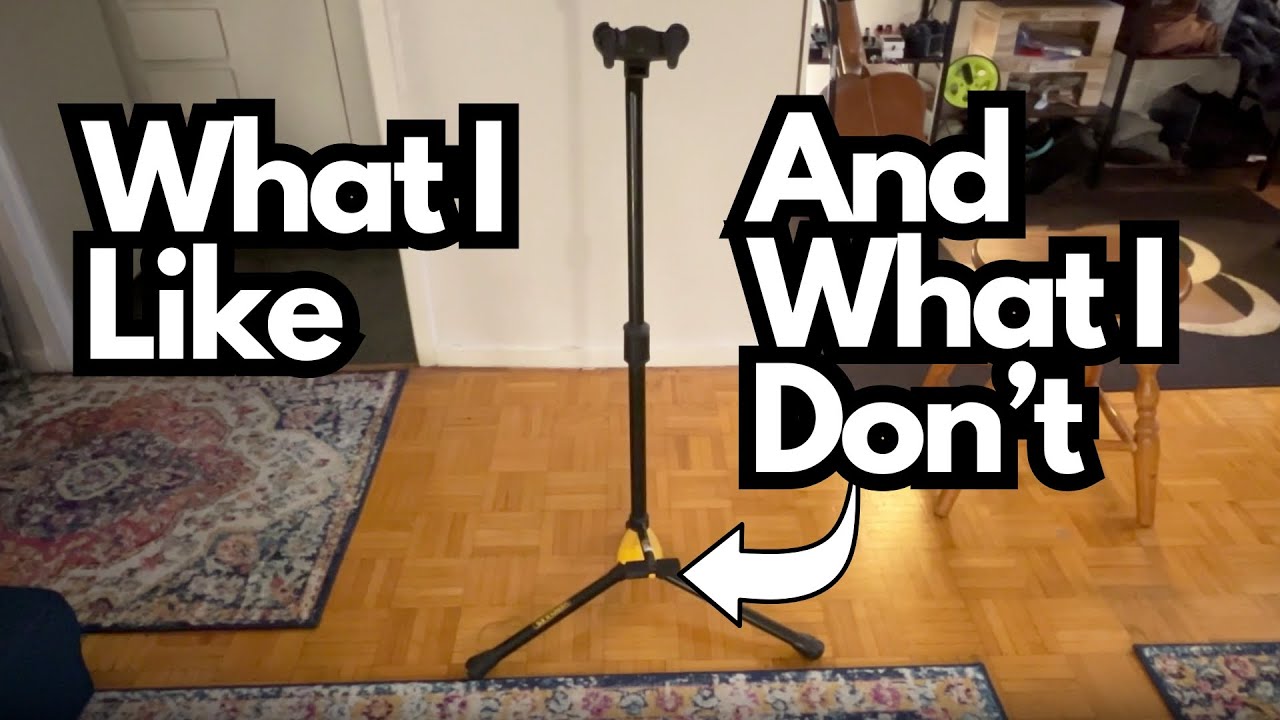
If you’ve spent any time around rehearsal rooms or stages, you’ve probably seen Hercules stands everywhere.
They’ve built a reputation for clever designs and rock-solid stability, especially with their multi-guitar and locking neck stands.
This particular Hercules stand (on Amazon), though, is a bit more specialized than it first appears. It shines with acoustic guitars but can be surprisingly awkward with electrics.
If you’re thinking about picking one up, it’s worth knowing exactly where it works well—and where it doesn’t.
Overview / First Impressions
I’m generally a big fan of Hercules. I own their three-piece multi-guitar stand and would easily give that a 10/10. It’s stable, intuitive, and lets you forget about your guitars once they’re parked.
This single-guitar stand, however, is more of a mixed bag:
- Excellent with acoustic guitars
- Fussy and less stable with electric guitars
The core issue isn’t the neck support—that part is actually great. The problem is how the guitar sits on the base, especially if you’re using a slimmer-bodied electric.
Build Quality & Design
As you’d expect from Hercules, the overall construction is solid:
- Sturdy frame with a good sense of weight and balance
- Adjustable neck support to accommodate different guitar sizes
- Locking neck mechanism that secures the instrument once it’s in place
Nothing about the materials or general build feels cheap. The stand itself isn’t the problem; it’s the way certain guitars interact with the design of the lower support.
Features & Functions
1. Locking Neck Yoke
The neck yoke automatically locks when you set the guitar in place. This is one of Hercules’ signature ideas, and it works well here:
- You place the guitar in the stand.
- The mechanism closes around the neck.
- The guitar is protected from being knocked forward.
From a neck-support standpoint, it feels secure and inspires confidence.
2. Adjustable Height
The stand includes an adjustable center column, so you can:
- Raise or lower the neck support to fit different body sizes
- Use it with various acoustics and electrics (in theory)
The adjustability is genuinely useful and works as advertised.
3. Lower Body Support
This is where things get tricky for electric players.
There’s a back piece at the bottom that the guitar body rests against. In theory, it should keep the guitar aligned and stable. In practice, it behaves very differently depending on the guitar’s body width.
How It Fits Into Real-World Playing
A stand doesn’t have a “tone,” but it absolutely affects how you play and live with your gear. If you’re constantly worried about a guitar tipping over, you don’t grab it as freely, and you’re always a little on edge in tight spaces.
Here’s how this stand fits into a guitarist’s real-world use.
Ideal Use: Acoustic Guitars
For acoustic players, this stand works very well:
- The wide base of an acoustic guitar keeps it naturally centered.
- No matter how you drop it into the stand, the body ends up sitting parallel and stable.
- You don’t have to think about “placing” the guitar carefully—just set it in and walk away.
If you’re a songwriter with a main acoustic next to your desk or a live player who needs a reliable stand on stage, this is perfectly serviceable.
Problematic Use: Electric Guitars
With electric guitars, especially those with slimmer or narrower bodies, the experience changes:
- It’s easy to set the guitar in slightly lopsided.
- The neck might be secure, but the body can sit off-center on the base.
- That off-center contact makes the guitar feel unstable, especially if the stand gets nudged.
In other words, you have to be very deliberate about how you place the guitar:
- You can’t just drop it in absentmindedly.
- You need to check that the body is sitting correctly on the bottom piece.
For some players, that extra attention is a deal-breaker. A good stand should be something you don’t have to think about.
Limitations / Things to Know
1. Best for Acoustics, Not Electrics
While it technically works with both, it’s clearly optimized for acoustic guitars. The wide body of an acoustic makes up for any quirks in the base design.
If your main guitars are:
- Full-size dreadnoughts
- Jumbos
- Other large-bodied acoustics
…then this stand will probably feel solid and trustworthy.
If you mostly play:
- Strat-style or Tele-style guitars
- Slim single-cuts or superstrats
…you may find it annoyingly easy to misplace the guitar on the base.
2. Requires Careful Placement
Unlike some stands where you can just drop the guitar in from any angle, this one demands a bit of attention—especially with electrics:
- Place the body carefully against the back piece.
- Make sure it’s not leaning lopsided on the lower support.
It’s not unusable by any means, but it’s not as “thoughtless” and forgiving as Hercules’ better designs.
3. Not “Bad Enough” to Return, But Not Ideal
This isn’t a catastrophic product. It works, it’s adjustable, and the neck lock is genuinely good. But:
- It’s not as stable as it could be with electrics.
- It doesn’t reach the same “set it and forget it” standard as Hercules’ top stands.
If you already own it and use mostly acoustics, you’ll probably keep it. If you’re shopping specifically for a dependable stand for your electric workhorse, you might want to look at other Hercules models.
Final Thoughts
This Hercules stand is a bit of a specialist:
- Excellent choice if you’re primarily an acoustic player and want a simple, adjustable stand with a locking neck.
- Just okay for electric guitars, where the base design makes it too easy to set the guitar in off-center and feel unstable.
The neck locking mechanism and adjustability are definite positives, but the lower support keeps it from being a universal recommendation.
If you’ve got a main acoustic that lives in one spot—by your desk, in your studio, or on stage—this stand will likely serve you well. If you’re looking for a no-drama solution for electrics, consider one of Hercules’ other designs, especially those that handle the lower body support more intuitively.
Resources & Further Study
If you’re working on your playing as much as your gear setup, there are a couple of useful resources mentioned:
- Fretboard Memorization Cheat Sheet Here – A guide to major and minor triads in every key, using octave mapping and other techniques to help you:
- Memorize the fretboard
- Understand triads as the foundation of chords and harmony
- Start improvising more confidently in multiple keys
- Guitar Forum – A community space to talk about guitar, music, and related topics with other players.
You can find both resources at TravelingGuitarist.com (look for the fretboard cheat sheet) and the forum at forum.travelingguitarist.com.