

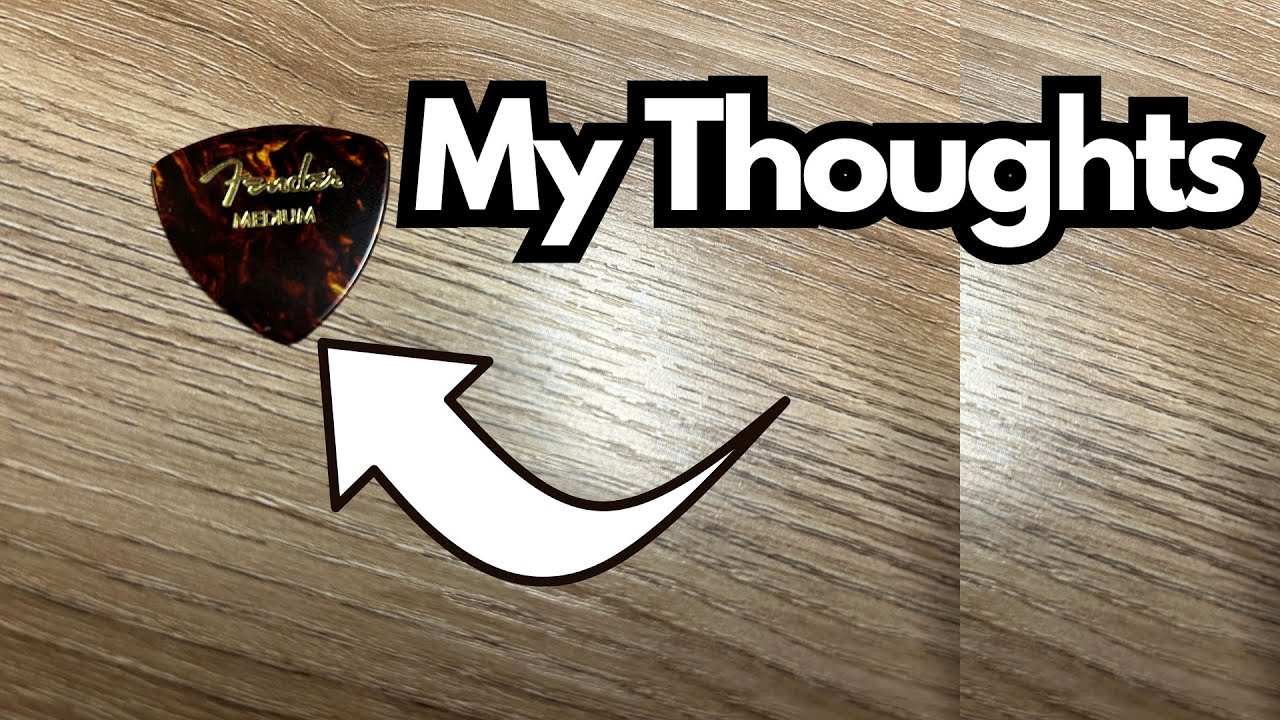
If you play guitar long enough, you eventually end up with a pile of picks from different brands, shapes, and thicknesses. Somewhere in that pile, there’s almost always a classic Fender pick. You can grab one here on Amazon if you’re interested.
This post takes a quick look at one of those: a large Fender pick that’s been around for a while in my collection, and how it stacks up—especially if you’re used to smaller, more precise plectrums like the Jazz III.
Overview / First Impressions
This particular Fender pick is one I’ve had for a long time but rarely reach for. It’s a fairly standard, larger-sized pick with a traditional shape and a nicely defined tip.
If you’ve ever tried the Ernie Ball classic-style picks, this Fender feels very similar—so similar, in fact, that it’s hard not to think Ernie Ball took some inspiration from Fender’s long-standing design.
For me, though, it’s just okay. It works, it’s functional, but it doesn’t really excite me the way a good Jazz III does.
Build Quality & Design
- Shape: Traditional teardrop, full-sized pick
- Tip: Nicely pointed tip that gives a bit more definition and attack than very rounded picks
- Size: Considerably larger than a Jazz III
- Material: Typical Fender-style plastic (celluloid or similar), with that familiar smooth feel
If you’re used to standard picks from starter packs or classic rock players, this will feel very familiar in the hand. The edges are smooth, and the tip is clean enough for articulate picking.
Features & Functions
From a guitarist’s perspective, here’s what this Fender pick brings to the table:
- Large surface area: Great if you like having more pick to hold onto. Players with bigger hands or those who feel “lost” with tiny picks might appreciate the extra real estate.
- Defined tip: The sharper tip gives you a bit more control over note attack compared to very rounded, floppy picks. It’s decent for both rhythm and lead playing.
- Versatility: Works fine for:
- Strumming open chords
- Basic rhythm work
- Light lead playing
It’s not a specialty pick; it’s more of a general-purpose, everyday option.
How It Sounds / Use Cases
Tone-wise, this Fender pick is pretty middle-of-the-road:
- Strumming: Good for acoustic or electric rhythm. The size and material give a familiar, classic pick sound—nothing extreme, no exaggerated brightness or dullness.
- Single-note lines: The pointed tip helps, but compared to a Jazz III, it feels less precise. If you’re into fast alternate picking, intricate lines, or tight metal riffing, you may find it a bit too big and “sloppy” feeling.
- Who it’s for:
- Players who like bigger picks and don’t get along with tiny Jazz-style picks
- Beginners who want something easy to hold onto
- Rhythm-focused players who don’t need ultra-precise tip control
As someone who prefers Jazz III picks, I find this Fender pick usable, but not inspiring. It does the job, but I don’t feel the same level of accuracy or connection to the strings.
Limitations / Things to Know
A few reasons this pick might not be ideal for everyone:
- Size vs. precision: The larger size can feel clumsy if you’re used to smaller picks. It’s harder to “choke up” on the tip for super-tight control.
- Not a shredder’s pick: If you’re into fast, articulate lead playing, sweep picking, or tight metal riffs, a smaller, stiffer pick (like a Jazz III) will likely feel much better.
- Nothing unique: It doesn’t really bring anything special to the table. It’s a solid, traditional pick—but if you already have a bunch of standard picks, this one doesn’t stand out.
Final Thoughts
This Fender pick is a classic, large-format plectrum with a decent tip and a familiar feel. It’s perfectly fine if you like bigger picks and mostly play rhythm or moderate lead lines.
For my own playing, I still gravitate toward Jazz III picks—they’re smaller, more precise, and feel more connected for the kind of detailed lead work I enjoy. Compared side by side, this Fender just feels a bit too big and generic.
That said, picks are incredibly personal. If you’ve only ever used small Jazz-style picks, it’s worth grabbing a larger Fender-style pick like this and seeing how it affects your grip, tone, and comfort. You might discover that a bigger pick actually suits your playing better.
Resources & Further Study
If you’re working on your playing and want something more substantial than just changing picks, here are a couple of useful resources:
- Fretboard Memorization Cheat Sheet – TravelingGuitarist.com
A handy reference that lays out all the major and minor triads in every key. It uses “octave mapping” and other techniques to help you:- Memorize the notes on the fretboard
- Understand the triad foundations of harmony
- Start improvising more confidently in multiple keys
- Traveling Guitarist Forum – forum.travelingguitarist.com
An online community where you can talk about guitar, music, gear (including picks), and more with other players.
Experiment with your picks, but don’t stop there—pair better gear choices with better fretboard knowledge, and your playing will move forward much faster.