

If you’ve played guitar for any length of time, you already know: cables are the unglamorous weak link in a rig. They’re not fun to buy, but a noisy or flaky cable will ruin a good tone faster than just about anything.
I recently needed a short, roughly 3-foot instrument cable to run from my amp’s effects loop to a small black box sitting on top of the amp. Nothing fancy—just a compact, reliable lead that I could plug in and forget about.
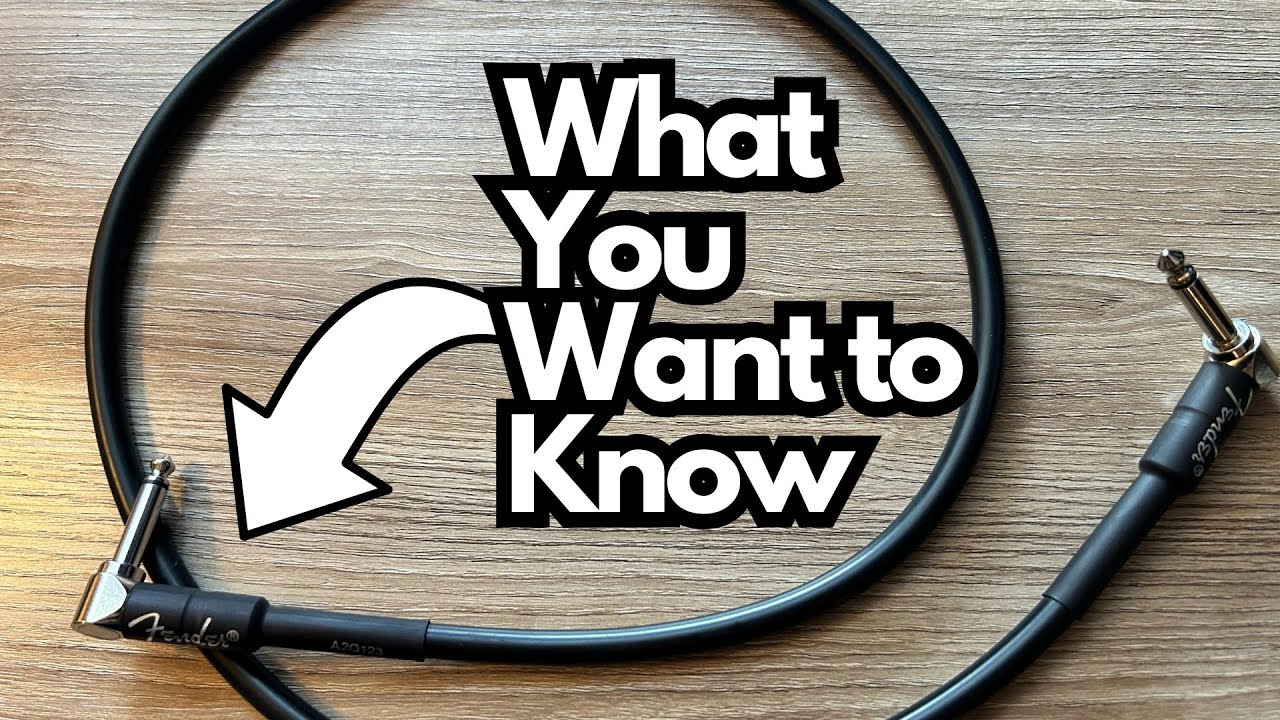
I ended up grabbing the Fender Professional Instrument Cable (on Amazon), and it turned out to be a lot better than I expected.
This post is for you if:
- You want a short, high-quality cable for an amp’s effects loop, pedalboard, or desktop setup.
- You’re tired of finicky, cheap cables that crackle, cut out, or fall apart.
- You want something “professional” that actually feels like it lives up to the label.
Overview / First Impressions
Fender calls this a “Professional Instrument Cable,” which usually makes me roll my eyes. Most cables are marketed as “pro” these days, even when they’re clearly budget builds.
But this one? It actually feels legit.
- The 3-foot length is perfect for short runs—especially between an amp and a device in the effects loop.
- It feels solid and confidence-inspiring right out of the box.
- There’s nothing flimsy, loose, or temperamental about it.
I liked it enough that I’ve already added another one to my cart for future use in the same role.
Build Quality & Design
The standout here is how sturdy and non-finicky the cable is.
- Connectors (jacks): The plugs feel solid and well-made—no wobble, no cheap metal, and no sense that they’ll loosen up after a few uses.
- Strain relief: The ends are reinforced properly so you’re not stressing the solder joints every time you plug in or move the cable.
- Cable feel: It has that “high-quality” feel in the hand—firm but not overly stiff, and not the kind of cable that’s going to kink itself into oblivion.
If you’ve dealt with cables that:
- randomly cut out,
- crackle when you move them,
- or just die way too early,
this feels like the opposite of that. It’s very much a plug-it-in-and-stop-worrying situation.
Features & Functions
While it’s “just” a cable, a few things about this one make it especially useful in a guitarist’s rig:
- Length: ~3 ft (short run)
Ideal for:- Amp effects loops
- Short connections between pedals
- Desktop interfaces and small setups
- Instrument-grade shielding
Designed for instrument-level signals, so it keeps noise down and tone intact. - Standard 1/4″ TS plugs
Works with:- Guitars and basses
- Pedals
- Amp inputs and effects loops
- Rack gear and small boxes that use standard instrument connections
Nothing exotic—just the right specs for everyday guitar work, with quality where it counts.
How It Sounds / Use Cases
Cables shouldn’t really have a “sound” if they’re doing their job right, and that’s the experience here: no tone suck, no added noise, no weirdness.
Where this cable shines:
- Effects loop connections
That’s my main use: running from the amp’s effects send/return to a small external box on top of the amp. The 3-foot length keeps everything tidy and avoids a spaghetti mess of extra cable. - Short pedalboard runs
If you’ve got a pedal or device that needs a slightly longer lead than a patch cable but shorter than a 10–15 ft cable, this length is a sweet spot. - Studio/practice rigs
Great for clean, short connections between:- An interface and a reamp box
- A desktop amp or modeler and another device
In all cases, the cable just works—no intermittent signal, no hum beyond what’s already in your signal chain, and no distractions.
Limitations / Things to Know
A few practical notes before you buy:
- It’s short by design
Around 3 feet is perfect for effects loops and close connections, but it’s not a main guitar-to-amp cable. You’ll still want a 10–20 ft lead for that. - Not a budget throwaway
It’s not the cheapest cable on the market. You’re paying for the build quality and reliability. If you just need a bunch of ultra-budget cables, this may feel like overkill. - No fancy gimmicks
No silent plugs, no right-angle on one end (depending on the exact model), no coiling—just a straightforward, well-made cable.
Final Thoughts
This Fender Professional Instrument Cable surprised me in a good way.
I went in skeptical of the “professional” label, expecting just another average lead with fancy marketing. Instead, I got a sturdy, reliable, no-drama cable that’s perfect for my amp’s effects loop and other short runs.
If you:
- need a compact cable for tight spaces,
- are tired of unreliable leads,
- and want something you can trust in a rig without babysitting it,
this one is absolutely worth considering. I’m happy enough with it that I’m already planning to grab another.
Resources & Further Study
If you’re looking to level up your playing while you’re dialing in your rig, here are a couple of helpful resources:
- Fretboard Memorization Cheat Sheet – TravelingGuitarist.com
A handy guide that lays out major and minor triads in every key, along with techniques like octave mapping to help you:- memorize the fretboard,
- understand harmony more deeply,
- and start improvising more confidently in multiple keys.
- Traveling Guitarist Forum – forum.travelingguitarist.com
A place to talk guitar, music, gear, and more with other players. Great if you want feedback, ideas, or just to hang out with fellow guitar nerds.