

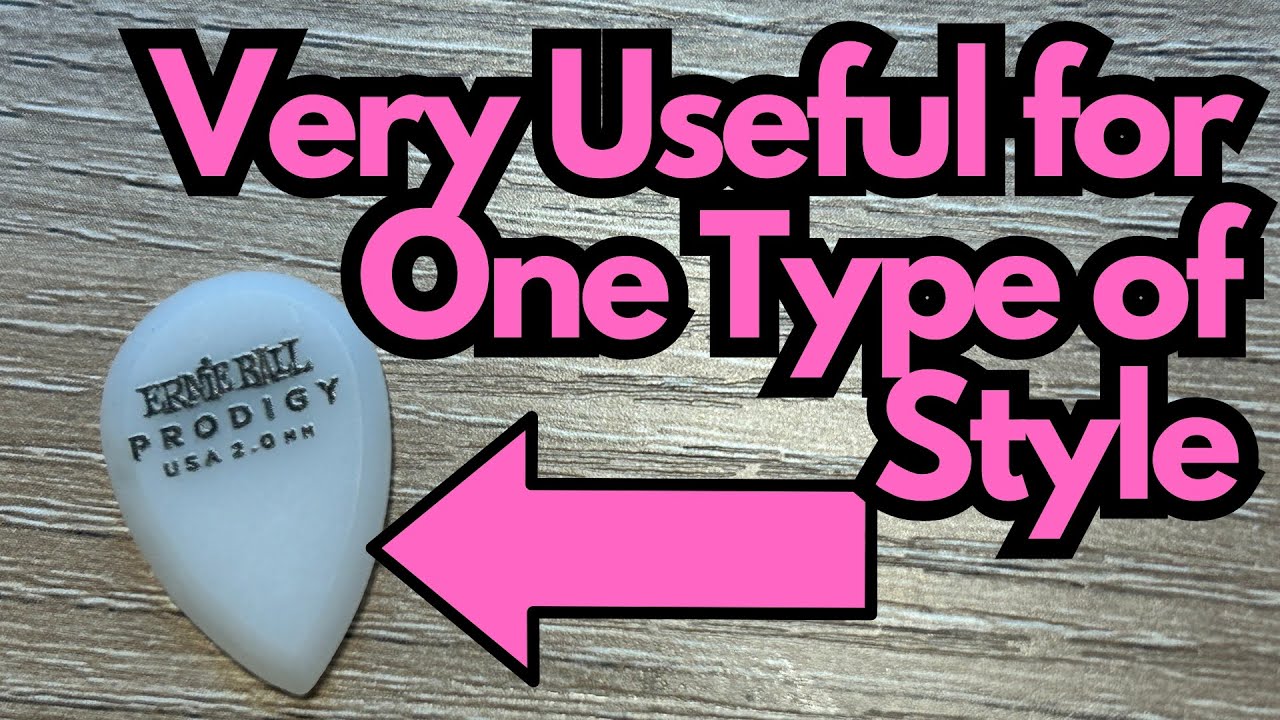
Picks like the Ernie Ball Prodigy series are probably on your radar if you’re serious as a guitar player and you’re looking for way to improve your technique. You can grab one of these on Amazon if you’re interested.
The Prodigy Teardrop in particular is designed for maximum precision and minimal bulk—especially appealing if you’re into hybrid picking or intricate lead work.
But is it a must-have, or more of a specialist tool that only suits certain players? Let’s dig in.
Overview / First Impressions
The Ernie Ball Prodigy Teardrop pick is a small, pointed plectrum aimed at players who want:
- Extremely precise attack
- Minimal pick surface getting in the way
- A shape that can work well for hybrid picking
Compared to a standard Jazz III–style pick (which many lead players already consider small and precise), the Prodigy Teardrop goes even further in that direction. It’s a more extreme form of a precision pick.
If you’re already comfortable with something like a Jazz III and want even less material between your fingers and the strings, this might be worth a look. If you like a bit more to hold onto, this may not be your favorite.
Build Quality & Design
Ernie Ball’s Prodigy line is known for:
- Sharp tip – Very defined point for articulate note attack
- Small footprint – Less surface area than a standard pick
- Thicker feel (depending on the gauge) – Stiffer response, less flex
- High-precision edges – Designed for clean string release
The Teardrop shape is essentially a minimalistic version of a traditional pick. It’s compact, with very little extra material beyond what you need to grip and strike the string. That’s the whole idea: reduce excess and keep things focused around the contact point.
Features & Playing Experience
From a player’s perspective, the key “features” of the Prodigy Teardrop are really about how it sits in your hand and interacts with the strings:
- Ultra-precise tip
Great for fast, accurate alternate picking and tight, articulated lines. Every note has a very defined attack. - Reduced “real estate” under your fingers
Because the pick is so small, it doesn’t occupy much space between your thumb and index finger. This can free up your middle, ring, and pinky fingers for hybrid picking. - Hybrid picking–friendly design
With less pick in the way, it’s easier to get your other fingers in position to pluck strings. That’s why many players recommend this shape specifically for hybrid picking. - High control at the cost of comfort (for some)
The trade-off is that some players will find it less comfortable or secure to hold, especially if they’re used to standard-size picks.
How It Sounds / Use Cases
Tone & Feel
Because of the sharp tip and stiffness, the Prodigy Teardrop tends to produce:
- A bright, clear attack
- Lots of definition on each note
- A tight, controlled feel with very little pick flex
This can be fantastic for:
- High-gain leads where you want every note to cut through
- Fast runs, arpeggios, and technical lines
- Clean, precise rhythm parts where timing and articulation are critical
Who It’s For
The Teardrop shape is especially suited to:
- Hybrid pickers who need room for their other fingers
- Lead players who love tiny, sharp picks and extreme precision
- Players with a very controlled picking hand who like minimal movement
If you’re already a fan of Jazz III–style picks and wish you had even less pick in your way, this could be right up your alley.
Limitations / Things to Know
From a practical guitarist’s perspective, there are some trade-offs:
- Not very forgiving
The sharp tip and small size punish sloppy technique. If your picking hand isn’t already tight, this pick won’t hide it. - Can feel too small
If you prefer the feel of a standard Jazz III (or larger), the Teardrop may feel cramped or insecure in your grip. - Niche appeal
For many players, the “standard” Jazz III shape already hits the sweet spot of precision and comfort. The Teardrop pushes further into more niche territory that not everyone needs.
Personally, I’d still reach for a standard Jazz III most of the time. It offers precision without feeling quite as extreme. The Prodigy Teardrop, for me, ends up being more of a specialty tool than a daily driver.
Final Thoughts
The Ernie Ball Prodigy Teardrop pick is a highly focused piece of gear. It’s built for precision, speed, and hybrid picking, with a design that removes anything unnecessary from under your fingers.
- If you’re a hybrid picker looking for maximum finger freedom and minimum pick bulk, this is worth trying.
- If you love tiny, sharp picks and want the most precise attack possible, it might become your new favorite.
- If you’re more comfortable with a standard Jazz III or larger picks, you may find the Teardrop too small and unforgiving.
As always with picks, it’s incredibly personal. The only real way to know is to grab a few and see how they feel in your own hand.
Resources & Further Study
If you’re working on your technique—especially hybrid picking, fretboard knowledge, and improvisation—here are a couple of helpful resources mentioned:
- Fretboard Memorization Cheat Sheet – Available at TravelingGuitarist.com, this cheat sheet lays out major and minor triads in every key. It uses octave mapping and other approaches to help you:
- Memorize the notes on the fretboard
- Understand the triads that form the foundation of harmony
- Start improvising more confidently in multiple keys
- Traveling Guitarist Forum – At forum.travelingguitarist.com, you can connect with other players, talk guitar, music, gear, and share ideas about practice and technique.
If you’re experimenting with more precise picks like the Prodigy Teardrop, pairing that with better fretboard knowledge and harmonic understanding is a powerful combo.