

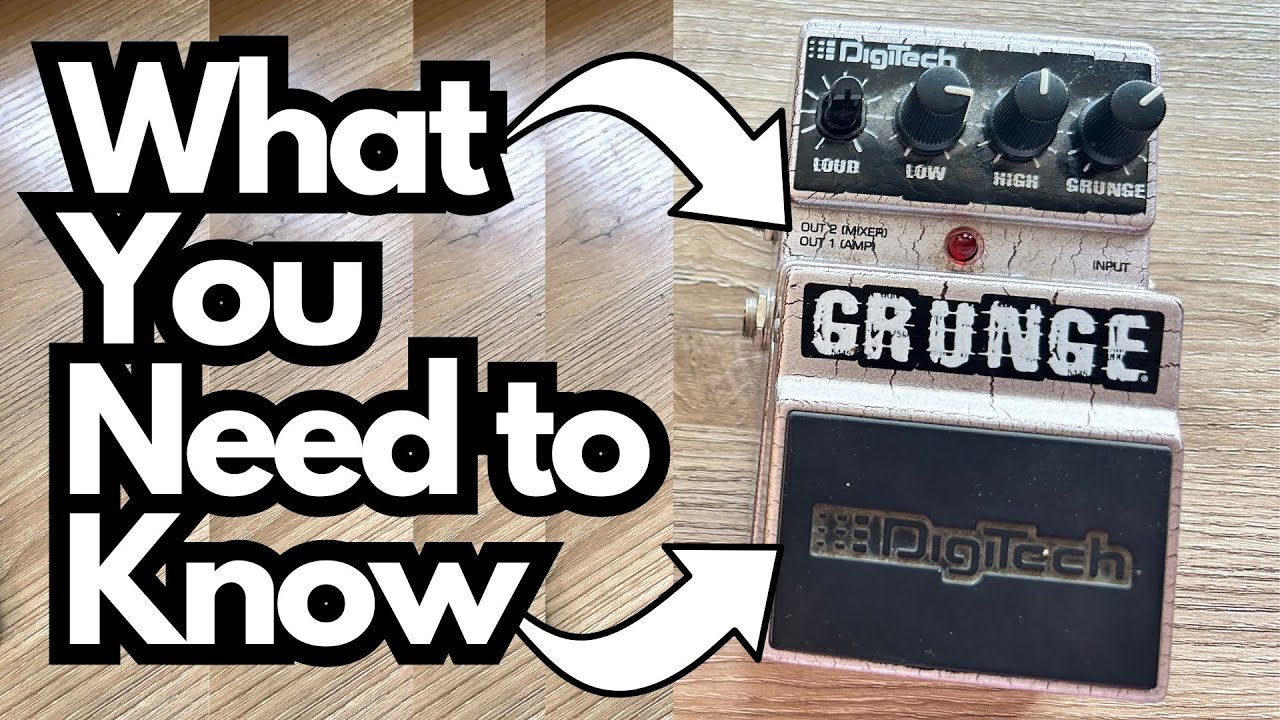
If you’ve spent any time digging through used pedal bins or old gig bags, you’ve probably seen the DOD Grunge pedal. It’s one of those infamous 90s boxes that looks like it should turn your tone into a flannel-soaked wall of noise. You can grab one here on Amazon.
But what does it actually do? And is it still worth plugging in today?
This post walks through real-world impressions of the DOD Grunge from a guitarist’s perspective: what it does well, where it struggles, and who might still get some use out of it.
Overview / First Impressions
The DOD Grunge is often assumed to be a “grunge-in-a-box” pedal, but in practice it behaves more like a heavy metal distortion. Even with the “Grunge” (gain) control set quite low, you’re dealing with a lot of saturation.
When I first got this pedal—about 15–20 years ago—I remember liking it but never quite managing to dial in a tone I truly loved. That’s still the core experience today: it can sound cool, but it’s finicky and not especially easy to tame.
If you’re into aggressive, scooped, high-gain sounds and don’t mind wrestling with a pedal a bit, the DOD Grunge might still have a place on your board. If you want smooth, responsive, amp-like drive, this probably isn’t it.
Build Quality & Design
The DOD Grunge is built in that classic DOD style:
- Sturdy enclosure – Solid metal housing that can take a beating.
- Top panel controls – Standard knob layout for gain and EQ.
- Battery access – It does take a 9V battery. To open it, you typically have to push on the small posts with a pen to pop off the bottom plate and get to the battery compartment.
It’s not the most user-friendly design for quick battery changes, but once you know the trick, it’s manageable. As with most older DOD pedals, it feels rugged enough for live use.
Aesthetically, it’s very “of its era”: bold graphics, not exactly subtle, and it looks like it’s going to rip your face off. In that sense, it delivers on the promise.
Features & Functions
The controls are simple but surprisingly touchy:
- Grunge (Gain/Distortion)
This is the main distortion control. Even turned way down, the pedal is still heavily saturated. There’s not much of a “mild overdrive” zone here—it’s basically always in high-gain territory. - Low (Bass EQ)
This control has a lot of range. Small adjustments can drastically change the sound. It’s easy to overdo it and end up with a flubby, boomy tone, especially with humbuckers or already-bassy amps. - High (Treble EQ)
The High control is also very sensitive. A little too far clockwise and things can get harsh or fizzy. It’s one of those knobs where less is usually more.
Overall, the EQ feels extreme rather than subtle. Tiny movements can make big differences, and the sweet spot is fairly narrow.
How It Sounds / Use Cases
From a guitarist’s perspective, here’s what the DOD Grunge really gives you:
- High-gain, aggressive distortion – Think more in the realm of heavy metal than classic “grunge” tones. It’s saturated, compressed, and unapologetically dirty.
- Best with conservative settings – Surprisingly, the pedal often sounds better with the controls set lower rather than cranked. Keeping the Low and High near the middle or slightly below can help avoid mud and fizz.
- Works for riffing and chunky parts – For big, heavy riffs or palm-muted power chords, it can sound decent if you spend time dialing it in.
- Less ideal for dynamic playing – If you rely on pick dynamics or volume-knob cleanup, this pedal isn’t particularly responsive in that way. It’s more of a “set it and smash power chords” kind of box.
In short, it can sound “all right” for heavier styles if you’re patient with the EQ, but it’s rarely subtle, and it’s not a versatile, do-everything distortion.
Limitations / Things to Know
A few practical points to consider before hunting one down:
- Hard to dial in
The biggest downside is how touchy the controls are. You can spend a lot of time twisting knobs and still feel like you’re not quite getting “that” tone. - Limited gain control range
Even with the Grunge (gain) set low, you’re already deep into distortion. If you’re looking for crunch or edge-of-breakup, this pedal won’t really go there. - EQ can get out of hand
The Low and High controls are powerful but not subtle. It’s very easy to end up with too much low-end woof or brittle top-end. - Not broken… just quirky
It’s easy to think something’s wrong with the pedal because the gain and EQ are so extreme. But that’s largely just how it’s voiced.
On the plus side:
- Surprisingly low noise
For a high-gain pedal—especially one from this era—it’s not as noisy as you might expect. That’s one of its genuine strengths. - Battery power option
You can run it on a 9V battery if you don’t want to rely on a power supply, which is handy for grab-and-go setups.
Final Thoughts
The DOD Grunge is not a refined, modern, amp-like distortion. It’s a loud, somewhat unruly, very 90s-sounding high-gain pedal with a narrow sweet spot and touchy controls.
For my own taste, it’s definitely not my favorite distortion pedal. I find it a bit frustrating to dial in, and I’d rather reach for something more flexible and responsive.
That said, if you:
- Like aggressive, saturated tones,
- Enjoy experimenting with characterful, slightly odd pedals,
- Or want that specific “compressed, scooped 90s” vibe,
then the DOD Grunge might still be worth a look—especially if you stumble on one cheap in the used market.
Just go in knowing you’ll probably spend more time tweaking than playing for the first while.
Resources & Further Study
If you’re looking to improve your playing and make better musical use of whatever distortion you’re running, check these out:
- Fretboard Memorization Cheat Sheet – TravelingGuitarist.com
A practical guide to major and minor triads in every key, mapped across the neck. It’s built around “octave mapping” and related techniques to help you:- Memorize the notes on the fretboard
- Understand triads as the foundation of chords and harmony
- Start improvising more confidently in multiple keys
- Traveling Guitarist Forum – forum.travelingguitarist.com
A place to talk guitar, music, and related topics with other players. Great if you want feedback on tones, practice ideas, or general guitar chat.