

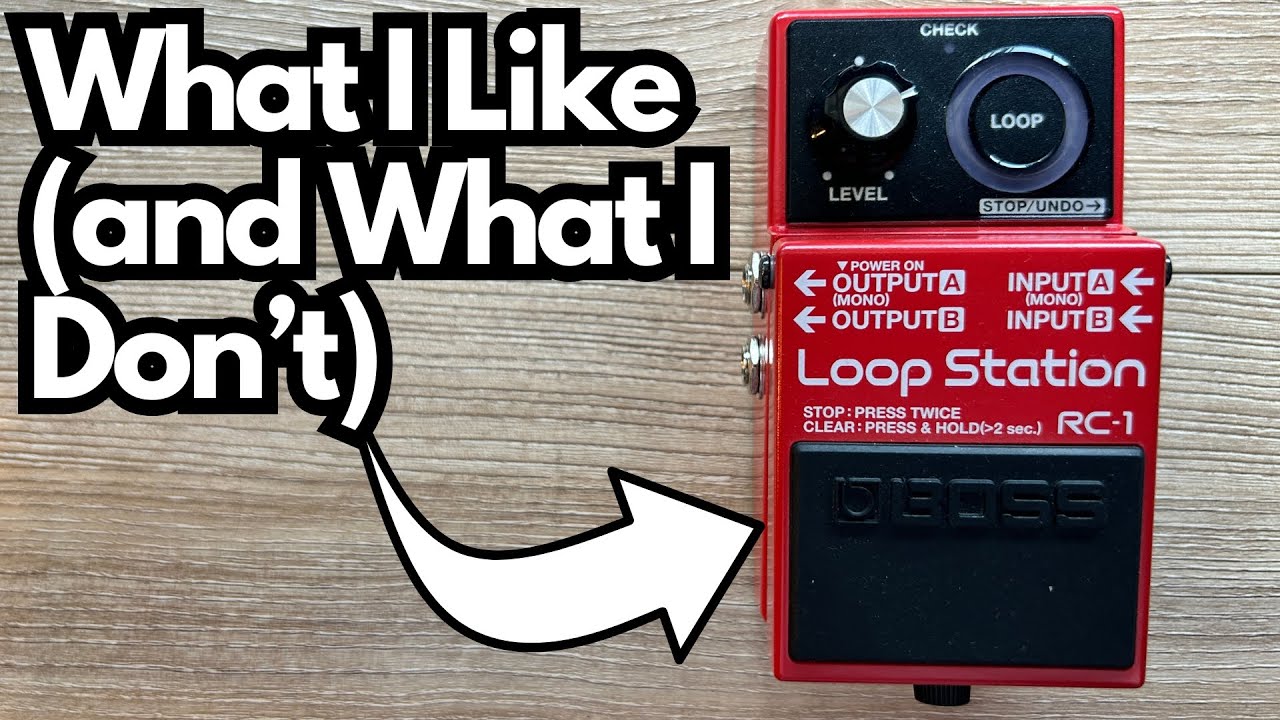
If you’ve been around guitar pedals for more than five minutes, you’ve seen this one.
The Boss RC-1 Loop Station (on Amazon) is arguably the most popular looper pedal ever made—and for good reason. It’s simple, robust, and does exactly what most players need a looper to do without getting in the way.
If you’re just getting into looping, practicing solo, or wanting a no-fuss way to build layers at home or on stage, the RC-1 is one of the easiest places to start.
Overview / First Impressions
The RC-1 is a straightforward, single-footswitch looper that focuses on the essentials:
- Record
- Playback
- Overdub
- Simple loop control via one switch
- Visual loop indicator
- Battery or power supply operation
There’s no screen, no menus, and no deep editing. That’s the point. This pedal is for guitarists who want to hit a switch, lay down a loop, stack a few layers, and play.
If you eventually want more advanced features—like memory slots, drum patterns, or USB connectivity—the RC-5 is a logical upgrade. But as an introduction to looping, the RC-1 is rock solid.
Build Quality & Design
Like most Boss pedals, the RC-1 is built like a tank:
- Standard Boss enclosure – Sturdy metal housing, familiar footprint, and the classic Boss footswitch design.
- Thumbscrew battery access – You can open the pedal by loosening the thumbscrew at the front to access the 9V battery compartment.
- Clear loop indicator – The circular LED display shows you what the loop is doing (recording, playing, overdubbing) and where you are in the loop cycle.
It’s designed to be thrown on a board, kicked repeatedly, and still work night after night. From a gigging guitarist’s perspective, it’s exactly what you’d expect from Boss.
Features & Functions
The RC-1 keeps things minimal but practical.
Core Functions
- Record – Start capturing your loop.
- Playback – Hear your recorded loop.
- Overdub – Layer new parts on top of your existing loop.
You can also change the order of functions to suit how you like to work, for example:
- Record → Playback → Overdub
- Record → Overdub → Playback
This might seem like a small detail, but it affects how the pedal responds to your footswitch presses, and that can make a big difference in how natural it feels when you’re performing.
Loop Control with One Footswitch
Everything is done with that single Boss-style switch:
- Start recording – Press once.
- Start playback – Press once again (depending on mode).
- Start overdub – Usually a second press after playback, or a double-tap depending on your chosen mode.
- Pause/stop loop – Double-tap.
- Delete last overdub – Specific tap/hold combinations let you remove only the overdub layer.
- Delete entire loop – Press and hold the switch to clear everything and start fresh.
Once you get used to the tap/hold behavior, it becomes second nature.
Level Control
The Level knob controls the playback volume of your loop, not your dry guitar signal. This is crucial for:
- Balancing your loop against your live playing
- Keeping rhythm parts slightly under your lead
- Preventing the loop from overpowering your tone in a band mix
Power Options
- 9V battery – Boss rates it at roughly 6–8 hours of use. The LED loop indicator draws a fair amount of power, so battery life isn’t huge.
- 9V DC adapter – Strongly recommended if you’re using it regularly or on a pedalboard.
For most guitarists, running it on a standard 9V center-negative power supply is the way to go.
How It Sounds / Use Cases
The RC-1 is designed to be transparent. It doesn’t color your tone in any obvious way; it simply records and plays back what you put into it.
Practical Uses for Guitarists
- Practice tool
- Loop a chord progression and practice scales, arpeggios, or phrasing over it.
- Work on timing and groove by layering rhythm parts.
- Songwriting
- Build up ideas quickly—bass line, chords, melody—without opening a DAW.
- Experiment with harmonies and arrangements on the fly.
- Live performance
- Create simple backing loops for solo sets.
- Add texture with subtle ambient overdubs.
Because it’s so simple, you spend less time thinking about how to work the pedal and more time actually playing.
Limitations / Things to Know
The RC-1’s strengths are also its limitations. A few things to keep in mind:
- No memory slots – Once you clear a loop, it’s gone. You can’t save loops for later like on higher-end loopers.
- No drum patterns or rhythm tracks – It’s just you and your loop. If you want integrated drums, you’ll need something more advanced.
- Single footswitch control – Everything happens from one switch. It’s efficient once learned, but not as flexible as multi-switch loopers.
- Battery life is limited – 6–8 hours is fine for casual use, but if you’re gigging or practicing a lot, use a DC adapter.
If you know you’ll eventually want built-in drums, multiple loop tracks, or memory banks, you might skip straight to something like the Boss RC-5. But if all you need is a clean, reliable looper for basic work, the RC-1 is more than enough.
Final Thoughts
The Boss RC-1 Loop Station has become a modern classic because it nails the basics:
- Easy to use
- Built to last
- Tonally transparent
- Perfect for learning how to loop
For guitarists who are new to looping or just want a simple, dependable pedal that “just works,” the RC-1 is one of the best starting points on the market. Once you outgrow it, Boss’s own RC-5 is a natural step up—but you may find the RC-1 covers more of your needs than you expect.
Resources & Further Study
If you’re using a looper to improve your playing, especially your fretboard knowledge and improvisation, structured material can help a lot. One useful resource mentioned is:
- Fretboard Memorization Cheat Sheet – Available at travelingguitarist.com
- Major and minor triads in every key
- Octave mapping and other visualization techniques
- Using triads as the foundation of harmony and improvisation
There’s also a forum at forum.travelingguitarist.com, where you can talk with other players about guitar, music, and related topics—handy if you’re sharing loop ideas, practice routines, or gear setups.
Using a simple looper like the RC-1 together with solid fretboard and harmony knowledge is one of the fastest ways to level up your rhythm, timing, and melodic playing.