

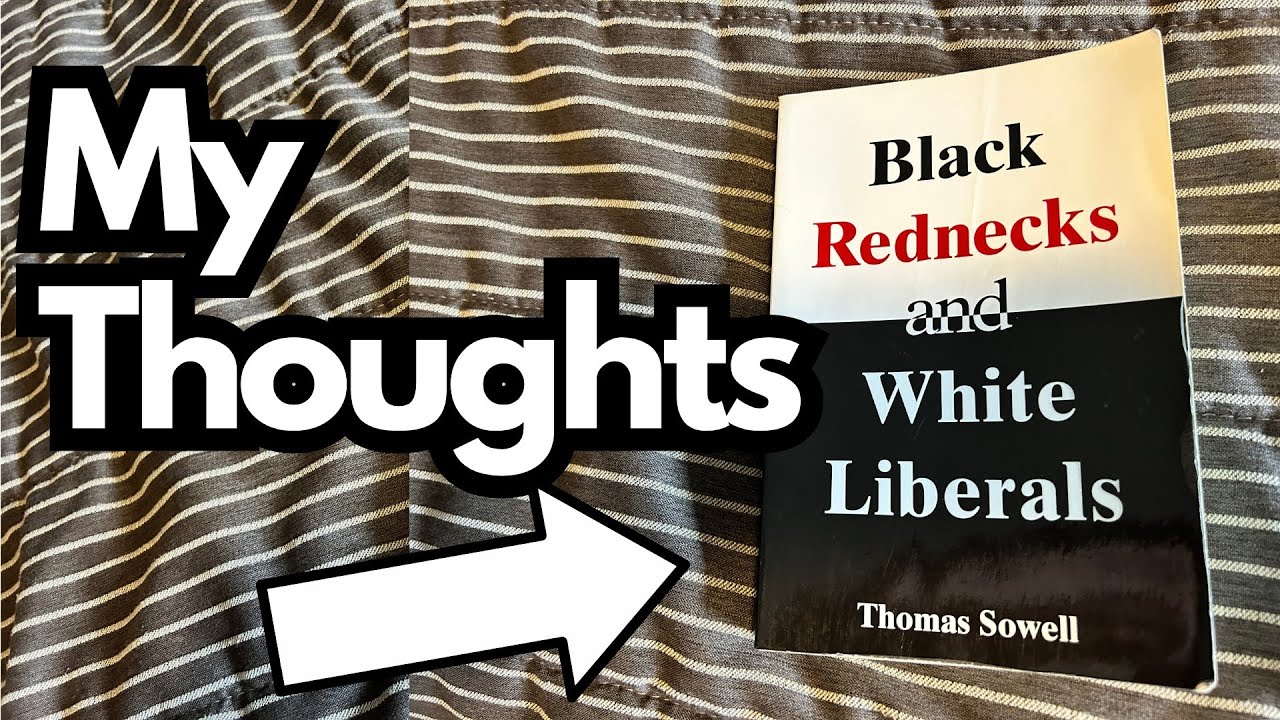
If you’re interested in how race, culture, class, and politics intersect in the United States, Thomas Sowell’s Black Rednecks and White Liberals is one of those books that sticks with you long after you’ve put it down.
It’s part history, part economics, part sociology, and all framed through Sowell’s trademark clarity and willingness to challenge popular narratives. This isn’t light reading in terms of ideas, but it’s very readable—and it can be genuinely eye-opening.
You can grab it here on Amazon if you’re interested.
Overview / First Impressions
Black Rednecks and White Liberals is a collection of essays rather than a single, linear argument, but there’s a central theme running through it: culture matters more than most people want to admit, and a lot of what we treat as “racial” issues are actually cultural, historical, and economic in origin.
For readers who have already spent time with Sowell—especially his book Intellectuals and Society—this feels like a natural next step. It digs deeper into how intellectuals, policymakers, and activists often talk about race and inequality, and how those conversations can be wildly disconnected from historical reality.
This book is:
- Great for readers who like data-backed arguments and historical context
- Challenging if you’re attached to mainstream narratives about race and class
- Written in accessible prose, even when the ideas are dense
Book Format & Readability
While this isn’t “gear” in the physical sense, it’s worth touching on how the book is put together from a reader’s perspective:
- Essay-based structure – You can read it straight through or tackle it one essay at a time. Each chapter stands reasonably well on its own.
- Dense but clear – Sowell doesn’t waste words. There’s a lot of information per page, but the language is straightforward.
- Heavily historical – Expect discussions of the American South, European migration patterns, slavery, and cultural transmission across centuries.
It’s not a casual, one-evening read, but it’s approachable if you’re willing to think and occasionally reread a paragraph or two.
Features & Core Ideas
While the book covers several topics, the title essay, “Black Rednecks and White Liberals,” lays out some of Sowell’s most striking claims.
1. The “Black Redneck” Culture
Sowell argues that what many people think of as “black ghetto culture” did not originate in Africa or uniquely within Black American communities. Instead, he traces many of its traits—speech patterns, attitudes toward education, violence, family structure, and honor culture—to the “cracker” or redneck culture of white immigrants from the border regions of Britain (Scots-Irish, in particular) who settled in the American South.
According to Sowell:
- This Southern white subculture was:
- Suspicious of formal education
- Prone to violence and honor-based disputes
- Marked by certain speech patterns and social habits
- Enslaved Black people, living in close proximity to this culture, absorbed many of its traits over generations.
The controversial implication: what’s often framed as “authentically Black” in some modern contexts may actually be inherited from a specific white subculture of the rural South.
2. White Liberals’ Role
The “white liberals” in the title are not just people with progressive politics, but a broader set of intellectuals, policymakers, and activists who, in Sowell’s view:
- Romanticize or excuse dysfunctional cultural traits as “authentic”
- Lower standards and expectations in the name of compassion
- Promote policies that inadvertently trap people in cycles of poverty and dependency
Instead of encouraging cultural change—toward habits that historically correlate with upward mobility (education, work ethic, family stability)—they often defend the very behaviors that hold people back, framing criticism as racism or betrayal.
3. Culture vs. Race
A key takeaway: Sowell pushes hard against the idea that disparities must be explained by race or racism alone. He emphasizes:
- Historical variation – Different groups rise and fall in different times and places.
- Cultural transmission – Behaviors and attitudes can cross racial lines and persist long after their original context disappears.
- Policy consequences – Misdiagnosing cultural problems as purely racial leads to policies that don’t work, or make things worse.
Who The Book Is For
Think of this book as a powerful lens rather than a casual opinion piece. It’s most useful if you:
- Care about policy and social debates – education, crime, welfare, affirmative action, and inequality all look different after engaging with Sowell’s arguments.
- Enjoy having your assumptions challenged – whether you lean left, right, or somewhere in between, there’s likely something in here that will unsettle you.
- Like history with teeth – the book doesn’t just recount events; it uses them to cut through modern rhetoric.
You’ll get the most out of it if you’re willing to:
- Sit with uncomfortable ideas
- Separate emotion from analysis
- Follow historical arguments across centuries and continents
Limitations / Things to Know
A few caveats before diving in:
- It’s been influential—but also controversial
Sowell’s framing of culture and race goes against much of mainstream academic and media discourse. Some readers will find it refreshing; others may find it provocative or even infuriating. - The arguments are complex
This isn’t a quick summary kind of book. Remembering every detail years later is tough because there’s a lot going on—data, history, and theory all woven together. - Not a beginner’s intro to race studies
If your only exposure to discussions of race is surface-level media discourse, this might feel like being thrown into the deep end. That said, it’s still very readable if you’re patient. - You need to read it yourself
No quick recap really does justice to the nuance. Sowell builds his case step by step; cherry-picked lines don’t capture the full picture.
Final Thoughts
Black Rednecks and White Liberals is one of those books that can permanently change how you think about race, culture, and class in America. Even if you don’t agree with everything Sowell says—and you don’t have to—it’s hard to walk away without feeling like your mental model of history and society has been sharpened.
If you’ve read Intellectuals and Society and appreciated Sowell’s ability to cut through comforting illusions, this is absolutely worth your time. It’s challenging, sometimes uncomfortable, but deeply impactful.