

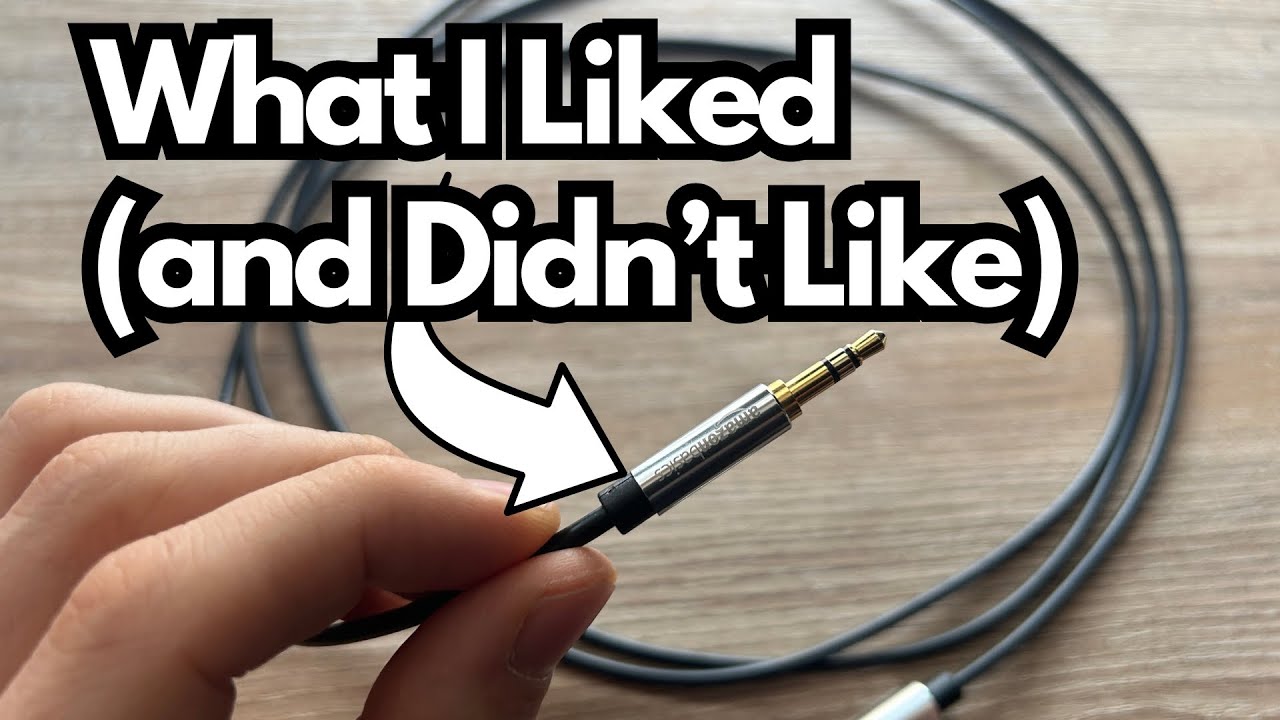
You’re in your chair with a guitar in hand, interface on the desk, amp sim running, backing track ready—and then your headphone cable doesn’t quite reach. Suddenly you’re leaning forward, locked into this awkward half-hunch just to hear what you’re playing.
That’s where a good, reliable headphone extension cable like this one becomes way more important than it looks on paper.
Overview / First Impressions
This is a straightforward headphone extension cable that I use primarily with a headphone splitter in my recording setup.
The goal is simple:
- Give me enough length so I can sit comfortably with a guitar in my chair
- Stay out of the way
- Not cut out, crackle, or act weird
And on those fronts, it does its job really well. I’ve been using it for close to a year and it has been:
- Stable
- Noise-free
- Reliable under regular use
There’s nothing “boutique” or flashy about it, but for day‑to‑day guitar recording and practice, it just works.
Build Quality & Design
Here’s where my one real gripe comes in: the cable is not braided.
Personally, I prefer braided cables for a few reasons:
- Durability – Braided jackets usually handle bending, twisting, and occasional foot traffic better.
- Tangle resistance – They’re less likely to knot up when you’re moving around a lot with a guitar.
- Feel – Braided cables often feel a bit more “premium” and confidence-inspiring.
This cable, by contrast, uses a standard rubber/plastic jacket. That’s not inherently bad—it’s pretty typical—but if I could redesign it for studio and guitar use, I’d go braided.
That said, despite not being braided:
- It hasn’t frayed
- The connectors haven’t loosened
- There’s been no intermittent crackling or signal loss
So while it doesn’t feel as tough as a braided option, it has held up surprisingly well over a year of normal use.
Features & Functions
Functionally, it’s as simple as it gets: a long headphone extension cable.
Here’s how I use it in a guitar context:
- Into a headphone splitter – I run it from a splitter so multiple people can monitor, or so I can position myself wherever I want in the room.
- Extra reach from the interface – It gives me enough slack to:
- Sit comfortably with the guitar
- Move a bit while tracking
- Avoid yanking on the interface or headphone jack
Key Functional Points
- Length – Long enough to bridge the gap between your desk/interface and your playing position in a chair.
- Stable connection – No random cutouts, no weird noise, no drop in signal quality.
- Plug-and-play – No adapters or special configuration needed if you’re already using standard headphone outputs and splitters.
For guitar players recording at home, it’s essentially a “set and forget” utility cable.
How It Sounds / Use Cases
With a cable like this, “tone” really comes down to whether it introduces noise, hum, or crackling.
In my use with guitar:
- No noticeable loss in audio quality – Monitoring feels the same as plugging straight into the interface.
- No added noise – No hiss or hum introduced by the cable itself.
- Consistent stereo image – Panning, effects, and amp sim details all translate clearly.
Practical Guitar Use Cases
- Home recording – Track guitar while sitting comfortably away from your desk.
- Re-amping and tweaking tones – Move around the room while listening closely to amp sims, IRs, or mic positions (if you’re using a real cab).
- Teaching or collaborating – Use it with a headphone splitter so you and another guitarist can both listen to the same mix.
- Late-night practice – Keep your interface or modeller in one place and roam a bit with your guitar without dragging your rig off the table.
It’s not a tone-shaping tool—it’s a comfort and workflow tool. But that comfort directly affects how long and how well you play.
Limitations / Things to Know
A few things to keep in mind:
- Not braided – If you’re rough on cables, travel a lot, or stomp on your lines frequently, you might want a braided version for extra durability.
- Cable management still matters – Because it’s a long cable, you’ll want to:
- Route it around your chair legs
- Keep it away from where you rest your feet
- Avoid tight kinks when storing it
Even though it’s been solid for me, treating it decently will go a long way toward making it last.
Final Thoughts
This headphone extension cable is one of those unglamorous pieces of gear that quietly makes everything better.
For guitarists:
- It lets you sit where you actually want to sit.
- It keeps your interface and splitter safe from accidental tugs.
- It delivers clean, consistent monitoring without fuss.
Would I prefer a braided version? Yes.
Has the non-braided design actually caused problems so far? No.
After close to a year of use, it still does exactly what I need: it works, every time, without getting in the way of playing guitar.