

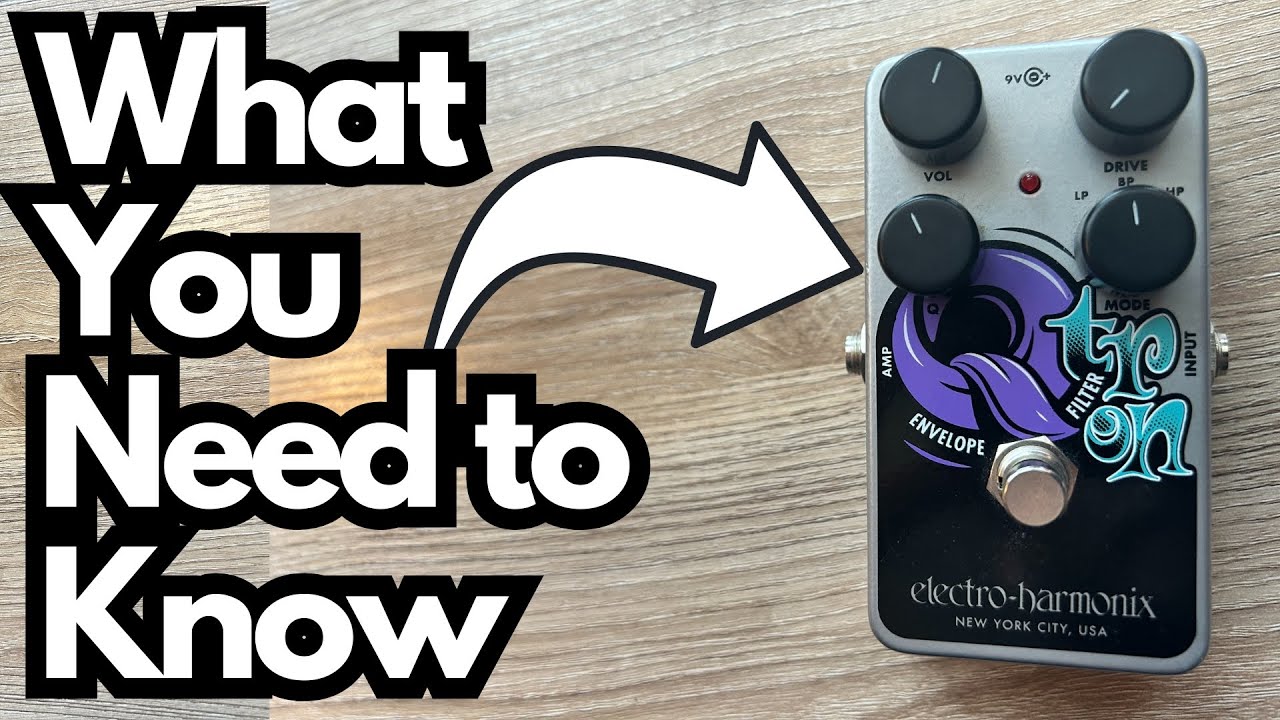
Envelope filters are one of those effects that can instantly turn a plain guitar part into something funky, vocal, and alive.
If you’ve ever loved auto‑wah tones on classic funk or jam band records, that’s exactly what this kind of pedal is doing. If you’re interested, you can grab one here on Amazon.
This post walks through how a typical envelope filter pedal works—specifically one with low‑pass, band‑pass, and high‑pass modes, plus controls like volume, Q, and drive.
If you’re a guitarist curious about auto‑wah sounds or just picked up an envelope filter and aren’t quite “getting it” yet, this will help you dial it in.
Overview / First Impressions
An envelope filter is essentially an automatic wah pedal.
Instead of rocking a treadle back and forth with your foot, the pedal uses your picking dynamics—how hard or soft you play—to sweep a filter across your signal. Play harder and the filter opens up; play softer and it closes down. The result is a vocal, quacky, funky tone that responds to your touch.
This particular pedal offers:
- Three filter modes: Low Pass, Band Pass, High Pass
- Volume control (a useful upgrade over some older versions)
- Q control to shape the intensity and range of the filter
- Drive (or sensitivity) to control how easily the filter is triggered
- Top‑mounted power jack and rear battery access
It’s simple on paper, but there is a bit of a learning curve—especially around how your picking and pickup volume interact with the drive control.
Build Quality & Design
From a guitarist’s standpoint, the design is straightforward and gig‑friendly:
- Top‑mounted power jack: Keeps your board tidy and makes it easier to fit into tight pedalboard layouts.
- Battery option: You can power it with a battery by removing the screws on the back plate—handy if you don’t always use a power supply.
- Dedicated volume control: A practical improvement over older versions that didn’t have an output level. It lets you match (or boost) your level when the effect is engaged so you don’t disappear in the mix.
Overall, it’s built to live on a pedalboard and be stomped on regularly, with controls that make sense once you understand what they’re doing.
Features & Functions
Let’s break down the main controls and modes from a guitarist’s perspective.
Filter Modes: Low Pass, Band Pass, High Pass
These modes determine which part of your frequency range gets emphasized when the filter sweeps.
- Low Pass
Focuses on lower frequencies.
The tone comes across as rounder and deeper.
Great for thicker, more subtle funk tones or bassier guitar parts. - Band Pass
Essentially a mid‑pass filter.
Emphasizes the midrange frequencies.
Often the most “classic” envelope filter sound—quacky, vocal mids that cut through a mix. - High Pass
Emphasizes the high frequencies.
Brighter, sharper, and more cutting.
Can be great for rhythmic, percussive funk parts or single‑note lines that need to sit on top of a dense arrangement.
Switching between these modes changes the character of the effect more than anything else. Low pass feels thicker, band pass feels balanced and funky, and high pass feels sharp and sizzly.
Volume
- Acts as an output level control.
- Lets you compensate for any perceived volume drop or bump when the effect is on.
- You can also use it to push the front of your amp or another pedal slightly harder if you want a little more presence or grit with the envelope engaged.
Q (Filter Range / Intensity)
The Q control adjusts how wide and how pronounced the filter sweep is.
- Higher Q
The filter affects a wider or more focused range of frequencies with more intensity.
The effect becomes more pronounced, more “vocal,” and more obvious. - Lower Q
The filter is subtler and affects fewer frequencies.
The envelope becomes more of a gentle movement rather than a dramatic “wah” sweep.
In practice, turning the Q up gives you that exaggerated, funky “wow” sound; turning it down keeps things more tasteful and supportive.
Drive (Sensitivity)
This is one of the most important controls on an envelope filter.
- Drive adjusts the sensitivity of the filter to your playing dynamics.
- It determines how hard you have to pick to trigger the filter sweep.
Here’s how it behaves:
- Low Drive setting
You have to pick quite hard to get the filter to open up.
Light picking might not trigger the effect much at all. - Higher Drive setting
The filter responds more easily.
Even moderate picking will trigger a noticeable sweep.
Around halfway is often a good starting point for most guitars.
This is where your pickup volume comes into play.
How Pickup Volume Affects the Pedal
One of the trickiest parts of using an envelope filter is understanding how your guitar’s output interacts with the drive or sensitivity control.
There’s an inverse relationship between your pickup volume and the pedal’s drive:
- If your pickup volume is high (full up or using hot pickups), you can usually run the Drive lower, because the pedal is already getting a strong signal.
- If your pickup volume is turned down or you’re using lower‑output pickups, you’ll need to increase the Drive to keep the filter responsive and easy to trigger.
If you find the pedal feels “dead” or unresponsive, check two things:
- Is your guitar volume rolled down more than you realized?
- Is the Drive set too low for how hard you’re actually picking?
Once you get that relationship dialed in, the pedal starts to feel much more musical and interactive.
How It Sounds / Use Cases
Envelope filters shine in a few classic scenarios.
Funk Rhythm & Single‑Note Lines
Band Pass mode with moderate Q and medium Drive is ideal for:
- 16th‑note funk strumming
- Nile Rodgers‑style chord chops
- Syncopated single‑note riffs
The filter responds to your dynamics, so you can “play” the effect by digging in or backing off.
Bright, Cutting Leads
High Pass mode with a higher Q can give you:
- Sharp, glassy, vocal lead tones
- Percussive lines that sit on top of a mix
This works especially well when paired with a transparent overdrive like a JHS Morning Glory in front of it or after it, adding a bit of grit without losing articulation.
Thick, Subtle Movement
Low Pass mode is great for:
- Warmer, darker grooves
- More subtle, synth‑like movement on the low strings
This can be cool for jammy, psychedelic textures or backing parts that move without being too in‑your‑face.
Stacking With Overdrive
The pedal pairs nicely with drives like the JHS Morning Glory:
- Put the envelope filter before the drive for a more natural, touch‑sensitive funk tone.
- Put it after the drive for a more pronounced, almost synth‑like sweep, as the filter reacts to the already‑compressed signal.
Experiment with both positions to see which feels better under your fingers.
Limitations / Things to Know
Envelope filters are powerful, but there are a few points to keep in mind:
- Learning Curve
It’s not a simple “set and forget” pedal. You need to balance:
Once you understand how these interact, it becomes much more intuitive. - Dynamics Matter
If you’re used to playing with a very light touch or with your guitar volume rolled down, the filter might not trigger the way you expect until you adjust the Drive. - Style‑Dependent
This is a very “effect‑y” effect. It’s incredible for funk, jam, fusion, and experimental tones, but it might be overkill if you mostly play straight rock or metal and rarely use clean or semi‑clean tones.
Final Thoughts
This envelope filter pedal is:
- Fun – It makes you want to play and experiment.
- Expressive – It reacts to your hands and your volume knob in a very musical way.
- Flexible – Low pass, band pass, and high pass modes cover everything from thick, chewy funk to sharp, cutting lead tones.
The addition of a volume control is a practical upgrade, and the Q and Drive knobs give you plenty of tone‑shaping power.
If you’re willing to spend a little time learning how your picking dynamics and guitar volume interact with the drive, this kind of pedal can open up a whole new side of your playing.
Resources & Further Study
If you want to get more out of effects like this—and your fretboard in general—there’s a helpful resource mentioned:
- Fretboard Memorization Cheat Sheet – TravelingGuitarist.com
A guide to major and minor triads in every key, using approaches like octave mapping to help you:
You can also join the community forum:
- Traveling Guitarist Forum – forum.travelingguitarist.com
A place to talk guitar, music, gear, and related topics with other players.
Pairing a solid understanding of harmony with expressive tools like an envelope filter is a powerful way to level up both your tone and your musicality.