

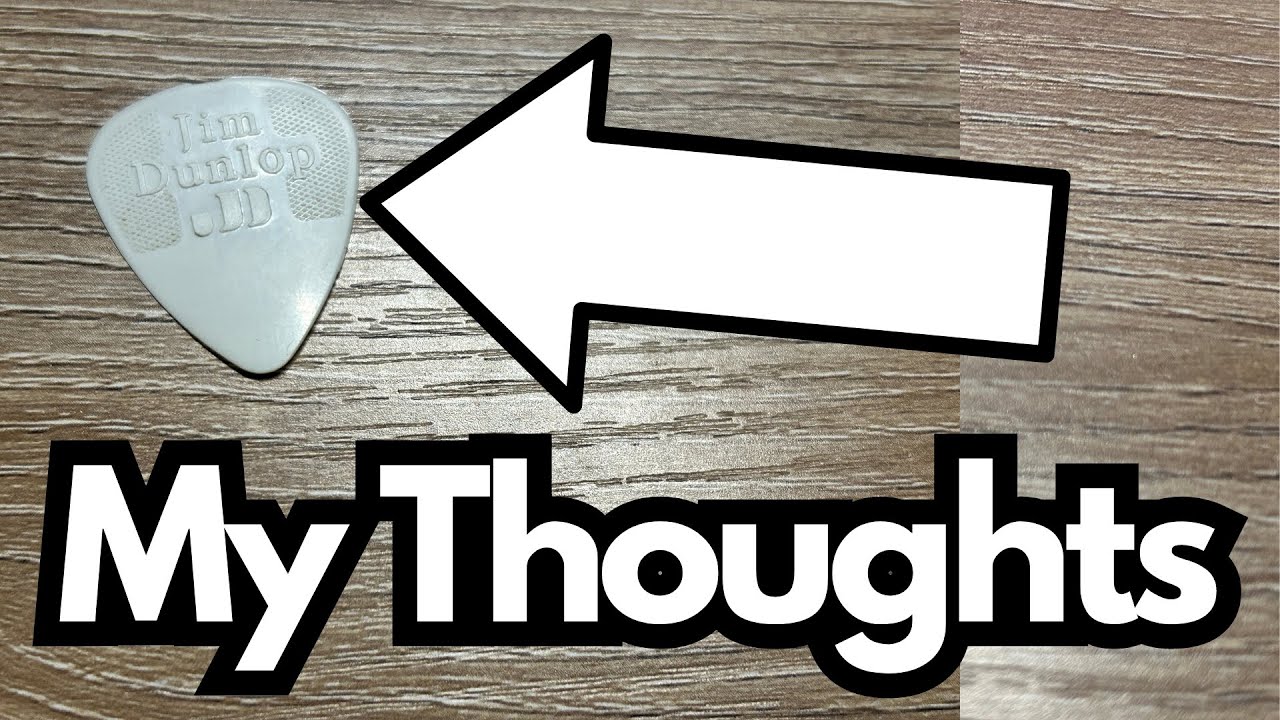
For many of us, these classic white Jim Dunlop thins were among the first we ever got. You can grab some here on Amazon.
They’re everywhere, they’re inexpensive, and they’re often handed to beginners without a second thought. But are they actually any good? And more importantly: who are they good for?
Let’s break down what these super-flexible picks do well, where they fall short, and when you might want to move on to something more precise.
Overview / First Impressions
These white Jim Dunlop thin picks are extremely flexible and light. The first thing you notice when you strum with them is how floppy they feel. There’s a lot of “give” when the pick hits the strings, and you can actually hear that in the tone:
- The attack is soft and imprecise
- The pick seems to bend out of the way rather than glide confidently through the strings
- Fast passages feel vague and hard to control
Compared to a stiffer pick like a Jazz III, which gives you a sharp, defined attack, these thin Dunlops feel loose and imprecise. That’s not ideal if you want to play fast, articulate lines or tight rhythm parts.
However, for absolute beginners, that same floppiness can actually be a blessing.
Build Quality & Design
These picks are:
- Very thin: they bend easily with almost no resistance
- Standard shape: the typical 351 teardrop style most players start with
- Smooth surface: not much in the way of grip or texture
That extreme flexibility is the defining feature. It’s what makes them forgiving for new players, but frustrating for more advanced techniques.
Features & Functions
Where They Struggle
From a more experienced guitarist’s perspective, these picks are not great for:
- Fast alternate picking – The pick flexes so much that your attack feels delayed and mushy.
- Precision playing – Single-note lines lack definition and clarity.
- Tight rhythm work – The floppy feel makes it harder to lock in with a groove; the pick sort of “lags” behind your hand.
The sound can best be described as loose or flappy—not the crisp, focused tone you’d want for metal, fusion, or tight funk rhythm.
Where They Actually Make Sense
Despite all that, there is a place for these picks:
- Total beginners – When you’re just starting, you don’t yet have control over your picking depth and angle. A stiff pick can easily get “stuck” between strings, causing you to fumble or stop mid-strum.
- Very light, gentle strumming – If you’re barely brushing the strings for quiet acoustic parts, the softness can be somewhat pleasant and forgiving.
For a new player, a floppy pick acts like training wheels. It bends out of the way instead of catching on the strings, so you can focus on basic coordination rather than fighting the pick.
How It Sounds / Use Cases
The Sound
With these thin Jim Dunlop picks, you tend to get:
- A softer, less defined attack
- A slightly papery, flappy noise as the pick flexes through the strings
- Less control over dynamics and articulation
If you compare them to something like a Dunlop Jazz III or even a medium/heavy standard pick, the difference is huge. The Jazz III gives you:
- A sharp, immediate attack
- Much better note separation
- More control over speed and articulation
So if your goal is to play fast, clean lines or punchy riffs, these thin picks work against you.
Who They’re For
Good for:
- Brand-new players learning basic strumming
- People who are terrified of the pick getting stuck in the strings
- Super-light acoustic strumming where precision isn’t critical
Not so good for:
- Lead guitarists working on speed and accuracy
- Players who want tight, percussive rhythm
- Anyone serious about tone and articulation
Limitations / Things to Know
If you’re still using these white Dunlop thins and you’re no longer a beginner, they’re probably holding you back.
Things to keep in mind:
- They hide bad technique – Because the pick bends out of the way, you never really learn to control picking depth and angle properly.
- They blur your tone – You’ll struggle to get that crisp, articulate sound you hear from your favorite players.
- Switching later can feel weird – Moving from a super-thin pick to a thicker one is an adjustment. It’s worth it, but expect a short adaptation period.
If you’re starting to work on scales, solos, or tighter rhythm playing, try stepping up to:
- A medium pick (around .73–.88 mm) as a transition
- Or go straight to a Jazz III or similar small, stiff pick if you’re serious about lead playing
Final Thoughts
These white Jim Dunlop thin picks are not great long-term tools for serious guitarists. They’re floppy, imprecise, and make fast or accurate playing harder than it needs to be.
But as beginner picks, they have a role. The flexibility makes them forgiving while you’re just trying to get your right hand and left hand working together without constantly getting the pick trapped in the strings.
If you’re still using them and feel like your playing is “sloppy” or your tone is “flappy,” it might not be all you—it might be the pick. Try a stiffer option and see how much your articulation and control improve.
Resources & Further Study
If you’re ready to move beyond basic strumming and actually start understanding the fretboard and harmony, there are some helpful tools available:
Fretboard Memorization Cheat Sheet – A resource that lays out major and minor triads in every key using approaches like octave mapping. It’s designed to help you:
- Memorize the notes on the fretboard
- Understand how chords and triads are built
- Start improvising in multiple keys using triad-based thinking
Traveling Guitarist Forum – An online community where you can talk guitar, music, and related topics with other players, ask questions, and share your progress.
Both are available via travelingguitarist.com and the forum at forum.travelingguitarist.com.