

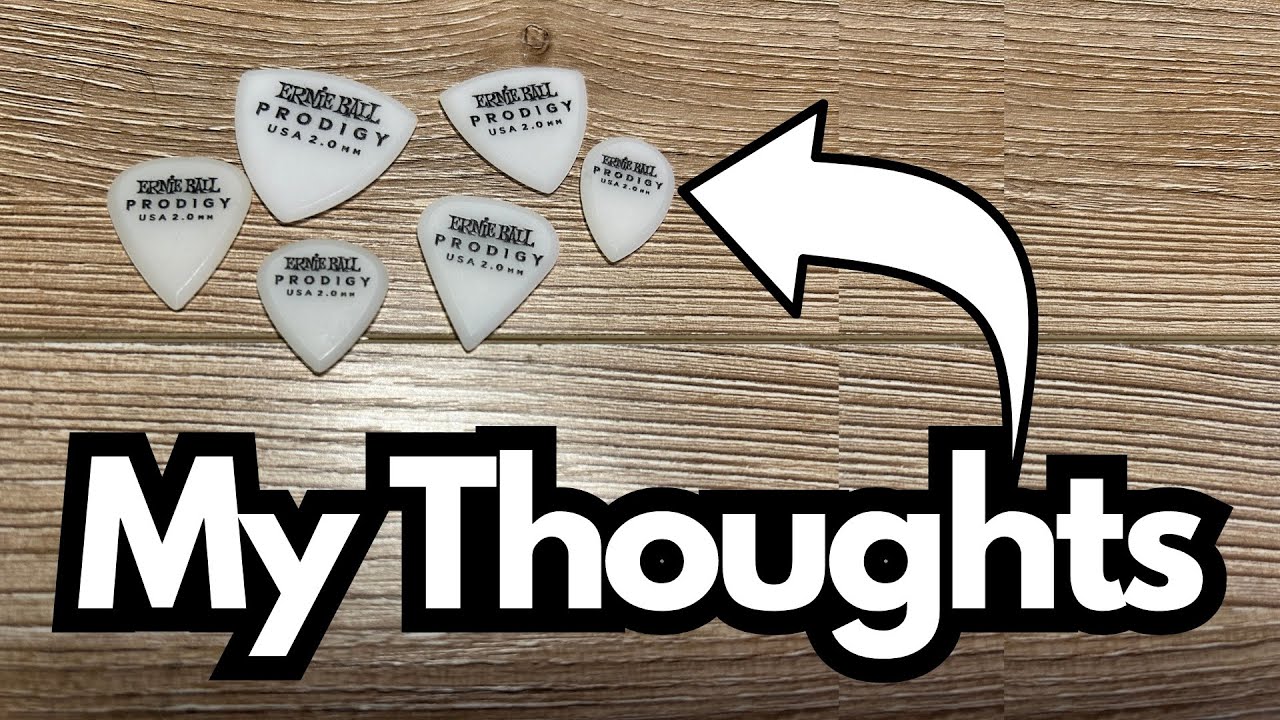
If you’re the kind of guitarist who obsesses over control, accuracy, and pick attack, your choice of plectrum matters a lot more than most people think. The Dunlop Prodigy series is aimed squarely at players who want maximum precision and a sharp, articulate tone.
I’ve spent time with a handful of Prodigy shapes, and while most of them didn’t really click with me, one stood out in a big way: the Jazz III–style Prodigy, in 2.0 mm. You can grab some here on Amazon.
This post is about that specific pick—why it works, who it’s for, and what you should know before grabbing a pack.
Overview / First Impressions
The Dunlop Prodigy Jazz III–style pick is essentially a hyper-refined take on the classic Jazz III shape:
- Similar compact Jazz III footprint
- Very sharp tip for maximum precision
- 2.0 mm thickness, with a firm feel
If you’re already a Jazz III user—especially if you like the Max Grip Jazz III—you’ll feel right at home. In fact, the Prodigy Jazz III has become my second-favorite pick overall, right behind the Max Grip Jazz III.
The big selling point? Precision. This is easily the most precise pick I’ve ever used.
Build Quality & Design
Dunlop makes the Prodigy series from a synthetic material (a polymer/oil-derived plastic). Whatever the exact formula is, it gives the pick a few standout characteristics:
- Stiff but not “brick hard” – There’s virtually no flex while playing, but just enough microscopic give that it doesn’t feel like it’s fighting the string.
- Extremely sharp tip – Compared to a standard Jazz III, the Prodigy’s tip is noticeably pointier in person, even if it’s hard to see in photos. That sharper point is what makes it feel so precise.
- Beveled edges / “rivets” around the outside – The edges and subtle texturing help with both grip and attack, giving you a confident feel when digging in.
In the hand, it feels like a refined, performance-focused version of a Jazz III—built for players who care about control and articulation more than anything else.
Features & Functions
Here’s what stands out about the Prodigy Jazz III–style pick in actual use:
1. Ultra-Pointed Tip
This is the defining feature. The Prodigy’s tip is:
- Sharper than a standard Jazz III
- Better at “finding” individual strings cleanly
- Great for fast, intricate picking and tight riffing
If you do a lot of alternate picking, string skipping, or precise arpeggios, this tip shape makes a real difference.
2. Thickness & Flex
At 2.0 mm, this pick is:
- Very stiff for strong, consistent attack
- Not floppy at all, so your hand controls the dynamics, not the pick
- Still just flexible enough that it passes through the string without feeling sticky or harsh
That combination of stiffness and a tiny bit of give is important: the pick doesn’t dig into the string and get “stuck.” Instead, it releases smoothly, which is crucial for fast playing.
3. Grip & Attack
The small “rivets” or textured areas around the edge help:
- Keep the pick stable between your fingers
- Give you a solid, defined attack
- Improve release so notes feel snappy rather than mushy
If you’ve ever had a pick twist slightly while playing fast, you’ll appreciate how locked-in this one feels.
How It Sounds / Use Cases
On Acoustic Guitar
On acoustic guitar, the Prodigy Jazz III delivers:
- Clear, articulate note definition
- Tight, focused attack
- A slightly bright, precise tone due to the sharp tip and stiff material
It’s not a “soft” or “warm” sounding pick. Instead, it excels at:
- Fast lead lines
- Clean, accurate runs
- Articulate chord voicings and riffs where you want every note to pop
If you’re into fusion, metal, prog, or any style where clarity and control matter more than big, strummy wash, this pick is very much in that lane.
On Electric Guitar
On electric, you can expect:
- Tight, percussive picking response
- Excellent tracking for high-gain tones
- Great feel for legato + picked hybrid lines
What About the Other Prodigy Shapes?
I tried several other shapes from the Prodigy line, and honestly, they weren’t for me:
- Some were too big and felt clumsy compared to a Jazz III.
- Others had shapes that just felt awkward or “weird” in the hand.
- None of them matched the balance of control and comfort that the Jazz III–style version has.
If you’re already comfortable with Jazz III picks, I’d strongly recommend starting with the Jazz III–style Prodigy specifically. That one feels like a natural upgrade. The others may appeal to players who prefer larger or more unconventional shapes, but they didn’t earn a permanent spot in my setup.
Limitations / Things to Know
A few caveats before you dive in:
- Not ideal for big strumming
If your playing is mostly acoustic strumming, singer-songwriter style, or you like a softer, rounder attack, this pick may feel too stiff and too sharp. - Very “locked-in” feel
The lack of flex and pointed tip demand decent technique. If you’re used to thin, floppy picks doing some of the work for you, there may be an adjustment period. - Tone is on the bright/precise side
Great for clarity and definition, but not the best match if you’re chasing super-warm, vintage-style attack.
Final Thoughts
The Dunlop Prodigy Jazz III–style pick (2.0 mm) is a fantastic choice for guitarists who:
- Already like Jazz III or Max Grip Jazz III picks
- Want even more precision and control
- Play styles where clean articulation and tight attack are essential
For me, it’s easily one of the best “precision tools” in the pick world—second only to the Max Grip Jazz III in my personal hierarchy. If you care about how your pick feels on the string and you’re chasing that ultra-accurate, surgical picking response, this one is absolutely worth trying.
Resources & Further Study
If you want to pair this kind of precise picking with stronger fretboard knowledge and improvisation skills, check out:
- Fretboard Memorization Cheat Sheet at travelingguitarist.com – A triad-based resource that lays out major and minor triads in every key. It uses “octave mapping” and other visual approaches to help you:
- Memorize the notes on the fretboard
- Understand harmony through triads (the foundation of chords)
- Improvise more confidently across multiple keys
- Traveling Guitarist Forum – At
forum.travelingguitarist.comyou can discuss guitar, gear, practice, and music with other players, ask questions, and share ideas.
Combine a precise pick with solid fretboard knowledge and you’ll feel a real difference in both your tone and your playing confidence.