

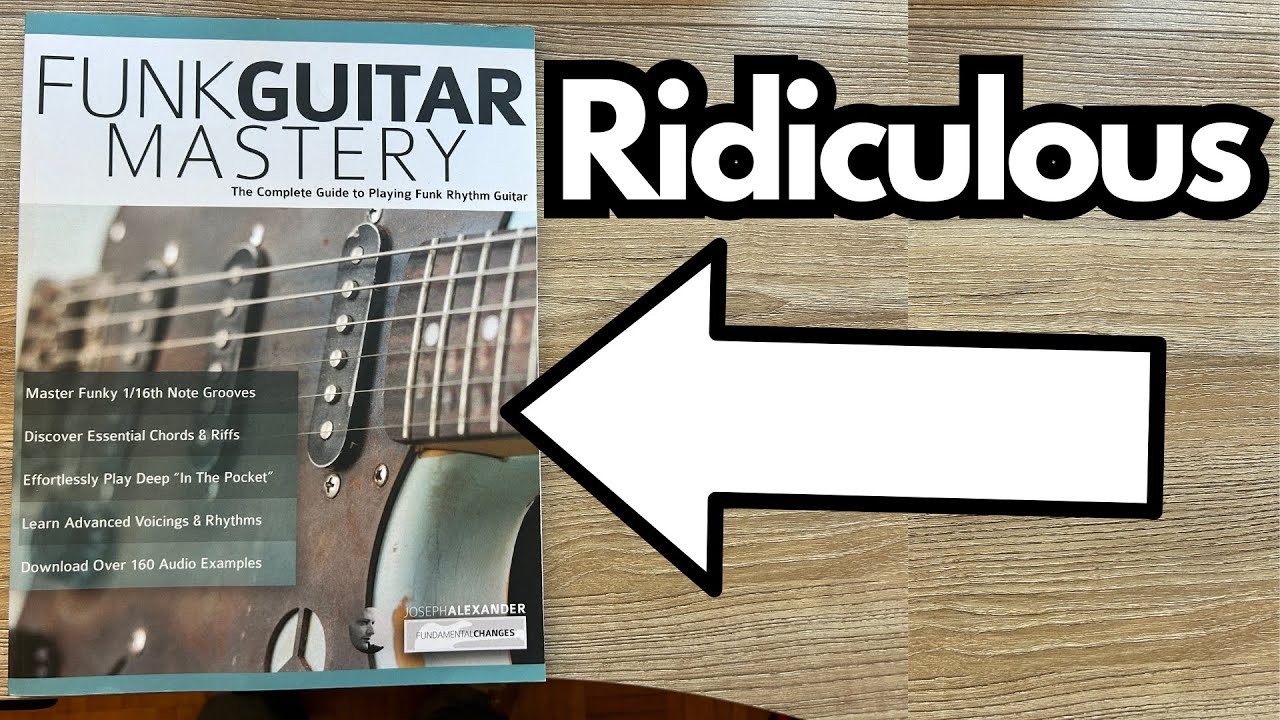
If you’ve ever tried to nail that tight, percussive funk feel and ended up sounding a bit… floppy, you’re not alone. Funk rhythm guitar is deceptively hard: it’s all about precision, timing, and control. That’s why a good resource can make a huge difference.
You can grab it here on Amazon.
Funk Guitar Mastery by Joseph Alexander is one of those rare books that doesn’t just talk about funk—it actually teaches you how to play it in a structured, practical way.
If you’re a guitarist who wants to sharpen your rhythm chops, improve your feel, or even build a stronger foundation for jazz and modern styles, this book is worth a serious look.
Overview / First Impressions
When I first picked up Funk Guitar Mastery, I wasn’t expecting much beyond a few cliché chord shapes and some generic strumming patterns. Instead, I found a surprisingly deep and well-organized guide to funk rhythm playing.
What stands out immediately:
- The focus is practical: everything is geared toward helping you actually play funk, not just read about it.
- The material is groove-oriented: exercises are designed to lock in timing, precision, and feel.
- It quietly doubles as a rhythm and harmony bootcamp for styles beyond funk, including jazz.
I was genuinely impressed by how much ground it covers while still feeling approachable.
Build Quality & Design
Physically, the book is solid and easy to work with:
- Clear notation and layout
- Logical progression of concepts
- Plenty of exercises to reinforce each idea
One downside: it’s not spiral-bound. For a practice-heavy book, spiral binding would have been ideal so it could sit open on a music stand. It’s a small complaint, but if you’re used to spiral-bound method books, you’ll notice it.
Features & Functions
This book isn’t just “here are some funk chords.” It systematically walks you through the core building blocks of funk rhythm playing.
Rhythm & Groove
- 16th-note strumming: The backbone of most funk rhythm. You learn how to keep a steady 16th-note motion while selectively hitting and missing strings.
- Syncopation: How to place accents off the beat to create that classic funky push-and-pull.
- Muting techniques: Left-hand and right-hand muting to create percussive, choked, and ghosted sounds that make funk rhythm feel alive.
Harmony & Chord Vocabulary
Although it’s a funk book, it sneaks in a solid harmony foundation:
- Major triads
- Minor triads
- Seventh chords
These are presented in ways that are directly usable in funk comping. You’re not just memorizing chord shapes—you’re learning how they function rhythmically and harmonically in a groove.
Technique & Precision
The exercises are built around:
- Accuracy: Hitting exactly what you mean to hit—no extra string noise.
- Consistency: Keeping your timing tight across bar after bar of rhythm.
- Control: Switching between muted, percussive, and fully voiced chords smoothly.
This is where the book really shines. It doesn’t just show you “cool funk stuff”; it trains your hands to behave like a funk player.
How It Sounds / Use Cases
From a guitarist’s perspective, this book is especially helpful if you:
- Want to sound like a rhythm guitarist, not just a lead player who occasionally strums.
- Need to tighten up your time feel—funk is unforgiving, and this material forces you to confront your timing.
- Are interested in jazz, neo-soul, R&B, or pop: the rhythmic and harmonic concepts transfer directly.
You’ll come away with:
- A better sense of where to place accents in a bar.
- More control over ghost notes and percussive hits.
- A clearer understanding of how triads and seventh chords sit inside a groove.
Even if you’re not a hardcore funk player, this kind of rhythmic discipline will improve your playing in almost any style.
Limitations / Things to Know
No book is perfect, and there are a couple of practical points to keep in mind:
- Not spiral-bound: As mentioned earlier, this is more of a usability annoyance than a content issue. You may find yourself wrestling with pages a bit on a music stand.
- Focused on fundamentals over flash: If you’re looking for a lick-heavy, “play like [insert famous funk guitarist] in 10 minutes” type of book, this isn’t that. It’s more about building real skills: groove, timing, and control.
Outside of that, there’s surprisingly little to complain about. The content is strong, well-structured, and musically useful.
Final Thoughts
Funk Guitar Mastery by Joseph Alexander is a very solid, practical guide to funk rhythm guitar. It:
- Teaches you the real mechanics of funk: muting, syncopation, 16th-note feel.
- Builds a harmonic foundation with triads and seventh chords that’s valuable beyond funk.
- Emphasizes precision and groove, which is exactly what most guitarists need more of.
If you’re serious about improving your rhythm playing—whether for funk, jazz, R&B, or just tighter pop/rock comping—this book is absolutely worth adding to your practice routine.
Resources & Further Study
If you want to go deeper into harmony and fretboard understanding alongside this book, there are a couple of useful resources mentioned:
- Fretboard Memorization Cheat Sheet – Available at travelingguitarist.com (look for the fretboard cheat sheet).
- Covers major and minor triads in every key
- Uses the “Optive mapping” technique and other approaches to help you:
- Memorize the notes on the fretboard
- Understand the foundation of harmony (triads)
- Start improvising more confidently in different keys
- Traveling Guitarist Forum – forum.travelingguitarist.com
- A place to talk about guitar, music, and related topics with other players.
Pairing a structured funk rhythm book like Funk Guitar Mastery with focused triad and fretboard work is a powerful combo. You’ll not only sound funkier—you’ll understand why what you’re playing works.