

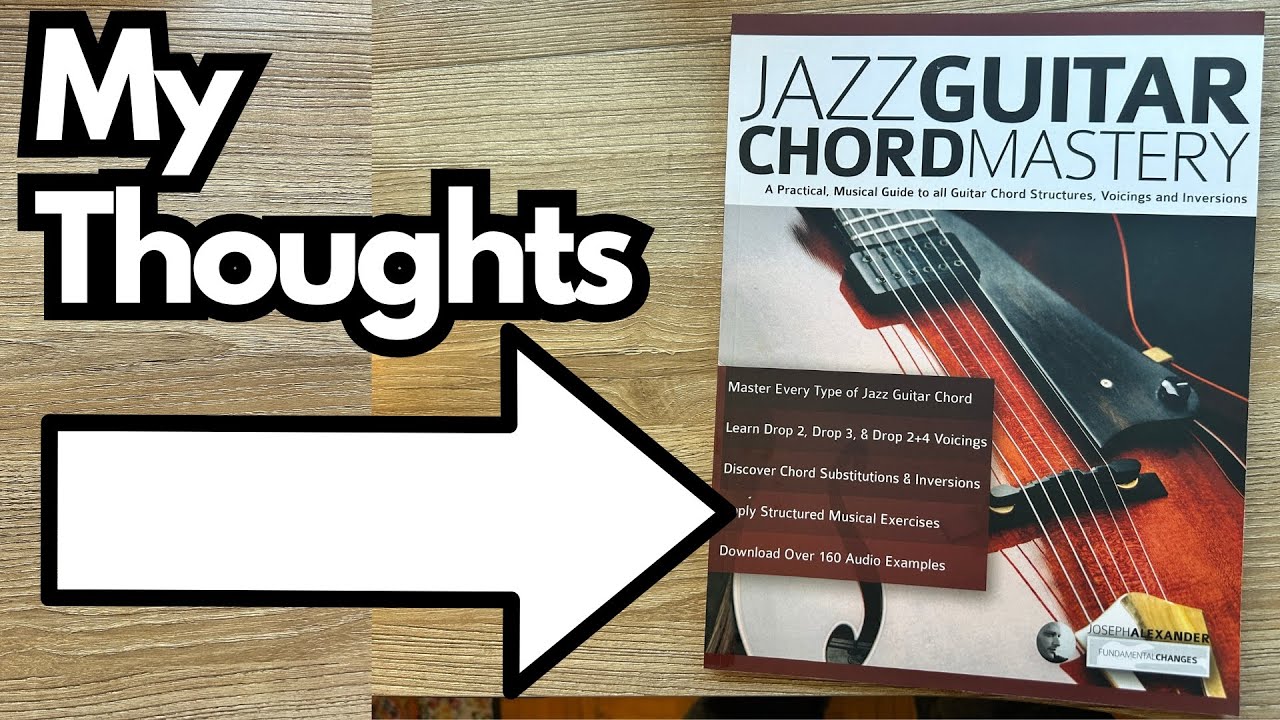
If you’re a guitarist who loves the sound of jazz but feels a bit lost in the harmony, Joseph Alexander’s Jazz Guitar Chord Mastery is a very solid resource. It’s especially useful if you’re more interested in understanding chords and harmony than ripping through bebop lines.
You can grab it here on Amazon if you’re interested.
This book approaches jazz from the chordal side of things—perfect if you’re fascinated by the rich voicings, lush extensions, and harmonic movement that make jazz sound like jazz.
Overview / First Impressions
I picked up Jazz Guitar Chord Mastery after being really impressed with Joseph Alexander’s Funk Guitar Mastery. Based on that experience, I expected this one to be strong as well—and it is.
Where Funk Guitar Mastery focuses more on rhythm, feel, and stylistic playing, Jazz Guitar Chord Mastery zooms in on harmony. It’s about:
- Understanding common jazz chord types
- Exploring their inversions across the neck
- Learning why these chords work the way they do
If you’re the kind of player who hears a beautiful jazz progression and thinks, “What is that chord and why does it sound so good?” this book is aimed squarely at you.
Build Quality & Design
The layout and presentation are very guitarist-friendly:
- Standard notation plus TAB for everything
- Clear chord diagrams for all shapes and inversions
- Logical, step-by-step structure that builds your understanding as you go
You don’t have to be a fluent reader of standard notation to get value from the book, but it’s there if you want to develop that skill alongside your chord knowledge.
The diagrams make it easy to visualize shapes on the fretboard, and the inclusion of inversions helps you break out of the “one shape per chord” mindset.
Features & Functions
The strength of this book lies in how it approaches jazz harmony through chord inversions and structure, rather than just giving you a bunch of grips to memorize.
Common Jazz Chord Types
It focuses on the most frequently used chords in jazz—things like major 7, minor 7, dominant 7, and extended or altered chords. You don’t just see the shapes; you understand what they are.
Inversions Across the Neck
Instead of just giving you one voicing per chord, the book explores all the useful inversions. This is huge for:
- Voice leading
- Smooth chord changes
- Comping in different areas of the neck
Theory Behind the Chords
The book doesn’t just say “here’s a chord, play it.” It explains:
- Why the chord is built the way it is
- What notes are inside it
- Why it sounds the way it does in context
This makes the material much more digestible than a dry theory textbook, while still giving you real theoretical grounding.
Why It’s Good For A Guitarist / Use Cases
From a guitarist’s perspective, this book is ideal if you want to:
- Comp behind a soloist with interesting, authentic jazz voicings
- Understand why jazz standards use the chords they do
- Move beyond basic barre chords into sophisticated harmony
- Build a foundation for chord-melody playing later on
By working through the inversions and understanding the theory, you’ll start to:
- Hear how chords relate to each other
- Choose voicings that fit the moment instead of defaulting to one shape
- Navigate the fretboard more freely when playing jazz standards
If your favorite thing about jazz is the sound of the chords, this book directly feeds that interest.
Limitations / Things to Know
A few honest notes:
- It’s chord-focused, not solo-focused.
If you’re looking for a book on jazz soloing, licks, or phrasing, this isn’t that. It’s primarily about harmony and voicings. - You need to put in the time.
Exploring inversions and theory is incredibly rewarding, but it’s not instant gratification. The material is explained in a digestible way, but it still takes practice to internalize. - Personal comparison to Funk Guitar Mastery.
Personally, I found Funk Guitar Mastery a bit more engaging overall—probably because of my own stylistic preferences. But if your main concern is understanding jazz chords, Jazz Guitar Chord Mastery is absolutely worth it.
Final Thoughts
Jazz Guitar Chord Mastery is a strong resource for guitarists who want to go deep into jazz harmony from a chordal perspective. It’s practical, clearly laid out, and focused on the real-world chords you’ll encounter in jazz.
If you love the sound of jazz chords and want to understand:
- How they’re built
- How to play them all over the neck
- Why they sound the way they do
this book will serve you well.
If, on the other hand, you’re more interested in groove, rhythm, and stylistic playing, you might gravitate more toward something like Funk Guitar Mastery. But for chord-focused jazz exploration, this is a very solid choice.
Resources & Further Study
If you want to go even deeper into fretboard understanding and harmony, there are a couple of useful tools mentioned:
Fretboard Memorization Cheat Sheet – Available attravelingguitarist.com/fretboard-cheat-sheet
This focuses on:
- Major and minor triads in every key
- Using “octave mapping” and other techniques
- Helping you memorize the fretboard and improvise in multiple keys by understanding triads—the foundation of chords and harmony
Traveling Guitarist Forum – Atforum.travelingguitarist.com
A place to:
- Talk guitar and music with other players
- Ask questions
- Share ideas, progress, and resources
Used together—a solid chord book like Jazz Guitar Chord Mastery, a triad-focused cheat sheet, and a community to ask questions—you’ll have a strong framework for really understanding jazz harmony on the guitar.