

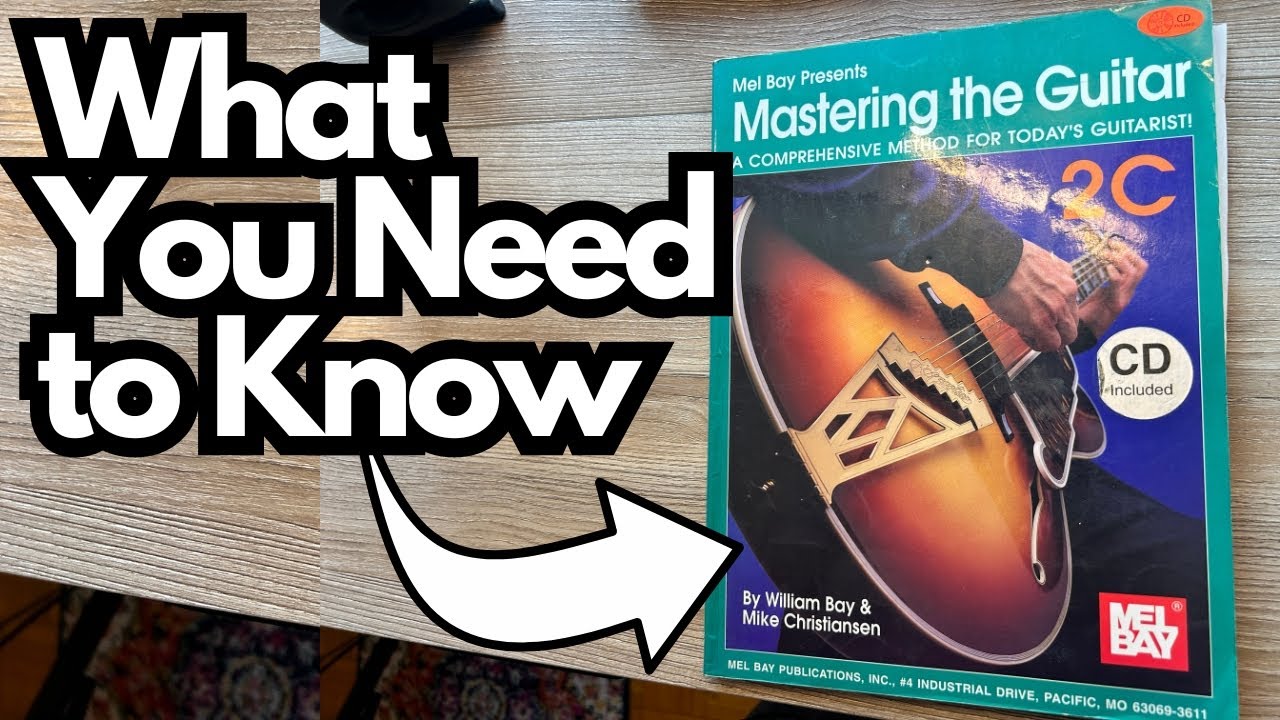
If you’ve been searching for a structured, no-nonsense way to level up your guitar playing, the Mastering the Guitar series is one of those old-school resources that quietly does the job.
It’s not flashy, but it’s thorough, and if you’re serious about getting better, that matters. If you’re interested, you can grab it here on Amazon.
The last book I worked through in the series was Mastering the Guitar 2C. I stopped there when I was about 18. Looking back now, I probably shouldn’t have. This post is about what this book is, what it covers, and whether it’s worth your time as a guitarist.
Overview / First Impressions
Mastering the Guitar 2C is a continuation of the earlier books in the series:
- 1A
- 1B
- 2A
- (Possibly 2B, though I don’t recall working through that one)
By the time you reach 2C, you’re not a beginner anymore. This isn’t about learning your first chords or basic strumming patterns. It’s about:
- Expanding your chord vocabulary (especially barre chords)
- Tightening up your technique
- Building real fretboard knowledge
- Developing more musical playing, not just “shapes”
When I went through 2C, I was working mostly on my own. My teacher’s notes aren’t in the book, so all the markings are mine. That alone tells you something: the material is laid out clearly enough that a motivated player can work through it independently.
Build Quality & Design
These books are very much in the traditional method-book style:
- Standard notation is used heavily
- Guitar tab shows up in places, but notation is the main focus
- Exercises are laid out logically, building one concept on top of another
- The layout is clean and functional, not cluttered or gimmicky
It’s not a glossy, picture-heavy “beginner guitar” book. It feels like something designed for serious students who want to actually understand the instrument, not just memorize a few licks.
Features & Functions
1. Barre Chords and Beyond
The book starts with barre chords and keeps building from there. This is a big step up from open chords and basic riffs:
- Full E-shape and A-shape barre chords
- Moving these shapes across the neck
- Using them in musical contexts, not just as isolated grips
If you’ve never really owned your barre chords—meaning you can move them anywhere, cleanly, in time—this book gives you the repetition and structure to nail that.
2. Progressive, Connected Material
2C doesn’t exist in a vacuum. It assumes you’ve done the earlier books and continues in the same structured way:
- Concepts introduced earlier (like basic chords, rhythm, and reading) are expanded
- New material is introduced gradually, so you’re not overwhelmed
- There’s a clear sense of progression from “student” to “musician”
3. Mix of Notation and Tab
While the series leans on standard notation, there are moments where guitar tab appears too. That’s useful if you’re in the transition phase between reading tab and learning to read notation more fluently.
How It Affects Your Playing
This isn’t a “tone” product like a pedal or amp, but it absolutely affects how you sound as a guitarist.
Here’s what working through 2C can do for you:
- Cleaner, stronger rhythm playing
Barre chords require hand strength, precision, and control. As you get better at them, your rhythm playing tightens up dramatically. - Better fretboard awareness
Moving chord shapes around the neck forces you to think in terms of keys and positions, not just “third fret” or “fifth fret.” - More confident improvisation and songwriting
Once you’re comfortable with chords all over the neck, writing progressions and improvising over them becomes much more natural.
Who It’s For
- Late beginner to intermediate players
- Anyone who can play open chords but struggles with barre chords
- Players who want a structured, methodical approach instead of random YouTube videos
- Guitar students who like notation-based learning and clear progression
Limitations / Things to Know
A few honest points to keep in mind:
- You really should start from 1A.
The series is designed to be progressive. Jumping straight into 2C without the earlier books will make things harder than they need to be. - It’s not “instant gratification” material.
There are no clickbait shortcuts here. You’ll be doing real practice: exercises, reading, repetition. - It’s more “classical method” than “rock magazine.”
If you’re only looking for riffs and licks, this might feel dry. But if you want long-term skill, it’s solid. - You’ll need discipline.
At 18, I stopped at 2C. Looking back, that was more about me than the book. If you stick with the series, you’ll absolutely become a more complete player.
Final Thoughts
Mastering the Guitar 2C is one of those books that doesn’t scream for attention but quietly delivers real progress if you put in the time.
If you:
- Already know your basic open chords
- Are ready to finally conquer barre chords
- Want a structured path rather than random tips
…then working through the entire Mastering the Guitar series—starting from 1A and moving up through 2C and beyond—is a smart move.
I stopped at 2C when I was younger. If I could go back, I’d keep going.
Resources & Further Study
If you’re using books like Mastering the Guitar and want to go deeper into fretboard understanding and harmony, I’ve put together a couple of resources that pair well with this kind of study:
Fretboard Memorization Cheat Sheet
Available at travelingguitarist.com – this cheat sheet lays out major and minor triads in every key, using the octave mapping technique and a few other approaches.
It’s designed to help you:
- Memorize the notes on the fretboard
- Understand triads as the foundation of chords and harmony li>Start improvising more confidently in multiple keys
Guitar & Music Forum
You can also join the community at forum.travelingguitarist.com.
It’s a place to:
- Talk guitar and music
- Ask questions
- Share progress and ideas with other players
Used together—a structured method like Mastering the Guitar plus triad-based fretboard work—you’ll build not just chops, but real musical understanding.