

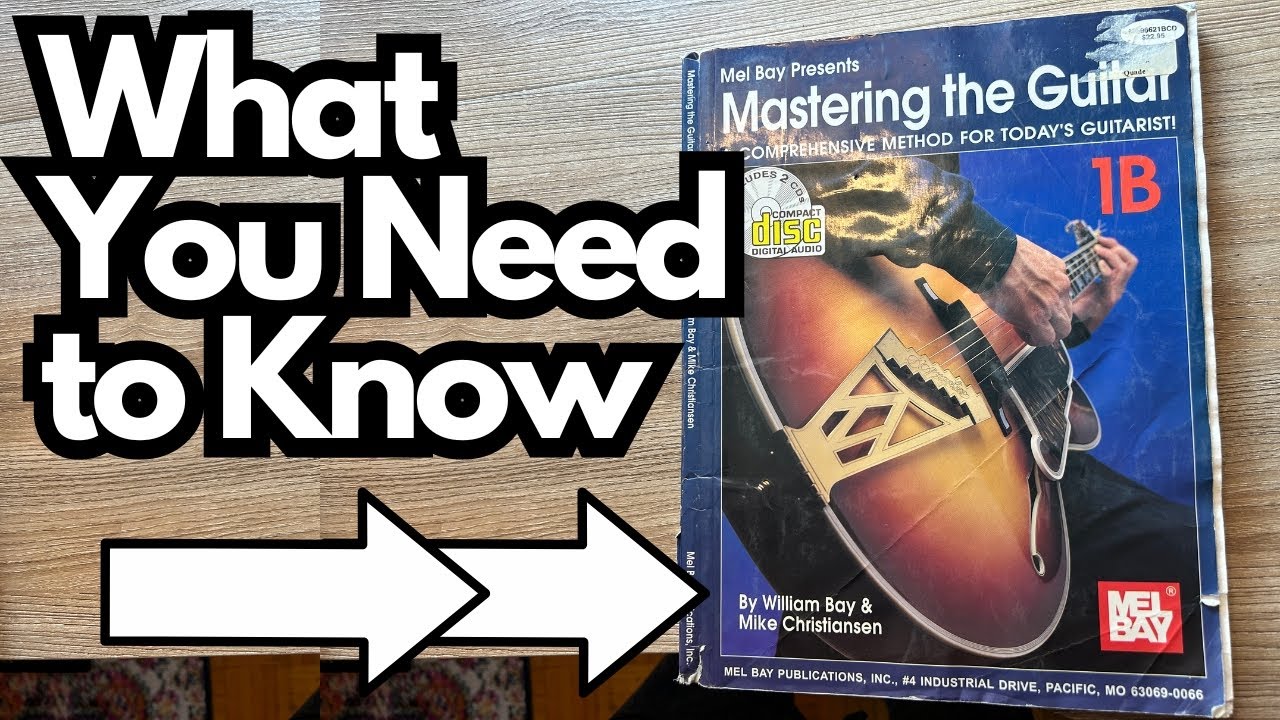
If you’ve worked your way through Mel Bay Mastering the Guitar 1A and you’re wondering what to do next, Book 1B is the natural continuation.
It’s aimed at players who already have the basics under their fingers and want to go a bit deeper into reading, technique, and musicality—especially if you’re interested in classical guitar or solid sight-reading skills. You can grab it here on Amazon.
This isn’t a flashy “learn three chords and a song” book. It’s a structured, methodical way to build real musicianship on the guitar.
Overview / First Impressions
Mastering the Guitar 1B picks up exactly where 1A leaves off. Think of it as “Chapter 2” of the same course, not a standalone method.
What you’ll notice right away:
- The notation gets more complex.
- Rhythms step up a level (including 16th notes).
- The pieces get more fingerstyle-oriented.
- The music starts to move more confidently through different keys, including flat keys.
- You see more “standard” classical-style tunes and study pieces.
If 1A helped you get comfortable with basic reading and simple pieces, 1B pushes you toward being a more complete, literate guitarist.
Build Quality & Design
Like most Mel Bay method books, 1B is laid out in a clear, traditional format:
- Standard notation is the main focus, with tablature included in sections to help bridge the gap for players more used to tab.
- The engraving is clean and readable, with progressively more complex scores as you move through the book.
- The material is organized in a logical sequence, so each new concept builds on what came before.
It also comes with a CD of audio examples. Even if you don’t absolutely need it, having reference recordings for phrasing, rhythm, and tone is handy—especially if you’re teaching yourself.
Features & What It Covers
Rhythmic Development
- Introduction and use of 16th notes and more detailed rhythmic figures.
- Continued work with different note values and rests.
- More rhythmically interesting pieces to help internalize timing.
Key Centers & Reading
- Expansion into new keys such as D major and eventually flat keys.
- More frequent key changes and modulations, so you get used to reading in multiple tonalities.
- Strong emphasis on sight-reading in standard notation.
Fingerstyle & Classical Focus
- More fingerstyle-oriented pieces, moving beyond simple block chords and basic melodies.
- A growing number of classical standards and traditional tunes—the kind of pieces you’ll see in many early classical guitar repertoires.
- Increased complexity in the score layout, with multiple voices and more sophisticated textures.
Progressive Difficulty
The difficulty doesn’t jump suddenly; it ramps up gradually:
- Early in the book: slightly more advanced than the end of 1A.
- Middle of the book: more challenging fingerings, more involved rhythms.
- Toward the end: noticeably more sophisticated pieces that demand better technique, coordination, and reading skills.
How It Sounds & Who It’s For
From a guitarist’s perspective, this book is ideal if you:
- Want to develop real reading skills instead of relying only on tab.
- Are getting into classical guitar or fingerstyle and want a structured path.
- Need repertoire that’s musical but still within reach for an advancing beginner or early intermediate player.
- Are teaching students and want a graded curriculum that goes beyond basic chord strumming.
The pieces in 1B:
- Sound more like actual music and less like exercises.
- Introduce standard classical and traditional tunes, so you’re learning pieces with some history and musical value.
- Give you enough challenge to push your technique without being overwhelming—assuming you’ve really digested 1A first.
Limitations & Things to Know
A few important points to keep in mind:
- You really should start with 1A. 1B assumes you already understand the fundamentals covered there—basic reading, simple rhythms, and foundational technique.
- The main focus is standard notation, not just tab. If you’re only interested in tab-based rock riffs, this might not be your ideal path.
- The CD is optional but useful. Some players never touch it, but it’s worth trying for timing, feel, and tone reference.
- The style leans toward classical and traditional repertoire, not modern pop or rock. That said, the reading and technique skills you get here carry over to any style.
Final Thoughts
Mel Bay Mastering the Guitar 1B is a strong, logical continuation for anyone who has completed 1A and wants to keep building real musicianship on the guitar.
Use this book if:
- You’re serious about reading music.
- You want to develop fingerstyle/classical technique.
- You prefer a structured, methodical path rather than random YouTube lessons.
Skip it—or at least don’t start here—if you haven’t gone through 1A yet. The two books are designed as a sequence, and 1B really shines when you treat it as the second half of the same journey.
Resources & Further Study
If you’re working through books like Mastering the Guitar and want to deepen your fretboard understanding, a couple of tools can really help:
Fretboard Memorization Cheat Sheet – TravelingGuitarist.com
A printable guide with major and minor triads in every key, laid out using techniques like octave mapping. It’s great for:
- Memorizing the notes on the fretboard.
- Understanding triads as the foundation of chords and harmony.
- Starting to improvise more confidently in different keys.
Traveling Guitarist Forum – forum.travelingguitarist.com
An online community where you can:
- Talk guitar, music theory, and practice strategies.
- Ask questions as you work through method books.
- Connect with other players on the same path.
Pairing a method like Mastering the Guitar 1B with solid fretboard and triad work will give you a much more complete command of the instrument.