

If you’re running modern pedals, loopers, or software rigs, a good MIDI controller can turn a tap dance into a simple, musical workflow.
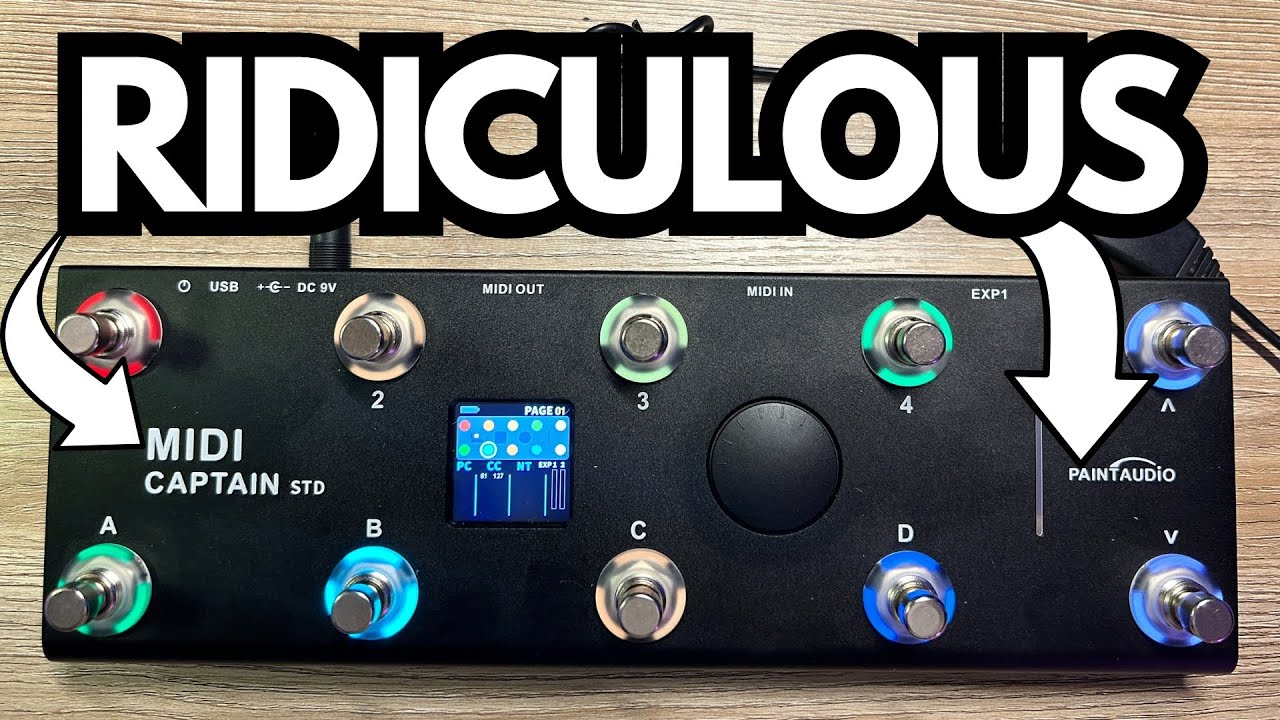
The MIDI Captain STD is one of those compact controllers that promises a lot in a small footprint—especially if you’re a guitarist trying to get more control out of gear like the Boss RC-5 looper.
You can grab it here on Amazon if you’re interested.
This post walks through what you get, how it’s built, what it can do, and how it performs in a real-world guitar setup.
Overview / First Impressions
Out of the box, the MIDI Captain STD feels like a serious tool, not a toy. It’s a fully featured mini MIDI controller with:
- A metal enclosure
- Multiple footswitches
- Expression pedal inputs
- MIDI in/out
- USB connectivity
- Battery power option
For guitar players, that “mini” form factor means it can actually fit on a pedalboard without a complete rebuild, but it still offers enough control for complex rigs.
The main reason it was picked up here was to control a Boss RC-5 looper—and it ended up handling every practical function needed.
Build Quality & Design
Physically, the MIDI Captain STD is impressive for its size:
- All-steel enclosure – feels solid and roadworthy.
- High-quality switches – the footswitches feel firm and reliable, not cheap or mushy.
- Rubber feet on the bottom – keeps it from sliding around on the floor or board.
On the back and sides, you get:
- MIDI In and MIDI Out
- Two expression pedal jacks – great if you want to control volume, wah, parameters, or multiple CCs.
- USB port – for connecting to a computer to configure it or control software rigs.
- Battery compartment – runs on two AA batteries, which is a huge plus if you don’t want to run another power cable.
That battery option is especially appealing for minimal or grab-and-go setups—busking, rehearsals, or simple rigs where you don’t want to rely on a full power supply.
Features & Functions
The MIDI Captain STD comes with a set of presets for various devices and software, but the real power lies in its fully customizable “geek mode.”
To enter the deeper configuration mode, you:
- Hold the power button
- Press the number 2 button on the side
From there, you can program it to send the exact MIDI messages you need for your specific device.
Key functional highlights:
- Customizable MIDI commands for each switch
- Presets for common gear and software, if you don’t want to start from scratch
- Two expression inputs for continuous control (CC messages)
- USB MIDI for DAWs or software loopers
- Battery or external power for flexible setups
For guitarists, that means you can tailor it to your specific pedalboard or software rig, not just live with whatever the manufacturer thought you might want.
How It Works with the Boss RC-5 (Guitarist’s Use Case)
The main test case here was using the MIDI Captain STD to control a Boss RC-5 looper, a very popular compact looper pedal that becomes way more powerful with MIDI.
The MIDI Captain STD was set up to handle essentially everything you’d want in a live looping situation.
Core Looper Functions
- Record / Play – one switch to start recording and toggle to playback.
- Stop – dedicated control to stop the loop cleanly.
- Clear – a command to fully clear the loop when needed.
Drum & Rhythm Control
- Drums On/Off – one switch toggles the RC-5’s built-in drum patterns.
- Tap Tempo – another switch is assigned as tap tempo, so you can set the tempo on the fly. The increasing speed of the LED feedback confirms the tempo is being updated.
Memory & Loop Management
- Memory selection – switches can be assigned to scroll through the RC-5’s memory slots, letting you move between saved loops or backing tracks.
Overdub & Undo
After recording a loop and going into overdub, one switch is assigned to undo the overdub, dropping you back to the original loop. That’s extremely useful for live layering and fixing mistakes without stopping the performance.
Reverse Playback
Another switch was assigned to Reverse, flipping the loop into reverse playback. This is great for ambient textures or experimental sections.
In practice, that means you have dedicated control over:
- Record
- Play
- Stop
- Clear
- Drums on/off
- Tap tempo
- Memory up/down
- Overdub undo
- Reverse
The RC-5 only exposes eight controllable MIDI functions in this context, so a couple of switches on the MIDI Captain STD couldn’t be assigned to anything extra. But within those limitations, the controller successfully covered every meaningful feature needed for performance.
How It Feels to Use (Guitarist Use Cases)
Since the MIDI Captain STD is a controller, it doesn’t have a “sound” of its own, but it dramatically changes how you use your sound-making gear.
For guitarists, some ideal use cases:
- Live looping with the RC-5 (or similar loopers)
- Hands-free control of recording, overdubbing, undo, reverse, and drums.
- More musical flow: you’re not bending down or double-tapping a single footswitch for secondary functions.
- Pedalboard MIDI control
- Switch presets on multi-effects units, delay/reverb units, or amp modelers.
- Use expression pedals to control delay mix, modulation depth, or amp gain levels.
- Studio / DAW setups
- Use it as a compact MIDI controller for software loopers, virtual instruments, or transport controls.
- USB connection makes it easy to integrate with a laptop rig.
Overall, it turns complex MIDI-capable gear into something that feels more like a natural extension of your playing instead of a menu-diving exercise.
Limitations / Things to Know
A few practical points to keep in mind:
- Device-dependent limits
- In the RC-5 example, the limitation wasn’t the MIDI Captain STD—it was the RC-5 only exposing eight controllable functions. So don’t expect to control more than your target device actually supports.
- Programming required for deep use
- To get the most out of it, you’ll likely want to dive into “geek mode” and program your own MIDI messages. It’s not difficult, but it’s not plug-and-play if you have a very specific setup in mind.
- Mini footprint = fewer switches
- The compact form factor is a strength, but also means you don’t have an endless number of footswitches. For many guitar rigs, though, it’s a good balance of size and control.
Final Thoughts
The MIDI Captain STD is a powerful, compact MIDI controller that punches well above its size, especially for guitar players using MIDI-capable pedals like the Boss RC-5.
From a guitarist’s perspective, the big wins are:
- Solid, steel construction and quality switches
- Battery power option (two AA batteries) for flexible setups
- Deep customization via geek mode
- Enough control to handle full-featured looping and performance workflows
If you’re looking for a small-footprint controller that lets you fully unlock your looper, multi-effects, or software rig, the MIDI Captain STD is a very capable option that can genuinely streamline your playing experience.
Resources & Further Study
If you’re working on your guitar skills alongside dialing in your MIDI rig, these resources may help:
- Fretboard Memorization Cheat Sheet – Available at
travelingguitarist.com/fretboard-cheatsheet. It covers major and minor triads in every key, using octave mapping and other techniques to help you:- Memorize the notes on the fretboard
- Visualize and navigate different keys
- Understand harmony and chord foundations through triads
- Traveling Guitarist Forum – Join the conversation at
forum.travelingguitarist.com. It’s a place to talk about:- Guitar technique and theory
- Gear and setups (including MIDI and looping)
- General music-related topics
Combining a solid understanding of harmony with a well-configured MIDI rig can make you not just a more technical player, but a more musical one.