

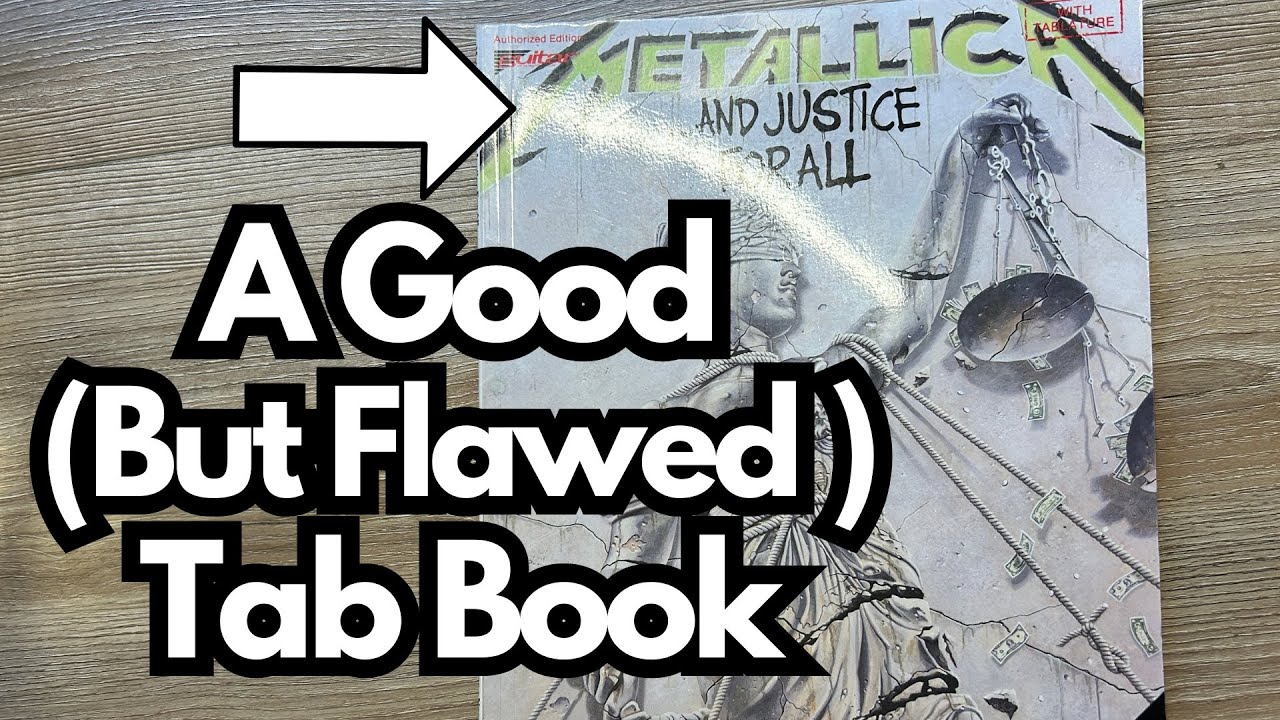
If you’re a guitarist diving into Metallica’s …And Justice for All era, you’ve probably wondered whether the official tab book is worth picking up (you can get it here on Amazon).
This album is packed with intricate riffs, odd-meter grooves, and some of James Hetfield’s most demanding rhythm work—not to mention Kirk Hammett’s solos.
This book can help you get a lot of that under your fingers, but it’s far from perfect. Here’s a guitarist’s-eye view of what it gets right, where it falls short, and how it fits into a serious Metallica practice routine.
Overview / First Impressions
The …And Justice for All tab book does a solid job capturing the core of the album:
- Main riffs: generally accurate and usable
- Solos: impressively close to the record, often “bang on”
- Layout: mostly standard notation plus tab, easy enough to follow
However, this book is also kind of infamous among Metallica players for being:
- A bit sloppy in places
- Over-reliant on power chords in spots where more detail would help
- Occasionally confusing in how it notates harmonized parts
Think of it as a mostly reliable working tool rather than a definitive, flawless transcription.
Features & Functions
What It Does Well
- Complete album coverage
Every track from …And Justice for All is here, so you can work through the album front to back. - Accurate solos
The standout strength of this book is the lead guitar work. The solos are very well transcribed:- Phrasing and note choice are very close to the recordings
- Great for learning Kirk’s style in this era
- Helpful if you’re trying to nail studio-accurate covers
Where It’s Just “Okay”
- Riffs and rhythms
The main riffs are mostly right, but:- Some sections lean too heavily on generic power chords
- Nuances in voicings and note choices are sometimes lost
- Certain rhythm details feel simplified
You’ll still get the essence of the songs, but more advanced players might hear discrepancies compared to the record.
How It Sounds / What It’s Good For
Who is this book actually good for?
Great For
- Intermediate guitarists
If you’re comfortable with basic metal rhythm and want to get into:- Galloping riffs
- Odd-time grooves
- Longer song structures
This book will give you a solid roadmap. - Learning solos note-for-note
If your priority is nailing the …And Justice for All solos, this is one of the best resources in print form. The lead work is where this book really shines.
Good as a Starting Point For
- Serious Metallica fans
If you’re okay cross-referencing:- Use the book to get the structure, main riffs, and solos
- Then refine your playing by ear and with live videos or isolated tracks
Limitations / Things to Know
This isn’t a perfect transcription, and it helps to know what you’re walking into:
- 1. Overuse of power chords
Some sections are written with too many straight power chords where more detailed voicings would be more accurate. This can:- Make certain parts sound a bit “generic”
- Hide some of the harmonic interest that’s actually on the record
- 2. Clunky harmonization notation
Harmonized guitar lines are sometimes shown with two notes stacked on the staff in a way that’s:- Technically readable
- But visually awkward and less intuitive for many guitarists
It can make multi-guitar parts harder to parse at a glance. - 3. The weakest of the Metallica tab books
Compared to other official Metallica books (for different albums), this one:- Has more noticeable imperfections
- Feels a bit rushed or less carefully edited
It’s still usable, but if you’ve worked with other Metallica tab books, you may notice the drop in overall accuracy and polish. - 4. Not a substitute for your ears
You’ll get the “brunt of the work” done for you—song structure, main parts, and solos—but:- Expect to tweak fingerings
- Expect to correct occasional notes or rhythms
- Use the album as your final authority
Final Thoughts
The …And Justice for All tab book is a flawed but useful tool.
- If your main goal is learning the solos and getting a functional version of the riffs, it’s worth owning.
- If you’re expecting a 100% meticulous, studio-perfect transcription of every rhythm nuance, you’ll be disappointed.
For many players, it works best as:
- A foundation for learning the album
- A solo reference
- A practice companion you refine with your ears and other resources
If you’re serious about Metallica, you’ll probably still get good mileage out of it—even if you find yourself grumbling at a few of the notation choices along the way.
Resources & Further Study
If you’re using this book to level up your playing, it helps to strengthen your fretboard knowledge alongside it. A particularly useful resource mentioned is:
- Triads All Over the Neck (Fretboard Cheat Sheet)
Available at: travelingguitarist.com/fretboard-cheatsheet/
This triad document is great for:
- Memorizing the fretboard using octave mapping
- Learning root note locations for common triad shapes
- Building chord-tone awareness that makes Metallica’s riffs and harmonies easier to understand and play
Working through those triads for a few months alongside the …And Justice for All material is a smart way to become not just a better Metallica player, but a better guitarist overall.