

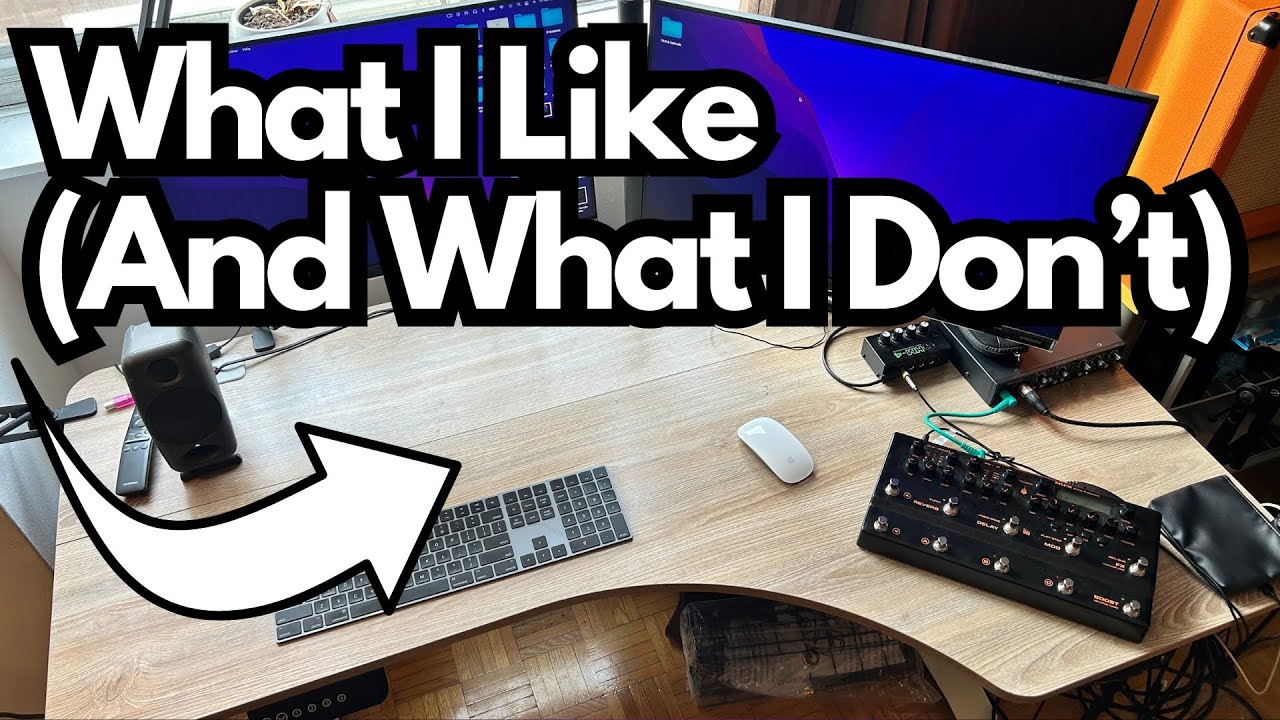
If you’re a guitarist or bedroom producer trying to squeeze a functional studio into a small space, your desk matters more than you think. It’s not just where your computer sits—it’s where your interface, monitors, pedals, headphones, and sometimes your guitar itself all have to coexist.
After three years of daily use, this 55″ electric standing desk has become the center of my music setup. It’s not perfect, but it’s been rock-solid, flexible, and surprisingly reliable for both work and music production (get it here on Amazon).
Overview / First Impressions
This is a 55-inch wide electric standing desk with programmable height presets. For an average-height player (I’m 5’9″ / ~178 cm), it hits a sweet spot between compact and usable:
- Width: 55″ – enough for a dual-monitor setup, studio monitors, and a small interface or pedalboard on top.
- Stability: Very stable at both sitting and standing heights. No wobble issues.
- Height presets: Multiple memory presets that make switching between sitting, standing, and “guitar mode” effortless.
If you’re working in a smaller apartment or studio room, this size is very manageable while still giving you enough real estate for a functional music workspace.
Build Quality & Design
Structurally, the desk has held up extremely well:
- Frame & lift mechanism: After three years, the lift system still works smoothly. No grinding, no stalling, and no need for oiling or maintenance so far.
- Stability: Even at maximum height, the desk feels secure. That’s important if you’ve got expensive monitors or a computer on top.
- Surface size: The 55″ top is enough for:
- A computer and monitor(s)
- A pair of speakers
- An audio interface / headphone amp
- Space to put a guitar on your lap without feeling cramped
The main design limitation is storage: this particular model doesn’t have drawers or an under-desk pull-out compartment. That’s something I definitely miss for things like pens, picks, capos, and small accessories.
Features & Functions
Electric Height Adjustment
The core feature is the motorized height adjustment with presets:
- Preset 1 – Standing: Set to my full standing height.
- Preset 2 – Sitting: Standard sitting position for typing, editing, and browsing.
- Preset 3 – Music Production / Guitar: A little lower than typical desk height, ideal when I’m playing guitar while seated so my arms and shoulders are more relaxed.
You can dial in a height very precisely and then save it as a preset by holding down the button. Switching between modes during the day is just a single button press.
Cable Management
For a music setup, cable management is critical, and this desk helps with that:
- Built-in pass-throughs / cutouts: Great for routing:
- Speaker cables
- Headphone cables
- Interface and USB cables
- Under-desk cable trays/compartments: Designed to hold power strips and excess cable length so everything isn’t dangling under the desk.
You can even buy additional cable trays if you need more. In practice, if you’re running:
- Studio monitors
- Headphones
- A headphone splitter
- USB devices
- Power cables
those trays and pass-throughs make a big difference compared to a basic table.
How It Works for Guitarists & Home Producers
From a guitarist’s perspective, the height presets are the game-changer.
Playing & Recording Guitar
- Low “guitar mode” preset: Lowering the desk slightly makes it much more comfortable to:
- Play guitar while seated
- Reach your interface knobs and controls
- Use a desktop modeler, amp sim, or pedalboard on the desk
- Standing work sessions: If you’re editing, mixing, or doing non-playing tasks, standing mode is great for long sessions and keeping your back happier.
Small Room / Apartment Use
In a cramped apartment or bedroom studio:
- The 55″ width is big enough to feel like a “real” studio desk.
- It doesn’t dominate the room like a massive L-shaped workstation would.
- The built-in cable management helps keep the inevitable tangle of audio, power, and USB cables somewhat under control.
If your space is tight but you still want a usable production setup that can handle guitar, this size and style of desk is a very practical middle ground.
Limitations / Things to Know
This desk has been reliable, but there are a few things to keep in mind—especially if you’re planning a more serious or larger studio setup.
1. Height for Taller Players
I’m 5’9″ (~178 cm), and at full extension, the standing height is perfect for me. If you’re significantly taller—say 6’4″ (193 cm) or more—this model may feel too short:
- You might have to tilt your monitor up awkwardly.
- Your arms and shoulders may not be at an ideal ergonomic angle.
If you’re tall, look for a desk with a higher maximum height and possibly a deeper or wider surface.
2. Lack of Built-In Storage
This model doesn’t include:
- Drawers
- A pull-out tray
- Upper shelves
For a guitarist or producer, that means no dedicated place for:
- Strings
- Picks
- Capos
- Cables
- Notebooks
You can work around this with separate drawer units or shelves, but if you know you want an all-in-one workstation with drawers and upper racks, you’ll probably want a more full-featured studio desk or an L-shaped setup.
3. Cable Chaos Is Still Possible
The desk gives you good tools for cable management, but:
- If you have a lot of gear (multiple headphones, splitters, interfaces, power supplies), it can still get messy.
- You’ll need to actually use the trays and tie things down—otherwise you’ll end up with a tangle under the desk.
The hardware is there; the organization still takes effort.
Final Thoughts
After three years of daily use, this 55″ standing desk has proven to be:
- Reliable: The motor and mechanics still work perfectly with no maintenance.
- Practical for guitarists and producers: The ability to save a lower “guitar mode” preset is genuinely useful, not a gimmick.
- Well-suited to small rooms: It fits comfortably in a cramped apartment while still supporting a full basic studio setup.
What I’d do differently next time:
- Get a model with drawers or an under-desk compartment for small items.
- Consider a larger or L-shaped desk once I have a bigger room, to add more workspace and storage.
But for an average-height player in a modest space who wants a flexible, height-adjustable desk that can handle both work and music production, this kind of 55″ standing desk is a solid, long-term solution.
Resources
If you’re considering a similar setup, here are a few things worth looking into:
- Cable trays and under-desk organizers – to take full advantage of the desk’s cable management.
- Monitor stands or risers – especially useful if you’re fine-tuning ergonomics for both sitting and standing.
- Side drawer units or small shelves – to make up for the lack of built-in storage for guitar accessories and studio odds and ends.