

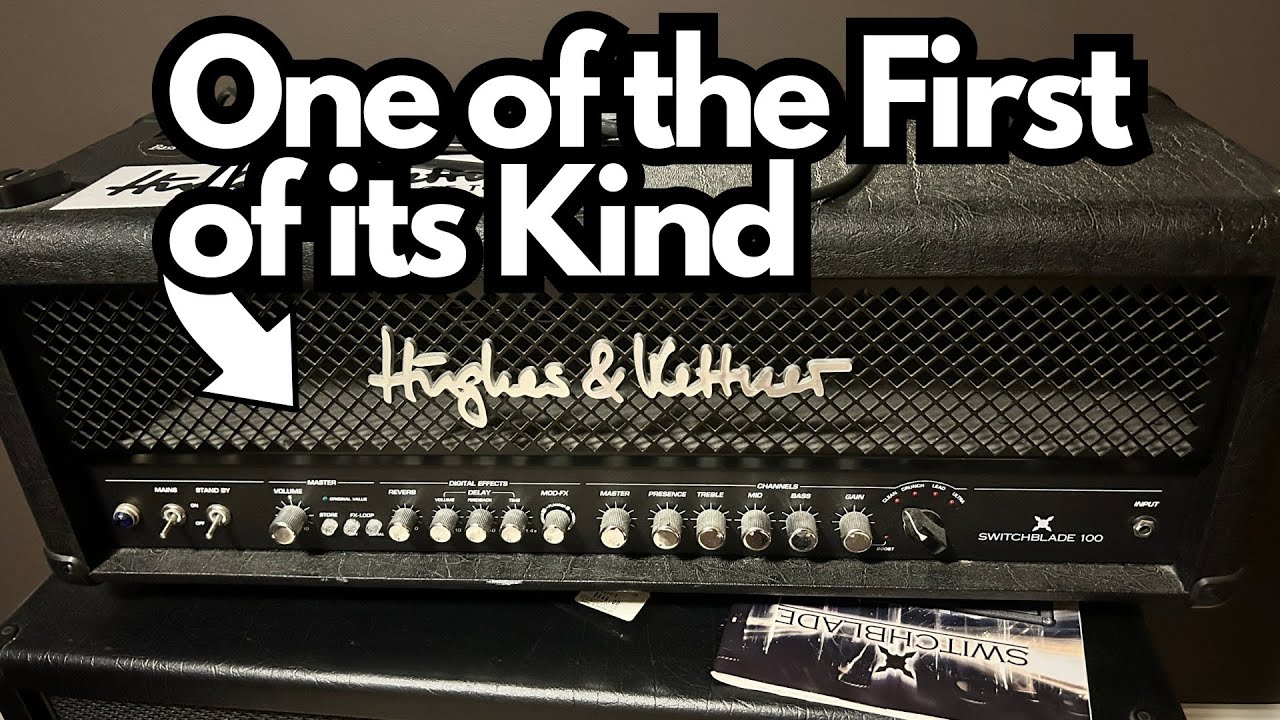
If you’ve ever lugged a full-size tube head to rehearsal, you know the love–hate relationship that comes with big amps. The Hughes & Kettner Switchblade 100 is very much that kind of amp: loud, feature-packed, visually striking… and, for many modern players, a bit more than we practically need.
I’ve had this amp for well over a decade, and while it doesn’t see much use these days, it’s still a solid example of a premium, all-in-one tube head designed for gigging guitarists who want flexibility and built‑in effects.
Overview / First Impressions
The Switchblade 100 is a 100‑watt tube head with multiple channels and onboard digital effects. When it came out, it was aimed at guitarists who wanted:
- Real tube power and feel
- Multiple switchable channels
- Built-in delay, reverb, and modulation
- MIDI/foot-controlled versatility for live use
It delivers on most of that. It’s loud, clear, and versatile, and it looks great with that signature Hughes & Kettner blue glow. For full-band rehearsals and gigging, it absolutely does the job.
The main downside, from my experience, is the distortion character. I never quite managed to dial in a gain tone I loved, especially compared to dedicated high‑gain amps or modern pedals. And in today’s world of compact rigs, modelers, and smaller tube combos, a 100‑watt head like this can feel like overkill if you’re mostly playing at home.
Build Quality & Design
Physically, the Switchblade 100 feels like a proper, roadworthy head:
- Size & Weight: It’s big and heavy—the classic 100‑watt tube head format. Great for stages, less great for apartments.
- Aesthetic: The front panel lights up in a cool blue when powered on. It’s a distinctive Hughes & Kettner look that still holds up visually.
- Standby Switch: There’s a proper standby switch, so you can power the amp on, let the tubes warm up, and then flip it into play mode. Standard tube amp stuff, but always appreciated.
- Footswitch: It comes with a dedicated footswitch that lets you access the different channels and features on the fly. Very handy for live sets where you’re switching from clean to crunch to lead within a song.
Overall, it feels like a premium piece of gear built for gigging guitarists who need reliability and flexibility.
Features & Functions
The Switchblade 100 is feature-rich for a tube head, especially considering its era.
Multi-Channel Layout
You get four different channels, covering the classic bases:
- Clean
- Crunch
- Higher gain rhythm
- Lead/solo tones
Each channel is voiced differently, giving you a wide range of gain structures without needing extra pedals for basic rock and metal tones.
EQ & Tone Shaping
The amp offers a four-band EQ, giving you more control than the typical three-band (bass, mid, treble) layout. While the exact labeling will depend on the front panel, think in terms of:
- Bass
- Low mids
- High mids
- Treble
This extra band lets you fine-tune your midrange in a more surgical way, which is especially useful when you’re trying to cut through a mix or tame harshness.
You also get gain and volume controls, as you’d expect, so you can balance your channels and sculpt your drive.
Built-In Effects
One of the Switchblade’s big selling points is its integrated digital effects section:
- Digital delay
- Reverb
- Flanger / modulation
- Tremolo
These aren’t boutique-level studio effects, but they’re genuinely useful for live work and practice. Having delay and reverb on tap without needing extra pedals makes this a very self-contained rig.
Effects Loop
The amp includes an effects loop, which is crucial if you want to:
- Run time-based effects (delay, reverb, chorus) after the preamp
- Integrate external pedals or processors more cleanly
- Use an attenuator or load box in a more flexible way
If you’re into more complex rigs, this loop keeps the Switchblade compatible with modern pedalboards and outboard gear.
How It Sounds / Use Cases
Clean & Modulated Sounds
The clean channel, paired with the onboard delay, reverb, and modulation, can get you into:
- Spacious ambient textures
- Classic chorus‑y clean tones
- Subtle tremolo‑enhanced rhythms
For worship, pop, or classic rock, the clean and edge-of-breakup tones are very usable, especially when you lean on the built-in effects.
Crunch & Gain Tones
The crunch and lead channels provide plenty of gain for rock and heavier styles. However, in my experience:
- The distortion character wasn’t my favorite
- I struggled to dial in a truly satisfying high‑gain tone
- It never quite matched the feel and clarity I wanted for more modern or tight metal tones
You can absolutely gig with the drive channels, but if you’re picky about your gain texture, you may find yourself preferring external pedals into the clean channel or another dedicated high-gain amp.
Volume & Practical Use
At 100 watts, this amp is loud. Very loud.
Perfect for:
- Full band rehearsals
- Larger stages
- Situations where you need real headroom
Less ideal for:
- Bedroom playing
- Small apartments
- Late-night practice without attenuation
You can tame it with tools like a JHS Little Black Amp Box or a proper attenuator, running it through the effects loop or between the head and cab. That helps, but it doesn’t change the fact that it’s a physically large, powerful head.
These days, that’s the main reason I don’t use it much—it’s simply more amp than I need for home and small-space playing.
Limitations / Things to Know
A few practical considerations if you’re thinking about a Switchblade 100:
- Sheer Size & Power: It’s a big 100‑watt head. Great for stages, awkward for home.
- Distortion Voicing: The gain channels may not satisfy players who are very picky about high‑gain tone. You might end up using pedals or sticking to other amps for your main drive sounds.
- Aging Digital Effects: The built-in effects are handy but not on the level of modern high-end multi‑FX units. They’re more about convenience than ultimate tone quality.
- Modern Alternatives: With today’s compact tube amps, modelers, and IR-based solutions, a big head like this is less essential unless you specifically want the feel and aesthetic of a full tube rig.
Final Thoughts
The Hughes & Kettner Switchblade 100 is a well-built, feature-rich tube head that still holds up as a serious gigging amp:
Strong points:
- Loud and clear with real tube punch
- Four channels and a flexible EQ
- Built-in delay, reverb, and modulation
- Solid footswitch and effects loop
Weak points:
- Distortion character that may not please every ear
- Size and volume that are overkill for many modern players
If you’re playing in a loud band, want an all-in-one head with built-in effects, and don’t mind the footprint, this amp can absolutely do the job. If you’re mostly practicing at home or chasing very specific high-gain tones, you might find it less ideal.
Resources & Further Study
If you’re working on your playing to match whatever amp you’re using, two resources are worth checking out:
- Fretboard Memorization Cheat Sheet – A triad-based system for learning all the notes on the fretboard and understanding major and minor triads in every key. It uses techniques like octave mapping to help you internalize harmony and start improvising more confidently in multiple keys. Available Here.
- Traveling Guitarist Forum – A place to discuss guitar, music, and related topics with other players:
forum.travelingguitarist.com
The amp is only half the equation—knowing your fretboard and harmony is what really unlocks your sound.