

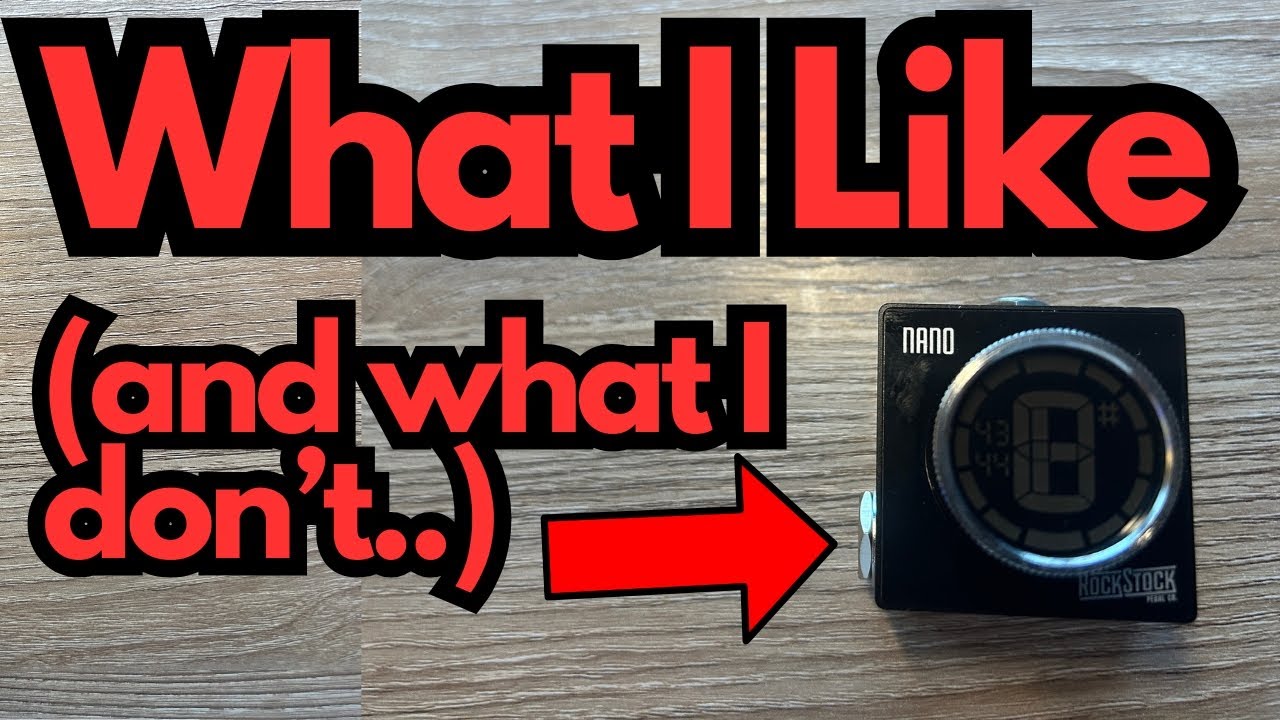
If you’ve been playing guitar for any length of time, you probably feel the same way I do about tuners: they’re everywhere. Your multi‑FX has one, your DAW has one, half your pedals have one hidden in a menu. It’s easy to think you don’t need another dedicated tuner on your board.
That’s exactly how I felt—right up until I saw how small the Rockstock Mini Tuner (on Amazon) actually is.
This little pedal is all about saving space while still giving you a quick, reliable way to get in tune. If you’re running a crowded pedalboard, playing small stages, or just want a no‑nonsense tuner that doesn’t eat up half a row of pedals, this is aimed squarely at you.
Overview / First Impressions
My first reaction when Rockstock offered to send this over was: “Another tuner? Why?” Between my Line 6 M5, the NUX processor, and the tuner in my DAW, I’m already covered.
The Rockstock Mini Tuner changed my mind for one simple reason: size.
To put it in perspective, it’s barely bigger than a quarter. On a real‑world pedalboard, that means it can squeeze into spaces where a regular pedal simply won’t fit. If you’ve ever had to re‑arrange your entire board just to add a tuner, you’ll immediately see the appeal.
Despite its tiny footprint, it behaves just like a standard stompbox tuner: plug in, step on it, tune up, and get back to playing.
Build Quality & Design
The design is minimal and functional:
- Ultra‑compact enclosure – This is the headline feature. It’s one of the smallest tuners you’re going to find for a pedalboard.
- Sturdy feel – Even though it’s tiny, it doesn’t feel like a toy. It’s built to live on a board and be stepped on.
- Simple control layout – No extra knobs or menus. Just a footswitch and a display that shows you what you need to see when you’re tuning.
It’s the kind of pedal you can tuck into the corner of your board and forget about until you need it.
Features & Functions
The Rockstock Mini Tuner keeps things simple, which is a plus if you just want to get in tune and play:
- Standard stomp activation
- Step on it once to engage the tuner.
- Step again to go back to your signal.
- Bypass mode – When you disengage the tuner with a quick press, it sends your guitar signal through as normal. It behaves like a standard pedal in your chain.
- Power on/off via footswitch
- Hold the footswitch for about two seconds to power the unit off.
- Power it back on with another long press.
There’s no learning curve here. If you’ve ever used a basic pedal tuner, you’ll feel right at home.
How It Sounds / Use Cases
In terms of sound, the best thing you can say about a tuner is that it doesn’t get in the way—and this one doesn’t.
- Accurate, quick tuning – Hit the switch, tune up, and you’re good. It does exactly what it’s supposed to.
- Ideal for cramped boards – If you’re already using something like a Line 6 M5 or a NUX processor but still want a dedicated tuner you can hit instantly, this is a great option.
- Great for live and rehearsal – Because it’s always there, always visible, and doesn’t require menu diving, it’s handy when you just need to mute and tune quickly between songs.
- Very Visible and Not Too Bright – One thing I really appreciate about it is that it’s not too bright, unlike the MXR Isobrick, which tends to have extraordinary LEDs. It’s the perfect amount of brightness, and there’s always a dim light on it so you can see what you’re doing.
- Chromatic – It’s worth mentioning that it’s a chromatic tuner as well. C#, Eb, it doesn’t matter. It knows what you’re trying to do.
Realistically, this isn’t about “tone enhancement” or wild features. It’s about convenience and space‑saving, and in that role it does really well.
Limitations / Things to Know
A few things to keep in mind:
- No extra bells and whistles – If you’re looking for alternate tunings, multiple display modes, or strobe‑style tuning, this isn’t that kind of unit. It’s straightforward.
- Display size – Because the pedal is so tiny, the screen is necessarily small. It’s fine up close on a pedalboard, but don’t expect huge, stage‑filling graphics.
- Single‑purpose tool – This isn’t trying to replace the deep functionality of a multi‑FX tuner or DAW plugin. It’s a dedicated, always‑on‑your‑board solution.
- Good for making angles the right way – What do I mean by that? It means that some pedals have input jacks on the top. Putting this before that pedal allows you to go straight into it like normal, unless you have a right-angled jacked. In which case, no worries.
None of these are dealbreakers if what you really want is a tiny, reliable tuner that just works.
Final Thoughts
I went into this pretty skeptical. With tuners built into nearly every piece of modern guitar gear, it’s easy to write off another standalone unit as redundant.
But the Rockstock Mini Tuner won me over for one simple reason: it takes up almost no space, and it just works.
If you’re running out of room on your board, or you like the idea of a dedicated tuner that doesn’t push anything else off your setup, this is a genuinely useful little pedal. It’s small, it’s practical, and it does exactly what it’s supposed to do without fuss.
I’ll be keeping it on my board—for something this tiny, there’s really no reason not to.
Resources
If you’re looking to tighten up not just your tuning but your overall fretboard skills, I recommend grabbing a fretboard cheat sheet to go along with a reliable tuner. You can check one out here:
- Fretboard Cheat Sheet: travelingguitarist.com/fretboard-cheatsheet