

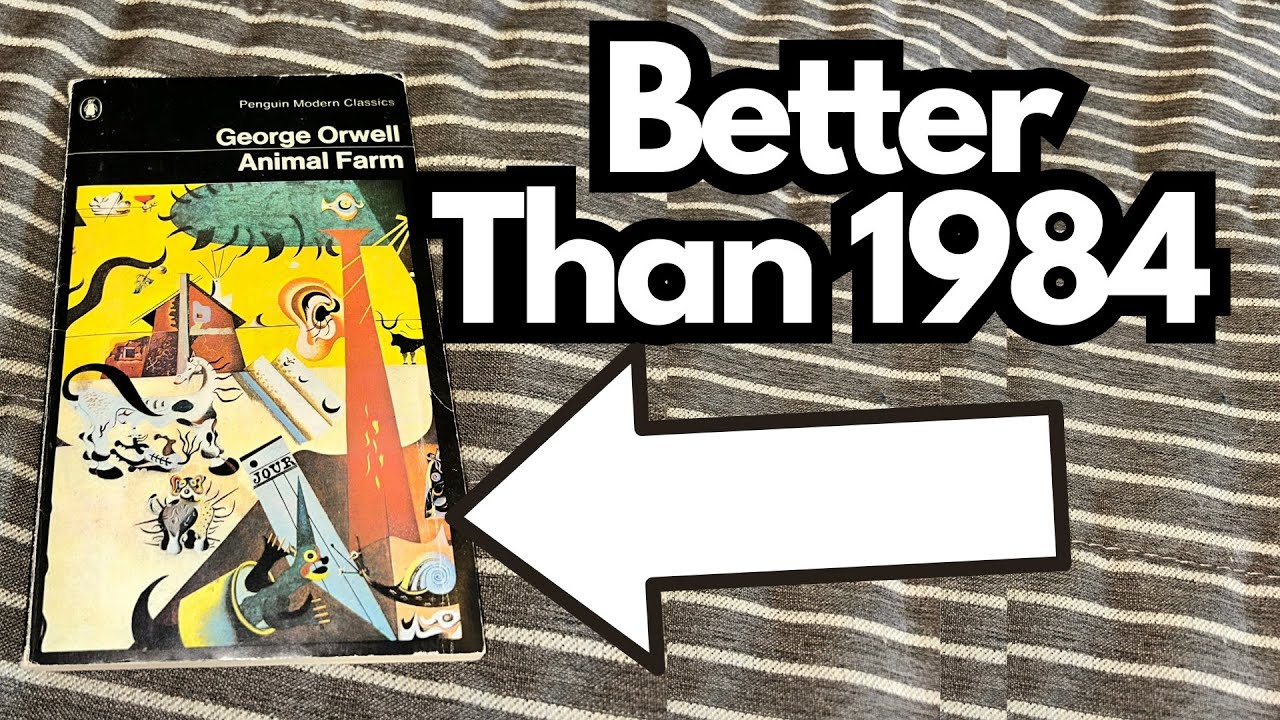
If you’ve ever felt like you should love George Orwell’s 1984 but found it a bit heavy or slow, you’re not alone. For many readers, Animal Farm ends up being the more entertaining, memorable, and re-readable of the two.
This short, deceptively simple book packs a lot into its roughly 120 pages. It’s quick to read, easy to follow, and still manages to explore some serious themes—especially the rise of authoritarianism and how power can corrupt. You can grab it here on Amazon if you’re interested.
Below is a breakdown of why Animal Farm might be worth your time, even if you’ve already read 1984 (or bounced off it).
Overview / First Impressions
Animal Farm is a short novel—almost a novella—that you can realistically finish in a day or two. That alone makes it appealing if you don’t have the time or patience for denser political fiction.
What stands out most is how entertaining it is. The story moves quickly, the characters are memorable, and the whole thing reads more like a sharp, dark fable than a heavy-handed political treatise. It’s the kind of book you can enjoy on the surface, then think about for days afterward.
Build Quality & Design (As a Reading Experience)
From a “design” perspective as a reader, Animal Farm is:
- Length: Around 120 pages, which keeps it tight and focused.
- Pacing: Very little filler; the plot keeps moving.
- Clarity: Written in plain, accessible language. You don’t need a background in political theory to follow what’s going on.
- Re-readability: Because it’s short and straightforward, it’s easy to revisit and pick up new details each time.
Compared to 1984, which can feel long and dense, Animal Farm is compact and efficient. You get the core of Orwell’s ideas without wading through as much exposition.
Features & Functions (What the Book Actually Does)
At its core, Animal Farm is an allegory about:
- The rise of authoritarianism
- How revolutions can be betrayed from within
- How language and propaganda are used to control people
- The gradual erosion of rights and equality
It uses a simple premise—animals overthrowing their human farmer and running the farm themselves—to explore these themes. The “functions” of the book, so to speak, include:
- Making complex politics understandable. Instead of abstract theory, you get a concrete story with characters and events that clearly mirror real-world history.
- Showing how power shifts gradually. The changes on the farm don’t happen all at once; they creep in little by little, which makes the story feel disturbingly realistic.
- Highlighting human (and animal) nature. Ambition, fear, loyalty, and naivety all play a role in how the farm’s society rises and falls.
Even if you don’t remember every detail, the overall arc and message tend to stick with you.
How It “Sounds” / Who It’s For
In terms of tone and feel, Animal Farm is:
- Entertaining and engaging: It reads more like a dark fairy tale than a textbook.
- Straightforward but not shallow: You can enjoy it as a story, but there’s a lot going on under the surface.
- Accessible to different ages: It’s often assigned in school, but adults can get just as much (or more) out of it.
You’ll probably enjoy Animal Farm if:
- You like political or dystopian themes but don’t want a 400-page slog.
- You prefer stories that show ideas through events and characters instead of long explanations.
- You want something you can read in a couple of sittings but think about for weeks.
Limitations / Things to Know
A few points to keep in mind:
- It’s short. If you’re looking for deep world-building or a sprawling cast, this isn’t that. Its strength is in its simplicity.
- It’s an allegory first. Some characters and events exist primarily to represent historical or political ideas. If you’re after purely character-driven fiction, you might find that a bit on-the-nose.
- It’s bleak. Even though it’s entertaining, it’s not a feel-good story. The themes are heavy, and the conclusion is pretty dark.
That said, these “limitations” are also part of what make it so effective.
Final Thoughts
For many readers, Animal Farm ends up being more interesting and entertaining than 1984. It delivers similar themes—authoritarianism, propaganda, the corruption of ideals—but in a tighter, more approachable package.
If you’ve been meaning to revisit Orwell or you just want a powerful, thought-provoking read that won’t take weeks to finish, Animal Farm is absolutely worth picking up. It’s short enough to read in a day or two, and strong enough that you might find yourself wanting to read it again.