

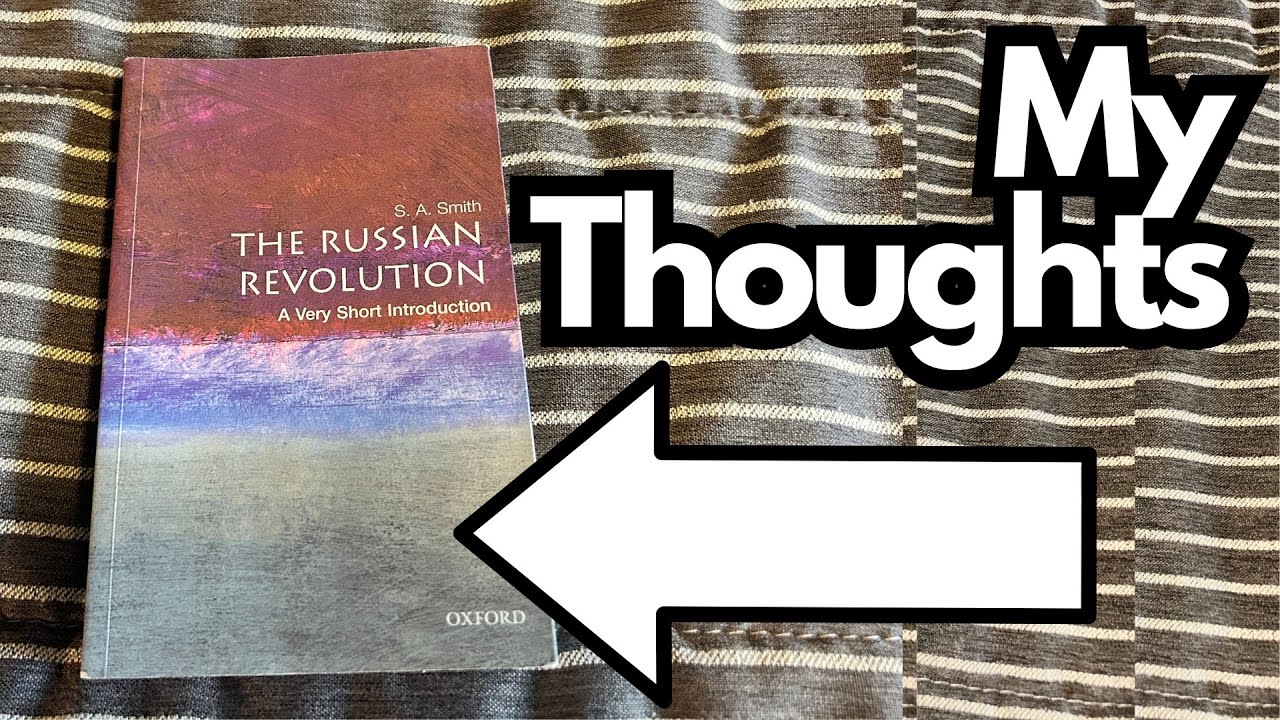
If you’re curious about big historical ideas but don’t want to wade through 500-page tomes, the Very Short Introduction series is usually a great place to start.
I’ve picked up a few of these—on Foucault, Marx, and now the Russian Revolution—because they promise compact, accessible overviews of complex topics.
Out of the ones I own, The Russian Revolution: A Very Short Introduction turned out to be the least engaging for me personally.
That doesn’t mean it’s a bad book; it just didn’t click with my interests the way the others did. Still, if you’re looking for a concise, illustrated primer on the Russian Revolution, this might be right up your alley. You can grab it here on Amazon if you’re interested.
Overview / First Impressions
This book is exactly what the title suggests: a short, general overview of the Russian Revolution. It’s designed for readers who:
- Want a quick introduction rather than an in-depth academic study
- Appreciate visual aids like pictures and text boxes
- Prefer a structured, textbook-style summary of events and themes
If you’re completely new to the topic and just want to understand the basics—what happened, why it mattered, and who the key players were—this book delivers that in a compact format.
For me, the main issue was that I simply don’t find the Russian Revolution as inherently interesting as some of the more theory-heavy topics like Foucault or Marx. So while the book does what it sets out to do, it didn’t hold my attention in the same way.
Build Quality & Design
Physically and visually, it’s a well-put-together little book:
- Short and portable – true to the “Very Short Introduction” branding, it’s slim and easy to carry or read in a couple of sessions.
- Illustrations and photos – there are images throughout that help give context to people, places, and events.
- Text boxes – important concepts, side notes, or key facts are highlighted in separate boxes, which break up the main text and make scanning or revisiting sections easier.
The layout feels more like an accessible mini-textbook than a dense historical treatise, which will appeal to readers who like structure and visual variety.
Features & Content Focus
The book focuses on giving you a broad, digestible picture of the Russian Revolution rather than arguing a bold new thesis. Expect:
- A chronological overview of major events
- Basic introductions to the main figures and factions
- Context around the political and social conditions leading up to the revolution
- Some discussion of the aftermath and how it shaped the 20th century
It’s not overloaded with footnotes or academic jargon. Instead, it aims to be a first step into the subject—something you can read quickly to get oriented before deciding whether you want to dive deeper with more specialized books.
How It Reads / Who It’s For
From a reader’s perspective, this works best if:
- You enjoy survey-style history writing
- You’re okay with a broad, surface-level treatment rather than deep analysis
- You like having visuals and callout boxes to guide your eye and reinforce key points
If you’re already well-read on the Russian Revolution, you’ll probably find this too basic. But if you’re a student, a casual history fan, or someone just trying to fill in a gap in your general knowledge, it’s a convenient entry point.
Personally, I found it a bit dry. That’s partly the subject matter for me—I just don’t connect with this particular slice of history the way I do with philosophical or theoretical works. So while the book is competent, it didn’t feel especially gripping.
Limitations / Things to Know
A few caveats before you pick it up:
- Very general – by design, it can’t go deep. Major debates and complexities are often simplified or only briefly mentioned.
- Tone can feel textbook-like – if you prefer narrative history with lots of storytelling and human drama, this may feel a bit clinical.
- Not for specialists – anyone with a solid background in 20th-century history will find much of it familiar and perhaps too light.
In other words, it’s an introduction in the strictest sense: useful as a starting point, but not a definitive or richly detailed account.
Final Thoughts
The Russian Revolution: A Very Short Introduction is a solid, compact overview of a major historical event. It does what it promises: gives you a clear, illustrated, and structured summary of the Russian Revolution in a small, approachable package.
For my own tastes, it was the least engaging of the Very Short Introductions I own—Foucault and Marx held my interest far more. But that’s more about my preferences than the quality of the book itself.
If you:
- Want a quick, visual, and accessible primer
- Are new to the topic and don’t need deep analysis yet
then this is a perfectly reasonable place to start learning about the Russian Revolution. If you already know the basics or prefer more narrative-driven history, you might want to skip straight to more in-depth works.