

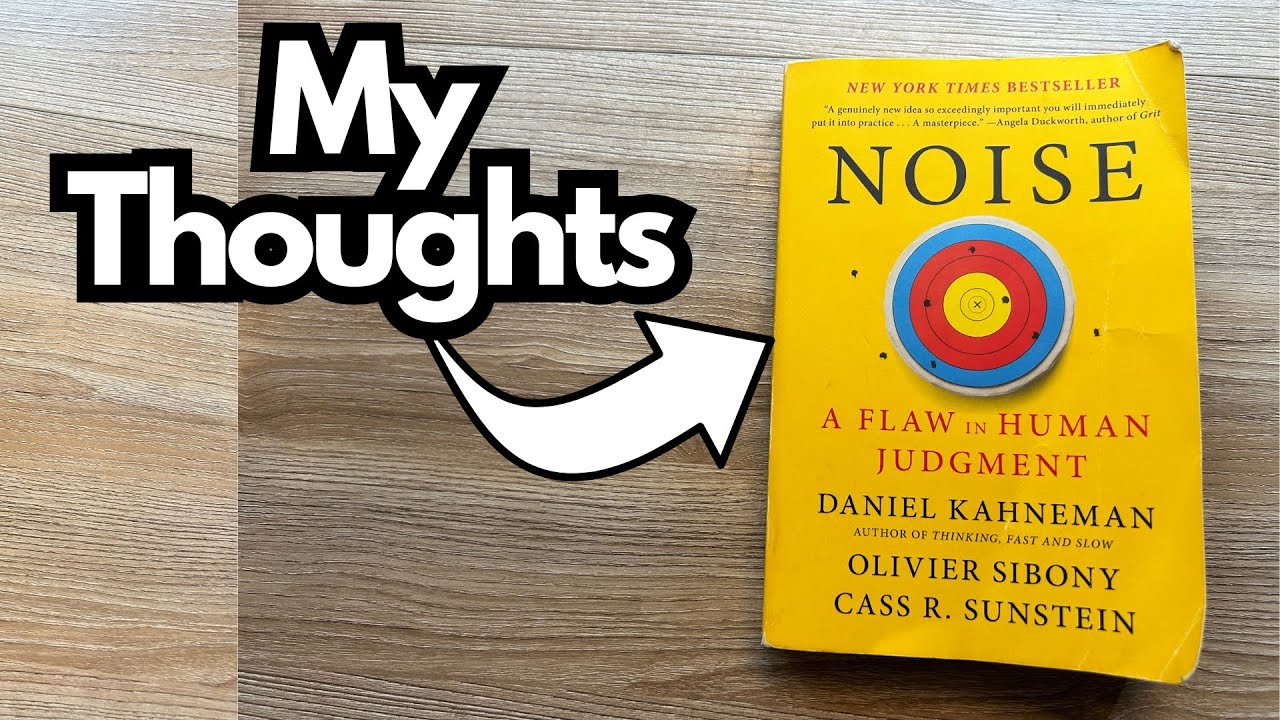
If you’re into psychology, decision-making, or behavioral economics, you’ve probably heard of Daniel Kahneman. His book Thinking, Fast and Slow became a modern classic for anyone curious about how we think and why we make the choices we do.
Noise: A Flaw in Human Judgment (on Amazon) is another big, ambitious book in that same space. But is it actually enjoyable to read—and more importantly, is it for you?
This post is a straightforward, no-fluff reaction to Noise from the perspective of a general, non-math-obsessed reader.
Overview / First Impressions
Noise tackles how inconsistent human judgment can be. Two people can look at the same situation and come to wildly different conclusions—not just because of bias, but because of random “noise” in their thinking. The book digs into how this shows up in fields like law, medicine, and business.
On paper, it’s a fascinating topic.
In practice, this is a very dense, very technical read. Compared to Thinking, Fast and Slow, Noise feels heavier, more mathematical, and less accessible if you don’t naturally enjoy stats and data.
If you’re not mathematically inclined, this book can feel like a slog.
Features & Functions (What the Book Tries to Do)
Conceptually, Noise sets out to:
- Define “noise” as a separate problem from bias in human judgment.
- Show how noise appears in real-world systems, like:
- Sentencing decisions in courts
- Medical diagnoses
- Hiring and performance reviews
- Business forecasts
- Explain how to measure noise using tools from statistics and decision theory.
- Propose ways to reduce noise, such as:
- More structured decision-making processes
- Clearer guidelines and checklists
- Statistical models and algorithms
You don’t need a statistics degree to follow it, but the book definitely leans on mathematical thinking. It frequently uses quantitative reasoning, probability, and measurement concepts to build its case.
If you’re comfortable with that kind of material—or you enjoy stretching yourself in that direction—you’ll likely appreciate what the book is trying to do.
How It Reads / Who It’s For
From a reading-experience standpoint, here’s the key point:
- If you loved the ideas and style of Thinking, Fast and Slow and wanted something even more technical, Noise might be right up your alley.
- If you struggled with the denser parts of Thinking, Fast and Slow, Noise will probably feel like too much.
The tone is:
- Serious and academic, rather than story-driven.
- Concept-heavy, with fewer “aha” moments that feel immediately applicable in everyday life.
- More math- and stats-oriented than many popular psychology books.
For someone without a strong math or stats background, it’s not impossible to get through—but it can feel like work. You may find yourself pushing just to finish, rather than genuinely enjoying the process.
Limitations / Things to Know
Before you dive in, it’s worth being realistic about a few limitations:
- Very dense: This isn’t a quick or light read. Expect to move slowly and reread sections.
- Math-leaning: While not a pure statistics text, it definitely leans that way. If you’re math-averse, that’s a big factor.
- Less engaging than Kahneman’s earlier work: If you’re comparing it to Thinking, Fast and Slow, this one feels heavier and, for many general readers, less enjoyable.
- Not ideal as an introduction: If you’re new to decision-making psychology or behavioral economics, this is a tough place to start.
Final Thoughts
Noise is a serious, ambitious book that will likely be excellent for a specific kind of reader:
- Someone with a stats or quantitative background, or at least a strong comfort level with numbers.
- Someone who enjoys dense, technical non-fiction and doesn’t mind a slower, more demanding read.
- Someone deeply interested in how to formalize and improve human judgment in professional or institutional settings.
If you’re more of a general-interest reader who enjoyed Thinking, Fast and Slow for its stories and big ideas, Noise may feel too dense and math-heavy to be enjoyable. You can still get value from it, but you’ll probably have to push yourself to finish.
In my own case, I found it difficult to get through and ultimately didn’t enjoy it nearly as much as Kahneman’s earlier work. That doesn’t mean it’s a bad book—it just means it’s aimed at a narrower, more technically minded audience.
If you see yourself in that description, Noise could be a rewarding deep dive. If not, you might be better off revisiting Thinking, Fast and Slow or exploring other, more accessible books on judgment and decision-making.