

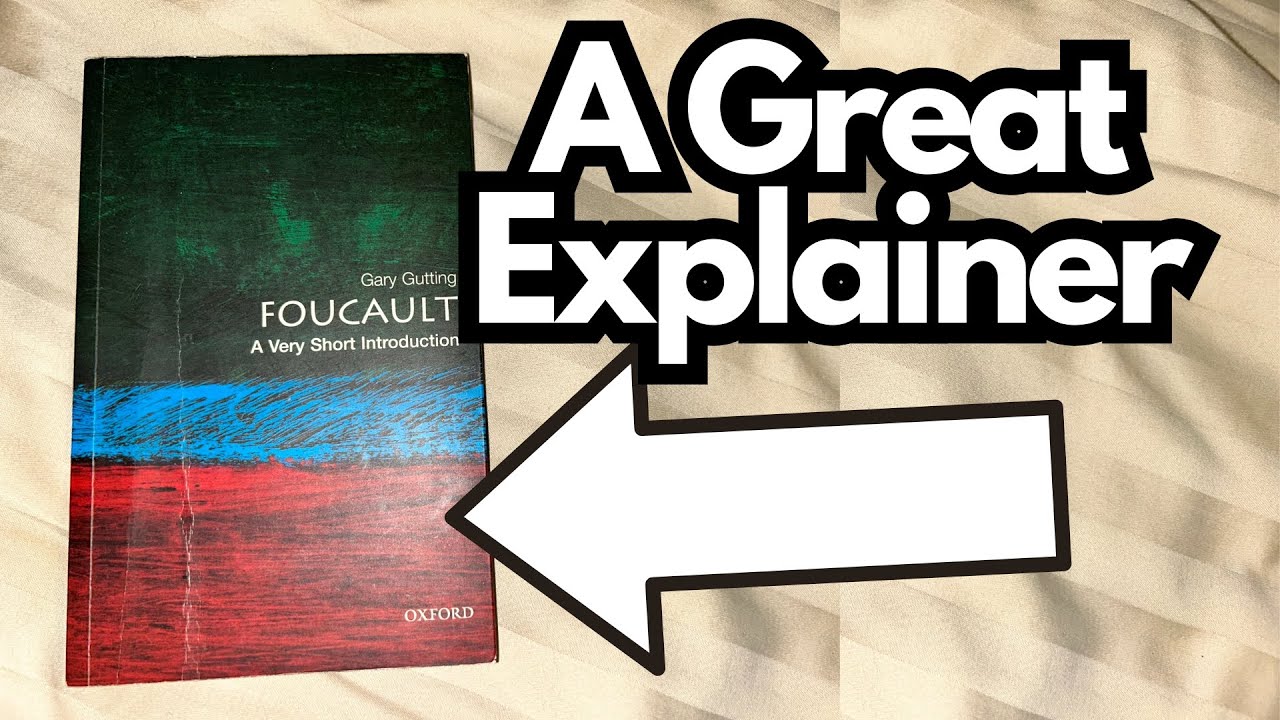
If you’ve ever wandered into the world of philosophy or critical theory—maybe through music school, art school, or just late-night YouTube rabbit holes—you’ve probably seen the name Michel Foucault pop up.
He’s one of those “you’re supposed to know this guy” thinkers that people love to reference in discussions about culture, power, and society.
But for most people—especially if you’re a working musician, creative, or just a curious reader—diving straight into Foucault’s original texts is often more pain than payoff. You can grab this book on Amazon if you’re interested.
This post breaks down why that is, what to do instead, and how to actually get the useful bits of Foucault without drowning in dense, pretentious prose.
Overview / First Impressions
Foucault’s writing has a reputation: dense, abstract, and, to many readers, unnecessarily difficult. The core ideas—about power, institutions, surveillance, and how societies shape individuals—are interesting and influential. But the way they’re presented in his original books can feel like wading through wet concrete.
The main argument here is simple:
- You don’t need to read Foucault directly to understand Foucault.
- For most people, especially outside academic philosophy, reading good summaries and secondary sources is a better use of time.
- The difficulty of his writing often isn’t rewarded with a proportional increase in understanding or personal growth.
If you’re a musician or guitarist who just wants to understand the cultural and philosophical backdrop to some of the art you love, there are far more efficient ways to get there.
My Thoughts On Focault’s Ideas
Think of Foucault’s work like a boutique pedal with a terrible user interface:
- Under the hood: There’s a lot going on—complex circuits, unusual routing, interesting tonal possibilities.
- On the surface: The controls are cryptic, the labels are obscure, and the manual is written in another language.
Foucault’s books are similarly “built”:
- Highly technical language loaded with specialized terms.
- Long, winding sentences that make it hard to track the main point.
- Assumes a lot of background knowledge in philosophy, history, and social theory.
From a “design” standpoint, his writing isn’t optimized for clarity or accessibility. It’s optimized for academic discourse. If you’re not already living in that world, it can feel like you’re being kept outside the club.
What Is Foucault Actually About?
Stripped of the jargon, Foucault’s main “features” as a thinker include:
- Power and institutions
How schools, prisons, hospitals, and other systems shape behavior and define what’s “normal.” - Discourse
How the way we talk about things (madness, sexuality, crime, etc.) creates the categories themselves. - Surveillance and control
Ideas like the panopticon—a metaphor for how being watched (or thinking you’re being watched) changes how you act. - Historical analysis
He looks at how ideas and institutions evolve over time, rather than treating them as timeless or natural.
These are legitimately useful ideas for understanding modern life, politics, and culture. They even show up indirectly in music scenes—think about:
- How genres get policed by “gatekeepers.”
- How streaming platforms and social media shape what we hear and how we present ourselves.
- How “normal” or “acceptable” music is defined and enforced by labels, platforms, and even scenes.
The ideas matter. The question is whether reading Foucault himself is the best way to get them.
Why Foucault is a Tough Sell For Me
From a guitarist’s perspective, reading Foucault is like:
- Listening to an album that’s all dissonance and no groove.
- Trying to learn a solo that’s technically impressive but melodically joyless.
The experience often feels:
- Needlessly challenging – The difficulty doesn’t always deepen understanding; it sometimes just slows you down.
- Low on payoff – You can spend hours on a few pages and still walk away with a vague sense of what was said.
- Detaching rather than enriching – Instead of feeling inspired or enlightened, you may just feel exhausted.
The key point: you don’t automatically become a better thinker, artist, or person by grinding through Foucault’s original texts. The struggle itself isn’t inherently virtuous if the same ideas can be accessed more clearly elsewhere.
A Better Approach: Use Good Summaries
Instead of buying every Foucault book and forcing yourself through them, a more practical and efficient route is:
- Read a solid overview or introduction to Foucault’s thought.
There are plenty of books and guides that:- Explain his main concepts in plain language
- Give context for each major work
- Show how his ideas connect to real-world issues
- Use secondary sources as your “amp sim.”
Just like a great amp sim can get you 95% of the tone without hauling a 4×12, a well-written summary can get you most of Foucault’s value without years of academic training. - Only go to the originals if you have a specific reason.
For example:- You’re doing academic work.
- You want to quote him directly.
- You genuinely enjoy reading dense theory.
For everyone else—especially working creatives with limited time—summaries are not “cheating.” They’re smart.
Limitations / Things to Know
If you skip the original texts and rely on summaries, there are a few trade-offs:
- You’re getting interpretation, not pure source.
Every summary filters Foucault through someone else’s understanding. That can be good (clarity) but also limiting (bias). - You might miss nuance.
The finer shades of his arguments, or the way he develops a concept across a whole book, may be simplified. - You’ll be less “impressive” in certain circles.
Some academic or theory-heavy communities place a lot of status on having read the originals. If that matters to you, keep it in mind.
But for most people—especially if your main thing is playing, writing, or producing music—those downsides are minor compared to the time and energy saved.
Final Thoughts
Foucault is one of those names that looms large in conversations about culture, power, and society. His ideas do matter—but his writing style is, for many readers, a barrier rather than a gateway.
If your goal is:
- To understand how power works in modern life
- To think more critically about institutions, norms, and systems
- To bring deeper awareness into your art, lyrics, or creative practice
…then you’re usually better off starting with clear, accessible explanations of his thought rather than grinding through the originals.
In other words: you don’t have to “do it the hard way” to get the benefit. Use the tools—summaries, guides, and introductions—that make the ideas playable in your own life, the way a good piece of gear makes your sound more expressive instead of more frustrating.
Resources / Further Study
If you’re curious about Foucault but don’t want to get lost in the weeds, look for:
- Introductory books on Foucault’s thought – Overviews that walk through his major works and concepts in plain English.
- Philosophy primers or “for beginners” series – Many of these include chapters on Foucault with diagrams, examples, and clear explanations.
- Lectures and long-form articles – Some university courses and public philosophers explain Foucault’s ideas in accessible ways, often connecting them to contemporary issues.
Start there. Get the signal without all the noise—and save your deep-focus energy for the things that actually make you a better musician, thinker, and human.