

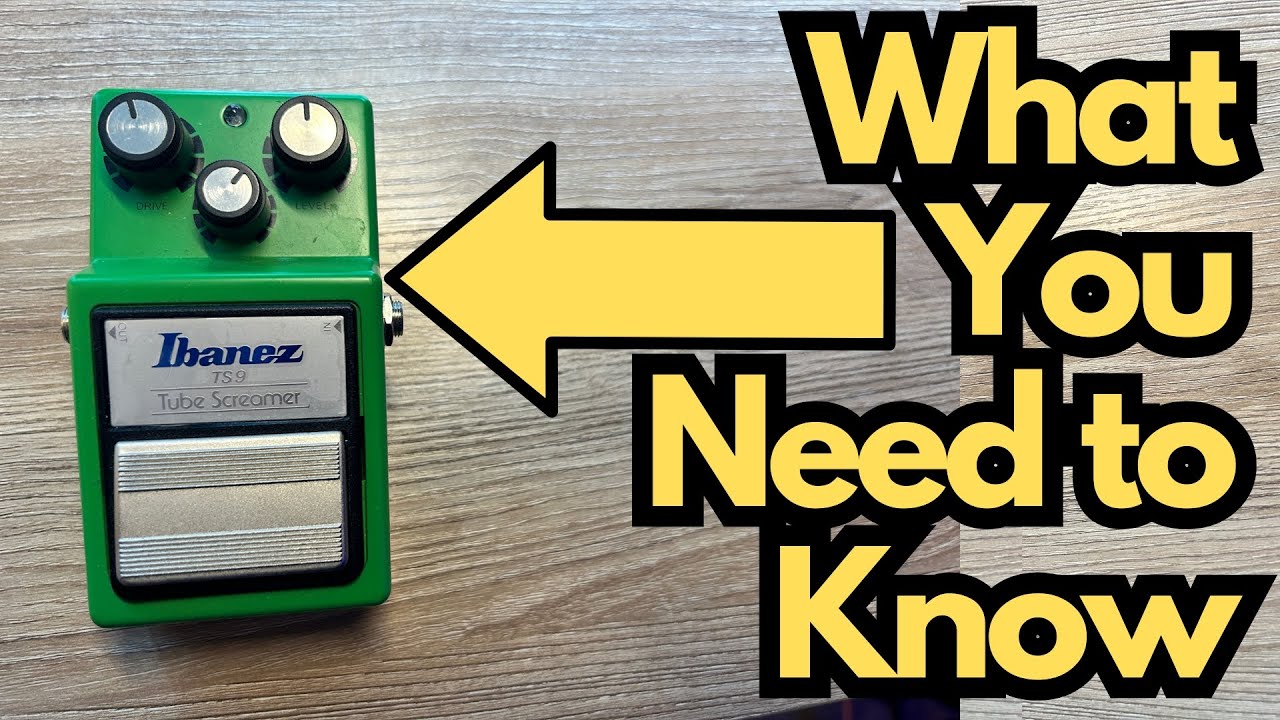
If you play electric guitar, you’ve heard the TS9 Tube Screamer. It’s one of those pedals that just keeps showing up—on pedalboards, in studios, on stages—decades after it first came out. You can grab it here on Amazon if you’re interested.
This post is for you if:
- You’re wondering what the hype is about.
- You’re trying to decide if the TS9 belongs on your board.
- You’ve tried one before and weren’t sure how to dial it in.
Let’s break down what the Ibanez TS9 actually does, how it sounds in a real-world rig, and where it shines (and doesn’t) from a guitarist’s point of view.
Overview / First Impressions
The Ibanez TS9 Tube Screamer is a classic mid-gain overdrive pedal known for:
- Its midrange-focused tone
- Smooth clipping
- Ability to tighten up an amp rather than completely transform it
At first, it can come across as a bit “mushy” or soft, especially if you’re expecting a modern, ultra-tight distortion. But with time and proper use, you start to understand why so many players—from blues to rock to metal—swear by it.
In the setup used here:
- Guitar → TS9 → Orange Crush 35RT (mic’d with a Shure SM57)
- Reverb and delay were turned off to hear the pedal clearly
This gives a good sense of how the TS9 behaves as the main overdrive into a fairly straightforward amp.
Build Quality & Design
The TS9 keeps things simple and old-school, which is part of its charm.
Key design points:
- Three control knobs
- Drive – controls the amount of overdrive.
- Tone – adjusts the treble content.
- Level – sets the output volume.
- Top-mounted power jack – The power input is on the top of the pedal, which is ideal for saving horizontal space on a pedalboard. Many players prefer this over side-mounted jacks (common on MXR-style pedals).
- Easy-access battery compartment – Unlike pedals that require a screwdriver to swap batteries, the TS9 has a convenient battery door on the back. You can open it without tools, making battery changes quick and painless if you’re not using a power supply.
- Sturdy enclosure – As with most Tube Screamers, the TS9 is built to be stomped on night after night. It’s not flashy, but it’s solid and dependable.
Features & Functions
The TS9 is all about simplicity, but there’s still quite a bit of nuance in how the three controls interact.
Drive
- Even at low settings, the TS9 adds a bit of grit.
- At higher settings, you get that classic, smooth, compressed overdrive.
- It’s not a high-gain pedal—think pushing an amp or giving your tone some edge, not full-on metal by itself.
Many players find a sweet spot around halfway on the Drive knob:
- Enough saturation to sustain and sing
- Still responsive to pick dynamics and guitar volume
Tone
- The Tone knob primarily shapes the treble.
- Turning it up adds bite and presence; turning it down warms and smooths things out.
- A middle or slightly below-middle setting often works well to avoid harshness while keeping clarity.
Again, a moderate setting tends to be a good starting point—bright enough to cut, but not ice-picky.
Level
- The Level knob sets how hard the TS9 hits your amp.
- Turned up, it can push the amp into extra breakup and volume.
- Turned down, it can sit closer to unity gain (same level as your bypassed clean tone).
In practice:
- Around halfway on the Level control is roughly unity gain in many rigs.
- Above that, you’re boosting your signal, which is great if you’re using the TS9 as a lead boost or to tighten an already driven amp.
How It Sounds / Use Cases
As a Main Overdrive
Into the Orange 35RT with the TS9 as the only drive source:
- Low Drive: Mild breakup with a bit of compression. Still noticeably colored—this isn’t a completely transparent boost.
- Medium Drive: Classic Tube Screamer territory. Smooth, mid-forward overdrive that works well for blues, classic rock, and edge-of-breakup rhythm.
- High Drive: More saturation, but still not a high-gain monster. You get a thick, singing lead tone, especially with single-coils or lower-output humbuckers.
This is where many players fall in love with the TS9: it just sits nicely in a mix, especially for leads and mid-gain rhythm parts.
With Different Guitars
The pedal interacts differently depending on your pickups:
- With passive pickups (like on many Strat/Les Paul-style guitars):
- The TS9 responds well.
- Dynamics and picking nuances come through.
- Great for expressive playing with a softer touch.
- With active pickups (e.g., some ESP guitars):
- It can feel less responsive for softer, more nuanced playing.
- The front end of the pedal may be hit too hard, leading to a more compressed, less touch-sensitive feel.
- This can be mitigated somewhat by turning down the guitar’s volume.
So if you’re using active pickups and aiming for a gentle, expressive overdrive, you might find the TS9 less ideal unless you tame the input level.
In Front of High-Gain Amps
This is a huge use case in modern rock and metal:
- Many “djent” and modern metal players run a Tube Screamer-style pedal in front of a high-gain amp or distortion.
- They often set:
- Drive low
- Level high
- Tone adjusted to taste (often slightly above noon)
What this does:
- Tightens the low end
- Adds a focused midrange push
- Makes palm-muted riffs more articulate
- Helps leads cut through an already saturated tone
In that context, the TS9 can sound incredible, even with active pickups, because it’s shaping and tightening an already heavy sound rather than being the sole source of gain.
Limitations / Things to Know
No pedal is perfect for every situation. Some things to keep in mind:
- Not ideal as a standalone high-gain distortion – If you’re chasing modern metal tones with the TS9 alone into a clean amp, you’ll probably be disappointed. It’s meant as an overdrive, not a full distortion box.
- Can feel “mushy” or soft at first – Especially if you’re used to very tight, modern drives. It has a bit of sag and compression, which some players love and others don’t.
- Pickup and guitar dependent
- Works beautifully with many passive setups.
- With active pickups, it might feel too compressed or less responsive for subtle playing unless you dial back your guitar’s output.
- Strong midrange character – That famous mid-hump is a feature, not a bug. If you want a totally transparent, flat-response boost, the TS9 isn’t that. It will color your tone.
Final Thoughts
The Ibanez TS9 Tube Screamer has earned its reputation for a reason:
- It’s simple, rugged, and easy to dial in.
- It excels as a mid-gain overdrive and as a boost in front of higher-gain amps.
- It pairs especially well with passive pickups and responsive amps.
- It may not be the best fit if you rely on active pickups for subtle, low-gain textures—unless you adjust your levels accordingly.
If you’re building a versatile pedalboard, the TS9 is still one of the most useful, classic tools you can add. Whether you use it as your main overdrive or as a tightener/booster in front of heavier tones, it earns its spot by doing one thing very well: making guitars sit in a mix with musical, mid-focused clarity.
Resources & Further Study
If you want to improve your playing alongside your tone, especially your fretboard knowledge and improvisation, check out:
- Fretboard Memorization Cheat Sheet – Available at travelingguitarist.com. This resource maps out major and minor triads in every key using octave mapping and other techniques. It’s designed to help you:
- Memorize the notes on the fretboard
- Understand the harmonic foundation of chords
- Improvise more confidently in multiple keys
- Traveling Guitarist Forum – at forum.travelingguitarist.com. A place to talk guitar, music, gear, and more with other players.
Pairing a classic pedal like the TS9 with solid fretboard and harmony knowledge is a powerful combo—for both your tone and your musicianship.