

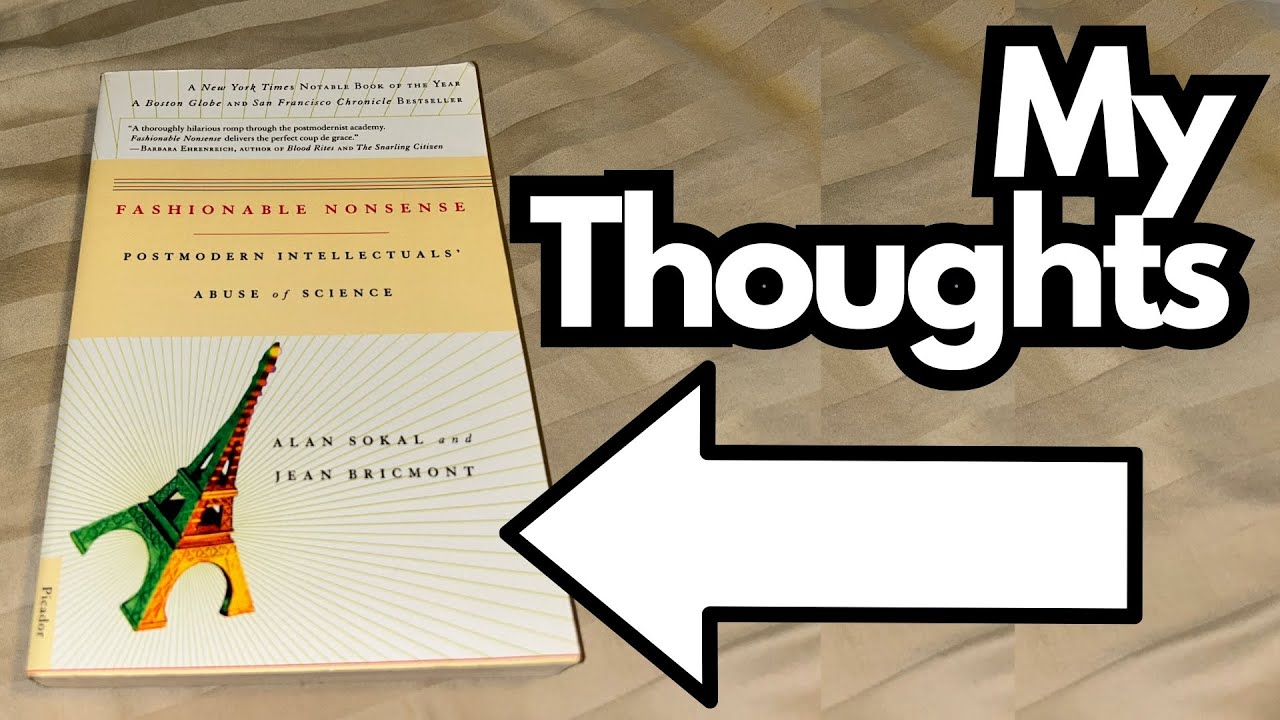
If you’ve ever dipped a toe into academic philosophy or critical theory and walked away thinking, “Is any of this actually saying anything?”, this book is for you.
The author sets out to critique postmodernism—especially the way it shows up in academia—and argue that a lot of what passes for “theory” is, frankly, pseudo-scientific nonsense. It’s not a gentle nudge; it’s a pretty direct takedown. You can grab it here on Amazon if you’re interested.
This isn’t a perfect book, and it wasn’t quite as mind-blowing as I initially hoped. But it was a very enjoyable and eye-opening read, and it’s worth picking up if you’re curious about how much of modern intellectual culture might be built on shaky ground.
Overview / First Impressions
The core of the book is simple: it’s a sustained critique of postmodernism, especially in its academic form. The author argues that:
- A significant portion of contemporary philosophy and theory is incoherent.
- Many “big name” thinkers misuse scientific concepts and language.
- This leads to a culture where sounding profound matters more than being clear or correct.
Even if you don’t remember every argument chapter by chapter, the overall impact is strong: it sharpens your sense of when language is being used to clarify ideas versus when it’s being used to obscure them.
General Vibe of the Book
Thinking about this like a piece of gear:
- Structure: The book is logically laid out, moving from specific examples to broader critiques.
- Readability: It’s more accessible than a lot of the material it critiques. You don’t need a philosophy degree to follow the main points.
- Tone: Critical, sometimes ruthless, but often entertaining. The author doesn’t hide their frustration with intellectual nonsense.
It’s not a “light read,” but it’s not impenetrable either. If you’re used to reading gear manuals, tech articles, or serious non-fiction, you’ll be fine.
Features & Plot Points
Here’s what the book actually does:
- Dissects Postmodern Jargon
The author pulls apart dense, convoluted passages from postmodern writers and shows how little substance is often hiding behind the language. - Calls Out Pseudo-Science
A big focus is on how certain philosophers and theorists borrow terms from physics, math, and other sciences in ways that sound impressive but are either wrong or meaningless. - Examines Academic Culture
The book doesn’t just critique individuals; it looks at the culture that rewards obscurity, encourages echo chambers, and often punishes clarity. - Builds a Case for Rationality & Clarity
Underneath the criticism is a positive argument: ideas should be testable, coherent, and communicated clearly—especially if they’re going to shape culture, politics, or education.
Use Cases (For Thinkers)
From a guitarist’s perspective, reading this is a bit like:
- Plugging into a clean amp after hours of swimming in reverb and modulation—you suddenly hear what’s actually there.
- Realizing that not every complex pedal chain is adding value; sometimes it’s just noise dressed up as depth.
Who this book is useful for:
- Students who are wading through dense theory and wondering if it’s them—or if the material really is nonsense.
- Readers of philosophy or cultural criticism who want a skeptical, rational counterpoint to postmodern thought.
- Anyone skeptical of intellectual fads who wants more than just a gut feeling that something’s off.
You come away with a better “ear” for empty complexity—the same way you eventually learn to hear when a mix is cluttered or when a tone is just overprocessed.
Limitations / Things to Know
A few caveats:
- It may not live up to sky-high expectations.
If you’re expecting the single definitive demolition of postmodernism, this might feel a bit less explosive than you’d hoped. It’s strong, but not flawless. - It doesn’t cover everything.
Postmodernism is a huge, messy field. This book focuses on particular writers, habits, and tendencies. It’s a powerful critique, but not a complete map. - It’s the kind of book you remember more for its impact than its details.
Don’t be surprised if what sticks with you is the overall skepticism and the examples of pseudo-science, rather than detailed chapter content.
Final Thoughts
Even if it wasn’t quite as great as I initially expected, this book was absolutely worth reading.
It does a valuable job of:
- Exposing how much of modern academic philosophy can drift into pseudo-scientific territory.
- Giving you tools to spot when language is being used to impress rather than to inform.
- Encouraging a mindset that values clarity, coherence, and intellectual honesty.
If you’ve ever suspected that a chunk of highbrow theory is just noise with fancy labels, this book will feel like confirmation—and a helpful guide to thinking more clearly about ideas.
Resources / Further Study
If this kind of critique interests you, it pairs well with:
- Other works that examine the misuse of science in the humanities.
- Clear, introductory philosophy texts that prioritize explanation over jargon.
- Rationalist and skeptical writing that focuses on critical thinking and logical argument.
Treat it like a good reference pedal on your board: not the flashiest thing you’ll ever own, but something that quietly improves how you hear everything else.