

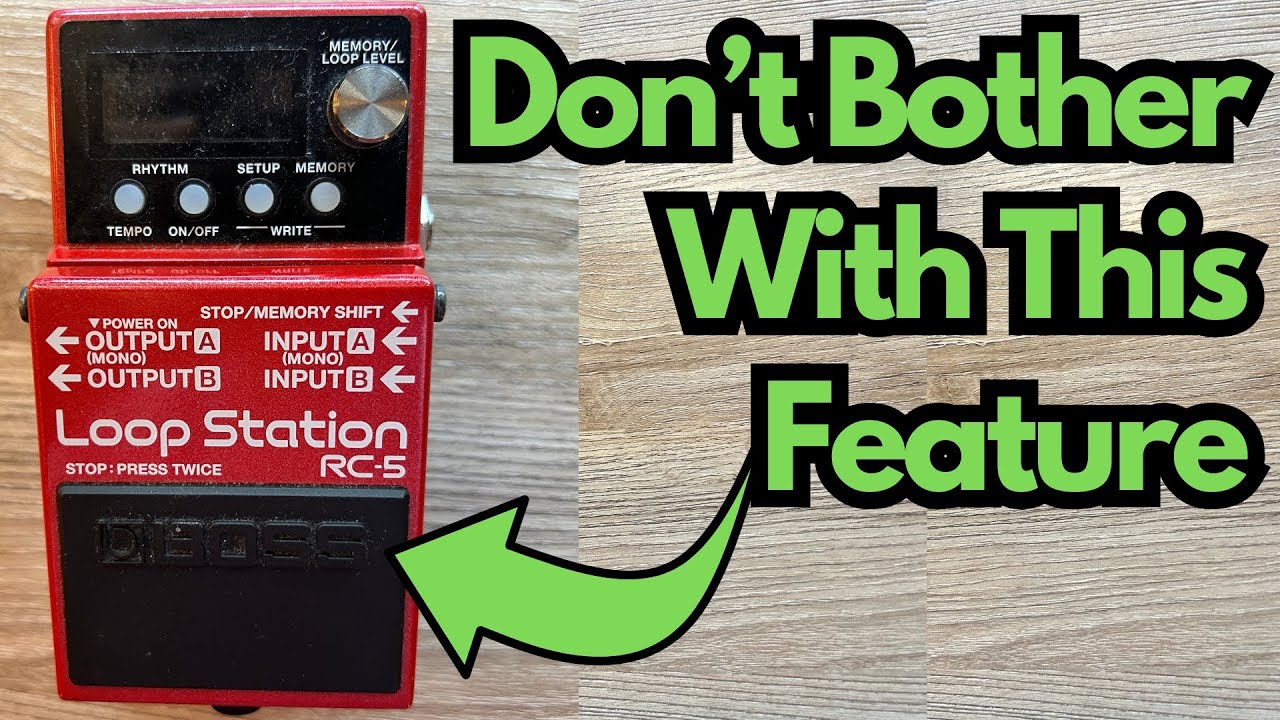
If you’re using a Boss RC-5 looper pedal, you’ve already got one of the most powerful compact loopers on the market. But how you power it has a big impact on how practical it is for real-world guitar practice and performance. Grab one here on Amazon if you’re interested.
This post walks through the RC-5’s battery compartment, why a 9V battery isn’t ideal for most players, and what you should use instead. I’ll also point you toward a useful fretboard resource if you’re looking to level up your practice routine.
Overview / First Impressions
Like most Boss compact pedals, the RC-5 gives you two main options for power:
- A 9V battery
- A standard 9V DC power adapter
Technically, both work. Practically, one is far better than the other—especially once you factor in the RC-5’s bright display and LED indicators.
Build Quality & Design
Boss has kept things familiar:
- Battery access: The battery compartment is in the same place as on almost every other Boss pedal.
- Footswitch plate: You access the battery by loosening the thumbscrew on the front of the pedal and lifting the footswitch plate.
- Connector: Inside, you’ll find the usual 9V battery clip/connector.
If you’ve used any classic Boss stompbox (DS-1, SD-1, CE-2, etc.), you’ll feel right at home. The RC-5 sticks to that tried-and-true design.
Features & Functions That Affect Power Use
The RC-5 isn’t just a simple one-button looper. It has:
- A multi-color LED screen
- Status LEDs and other visual feedback
Those visual features are incredibly useful for timing and navigation, but they also draw more current than a basic analog pedal. That’s the key reason battery life is so limited.
Battery vs. Power Supply: What You Need to Know
Battery Use
You can run the RC-5 on a 9V battery, but there’s a major downside:
- Approximate battery life: around 1.5 hours of use
That short runtime is largely due to the LED display and lights. For most players, that’s not enough for:
- A full rehearsal
- A gig with soundcheck
- A long practice session
So while a battery might be okay in a pinch or for very short, occasional use, it’s not something you want to rely on.
Recommended: 9V DC Adapter
For practical, everyday use, a 9V DC adapter is the way to go. Specifically:
- Use a standard 9V DC, center-negative adapter (typical Boss-style power).
- You can also power it from a pedalboard power supply with isolated outputs.
Benefits:
- No worrying about the pedal dying mid-loop
- Consistent performance and brightness from the display
- Better for regular practice, recording, and live use
From a guitarist’s perspective, nothing kills the vibe faster than your loop disappearing mid-solo because the battery gave out. A proper power supply is almost essential with a pedal like this.
How It Fits Into a Guitarist’s Setup
The RC-5 is often used as:
- A practice tool for working on timing, phrasing, and improvisation
- A writing tool for building chord progressions and layering parts
- A performance tool for solo gigs or live looping
All of these scenarios usually involve extended use—30 minutes, an hour, or more. That’s exactly why:
- A battery-only setup is frustrating and unreliable
- A dedicated power supply turns the RC-5 into a dependable part of your rig
If you’re building a pedalboard, just treat the RC-5 like any other digital pedal: give it solid, stable power.
Limitations / Things to Know
- Battery life is short: roughly 1.5 hours due to the LED screen and lights.
- Not ideal on battery for gigs: you risk losing power mid-set.
- Still fine as a backup: a fresh 9V battery can be a decent emergency fallback if your power supply fails.
In short, the battery option is there, but it’s best viewed as a backup, not your main power source.
Further Study & Practice Resources
If you’re using a looper like the RC-5 to practice and improve your playing, it’s worth pairing it with some structured fretboard work.
A useful resource is the Fretboard Memorization Cheat Sheet from TravelingGuitarist.com. It focuses on:
- Major and minor triads in every key
- An “octave mapping” approach to seeing the neck
- Using triads as the foundation of harmony and improvisation
Working through triads across the neck is one of the fastest ways to:
- Memorize the fretboard
- Understand chord tones
- Improvise more musically over your own loops
There’s also a community forum at forum.travelingguitarist.com, where you can talk guitar, music, practice approaches, and more with other players.
Final Thoughts
The Boss RC-5 is a powerful, compact looper that fits easily into any guitarist’s rig—but its battery option is more of a convenience than a real solution. Because of the LED display and lights, you’re looking at about 1.5 hours of battery life, which isn’t enough for serious practice or performance.
If you want the RC-5 to be a reliable part of your setup:
- Use a 9V DC adapter or pedalboard power supply as your main power source.
- Keep a single 9V battery around only as an emergency backup.
Do that, and the RC-5 becomes exactly what it should be: a rock-solid looping tool for practicing, writing, and performing.